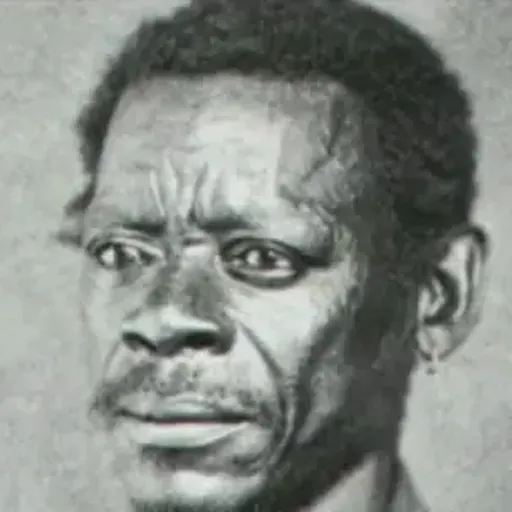
Besouro Mangangá
Capoeirista from Bahia
About Besouro Mangangá
Lived 1895 – 1924 (aged 28–29). Besouro Mangangá was a Brazilian martial artist and capoeira practitioner.
Manoel Henrique Pereira (c. 1895 in Santo Amaro, Bahia – c. 1924 in Santo Amaro, Bahia), known as Besouro Mangangá was a legendary capoeira fighter from Bahia who ran capoeira school in Santo Amaro at the beginning of the 20th century.
Besouro was a dangerous faquista, highly skilled in knife fight, and known to play with a straight razor using his foot. Besouro was murdered quite young in 1924 in the Maracangalha camp, in the Santa Casa de Misericórdia of Santo Amaro.
Shortly after his death, Besouro became a mythical capoeira hero. Its fame reached the national level from the 1930s and, with the expansion of capoeira to other continents, it became international.
Besouro was the teacher of capoeira mestre Cobrinha Verde.
Biography
Besouro Mangangá was the son of Maria José and João Matos Pereira, born in 1895. He was a native of the Bahian recôncavo and lived in that region, during a period when the sugarcane fields flourished in Santo Amaro, they played an important role in the productive scenario, through the sloops along the subaé river they took the goods that went to and arrived at the pier in Salvador.
Capoeira career
Manoel Henrique, who, from an early age, learned the secrets of capoeira from Mestre Alípio in Trapiche de Baixo, was baptized as Besouro Mangangá because of the belief of many who said that when he got into a conflict where the number of enemies was too great to be able to beat them, he would turn into a beetle and fly away. Several legends arose around Besouro to justify his deeds; the main one attributes to him the "closed body" (corpo fechado) and imperviousness to bullets and daggers. Due to his supposed powers, the Beetle Mangangá became a mythological character for capoeira practitioners, having his identity related to bullies, cappadocians and rascals.
It is speculated that he disliked the police and had several confrontations with their forces, sometimes gaining the upper hand in the clashes. However, according to Antonio Liberac Cardoso Simões Pires:
Some historical documentation records the confrontations between Besouro Mangangá and the police, such as what happened in 1918, in which Besouro would have gone to a police station in the neighborhood of São Caetano, in Salvador, to recover a berimbau that belonged to his group. With the agent's refusal to return the seized object, Besouro went on the attack with the help of some companions. They were unable to recover the desired berimbau, as they were repelled off by the police, who received help from a group of local residents.
Death
Nestor Capoeira wrote a legend of Besouro's death:
In popular culture The Assailant, a film adaptation of the story of Besouro, directed by João Daniel Tikhomiroff, premiered in Brazil on 30 October 2009. Besouro was played by Ailton Carmo, and the fight choreography was handled by Huan-Chiu Ku, choreographer for the fight scenes in Kill Bill.
Literature
Don’t just read it —
keep it.
Full-length biographies made to live with: read them, listen on the way to work, watch them tonight.
- E-book
- Audio
- Video
Instant download · yours to keep · every purchase keeps this site free
Important facts
Related people
Same field, nearest in time


Contemporaries
People whose lives overlapped Besouro Mangangá's


Frequently asked questions
Who was Besouro Mangangá?
capoeirista from Bahia
When was Besouro Mangangá born?
Besouro Mangangá was born in 1895 in Santo Amaro.
When did Besouro Mangangá die?
Besouro Mangangá died on 8 July 1924 in Bahia.
What was Besouro Mangangá's occupation?
Besouro Mangangá was a martial artist and capoeira practitioner.
What nationality was Besouro Mangangá?
Besouro Mangangá was Brazilian.
Sources & further reading
Cite this page
APA: Biography.guide. (2026). Besouro Mangangá. https://biography.guide/besouro-manganga/
MLA: "Besouro Mangangá." Biography.guide, https://biography.guide/besouro-manganga/.
Chicago: "Besouro Mangangá." Biography.guide. https://biography.guide/besouro-manganga/.
Data last updated: 2026-09-22 · Spot an error? Report a correction.
Portrait: Wikimedia Commons · author & licence
Page generated 2026-09-27 05:03 UTC