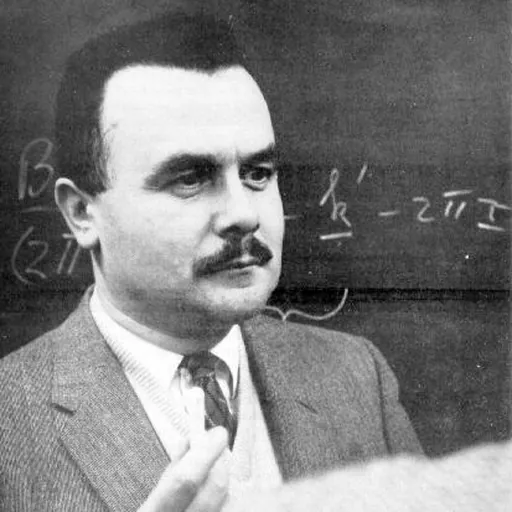
About Bertram Brockhouse
Lived 1918 – 2003 (aged 85). Bertram Brockhouse was a Canadian physicist, university teacher and nuclear physicist, known for Neutron triple-axis spectrometry.
Bertram Neville Brockhouse, (July 15, 1918 – October 13, 2003) was a Canadian physicist. He was awarded the Nobel Prize in Physics (1994, shared with Clifford Shull) "for pioneering contributions to the development of neutron scattering techniques for studies of condensed matter", in particular "for the development of neutron spectroscopy".
Early life and education Brockhouse was born in Lethbridge, Alberta, to a family of English descent. He was a graduate of the University of British Columbia (BA, 1947) and the University of Toronto (MA, 1948; Ph.D, 1950).
Career and research From 1950 to 1962, Brockhouse carried out research at Atomic Energy of Canada's Chalk River Nuclear Laboratory. Here he was joined by P. K. Iyengar, who is treated as the father of India's nuclear program.
In 1962, he became a professor at McMaster University in Canada, where he remained until his retirement in 1984.
Brockhouse died on October 13, 2003, in Hamilton, Ontario, aged 85.
Awards and honours Brockhouse was elected a Fellow of the Royal Society (FRS) in 1965. for developing neutron scattering techniques for studying condensed matter.
In October 2005, as part of the 75th anniversary of McMaster University's establishment in Hamilton, Ontario, a street on the university campus (University Avenue) was renamed to Brockhouse Way in honour of Brockhouse. The town of Deep River, Ontario, has also named a street in his honour.
The Nobel Prize that Bertram Brockhouse won (shared with Clifford Shull) in 1994 was awarded after the longest-ever waiting time (counting from the time when the award-winning research had been carried out-[1958-1994 36 years] ).
In 1999 the Division of Condensed Matter and Materials Physics (DCMMP) and the Canadian Association of Physicists (CAP) created a medal in honour of Brockhouse. The medal is called the Brockhouse Medal and is awarded to recognize and encourage outstanding experimental or theoretical contributions to condensed matter and materials physics. This medal is awarded annually on the basis of outstanding experimental or theoretical contributions to condensed matter physics. An eligible candidate must have performed their research primarily with a Canadian Institution.
Don’t just read it —
keep it.
Full-length biographies made to live with: read them, listen on the way to work, watch them tonight.
- E-book
- Audio
- Video
Instant download · yours to keep · every purchase keeps this site free
Important facts
People in Bertram Brockhouse's life
Named in this biography and alive at the same time
Related people
Same field, nearest in time


Contemporaries
People whose lives overlapped Bertram Brockhouse's


Frequently asked questions
Who was Bertram Brockhouse?
Canadian physicist
When was Bertram Brockhouse born?
Bertram Brockhouse was born on 15 July 1918 in Lethbridge.
When did Bertram Brockhouse die?
Bertram Brockhouse died on 13 October 2003 in Hamilton.
What was Bertram Brockhouse's occupation?
Bertram Brockhouse was a physicist, university teacher and nuclear physicist.
What was Bertram Brockhouse known for?
Bertram Brockhouse was known for Neutron triple-axis spectrometry.
What nationality was Bertram Brockhouse?
Bertram Brockhouse was Canadian.
Sources & further reading
· Wikipedia: Bertram Brockhouse
Cite this page
APA: Biography.guide. (2026). Bertram Brockhouse. https://biography.guide/bertram-brockhouse/
MLA: "Bertram Brockhouse." Biography.guide, https://biography.guide/bertram-brockhouse/.
Chicago: "Bertram Brockhouse." Biography.guide. https://biography.guide/bertram-brockhouse/.
Data last updated: 2026-09-23 · Spot an error? Report a correction.
Portrait: Wikimedia Commons · author & licence
Page generated 2026-09-27 05:08 UTC