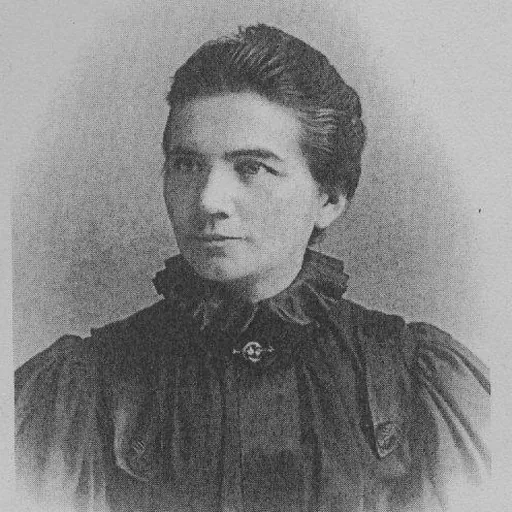
Bertha Kipfmüller
German teacher and independent scholar
About Bertha Kipfmüller
Lived 1861 – 1948 (aged 87). Bertha Kipfmüller was a German teacher, independent scholar, women's rights activist, pacifist, philologist and feminist.
Bertha Kipfmüller (28 February 1861 – 3 March 1948) was described by an admiring journalist as a "small person with a powerful voice and an iron will". Her work as a German school teacher made her a women's rights activist and a pioneering figure in respect of women's education. She was, in addition, a committed pacifist during a period remembered for intensifying nationalist-populism in Europe, a linguistic genius and a passionate believer in life-long learning.
In 1899 Kipfmüller became the first woman in Bavaria to receive a doctorate. In 1929, after retiring from her work as a school teacher, she earned a second doctorate. In 1942 she wrote her autobiography, using notebook diaries. It had been her intention that it should be published during her lifetime. That did not happen; but 65 years after her death it was, triggering a renewed interest in her life and achievements. One reason that it had not been published sooner was that she wrote much of it using Gabelsberger shorthand, which presumably made sense at a time when writing paper was in short supply. But it was a form of shorthand that had not been widely used or understood, even in Germany, since the 1920s. It was her great x 2 nephew, Hans-Peter Kipfmüller, who mastered the script and transcribed the book into a more usable format, before arranging for its publication.
Life Provenance and early years Bertha Friederika Kipfmüller was born and grew up in Pappenheim, a small town in the Franconian hill-country between Nuremberg and Augsburg. She was one of eleven recorded children of the jeweler-goldsmith Christian Albert Kipfmüller (1822–1898) and his wife, born Christina Sabina Rist (1827–1916). She successfully completed junior school locally, and then between 1874 and 1877 was privately tutored by a Pappenheim teacher called Josef Fleischmann, who prepared her for the entrance exam for admission to the Upper Bavaria Teacher Training Seminary ("Kreislehrerinnenseminar für Oberbayern") in Munich. In order to prepare for the exam she was obliged to depend on private tutoring since the relevant government "preparatory school" only provided places to candidates who were boys. Kipfmüller completed the teaching course and in 1879, still in Munich, passed the appropriate teaching exams.
In 1886 she founded the "Middle Franconia Women Teachers' Association" ("Mittelfränkischer Lehrerinnenverein"), which was the first professional association for women anywhere in Bavaria.
Peace In her posthumously published memoires Kipfmüller would recall that she came to Pacifism as early as 1886 through studying Kant and to socialism in 1890 through studying the (at that time hugely influential in Germany) writings of August Bebel.
Women's welfare During 1895 she teamed up with Helene von Forster to found, formally on 16 November, the Nuremberg section of the Verein Frauenwohl ("Women's Welfare Association"), committed to improving conditions for women in the city and surrounding region.
Life-long learning Her rejection of the widespread view that women were not suited to further education, combined with her own private study which at the time was focused on Kantian philosophy, languages and linguistics, drove Kipfmüller to the conviction that she needed to obtain a degree in Philology. In order to access a university education it was necessary to pass the "Abitur" (school final exams). Unfortunately, in Germany none of the girls' secondary schools prepared their pupils for the "Abitur", so Bertha Kipfmüller had never been entered for the exam. She therefore prepared to prepare for and take the exams as a foreign student in Switzerland where, despite entrenched conservatism across much of the education system, the decentralised nature of political power meant that there was an element of flexibility, especially in one or two of the cities, that was absent from the more rigid German education framework. Meanwhile, 1894 she embarked on a self-study programme of the "Abitur" syllabus in 1894, using the material that was distributed to the (boys') secondary schools. A change of plan became possible in 1895 when the Heidelberg University introduced a concessionary arrangement whereby, exceptionally, female school teachers, might attend university lectures as "guest listeners", despite the handicap of their gender, even if they had not been able to fulfil the legal precondition of an "Abitur" pass. Kipfmüller was admitted to join university lectures on the basis, starting with the 1896/97 winter term.
Kipfmüller used the opportunities arising at Heidelberg to embark on a broad range of university-level studies that embraced Germanistics, Sanskrit, Comparative philology, Philosophy, History and "Nationalökonomie" (very loosely, "Applied economics"). After that she returned to the Franconian heartland and resumed her teaching career, now armed with the first doctoral qualification awarded to any Bavarian woman.
On the fringes of politics Meanwhile, she continued to find time for activism and campaigning. She co-founded the Richard Wagner Association of German Women ("Richard-Wagner-Verband deutscher Frauen") . An unusual feature of this doctorate was the status that it conferred on its recipient as a "Doctor utriusque iuris" ("Doctor of both laws"): it counted as a doctorate in both civil law and church law.
One personal aspect of Kipfmüller's commitment to lifelong learning was her fascination with languages, of which by the time she died she had learned twelve. In 1938, aged 77, she spent several months living at the Harnack House in Berlin-Dahlem. Harnack House was home to the Kaiser Wilhelm [scientific] Society, but on this occasion its attraction to Kipfmüller was its proximity to Berlin University, where she was able to improve her Mandarin while studying Sinology more broadly. During 1939/40 she learned Polish.
Personal While she was working at Eysölden, Bertha Kipfmüller met a young army officer who was still recovering from physical and psychological wounds inflicted by participation in the Franco-Prussian War. He was living in a little foresters' lodge at Stauf. The social conventions of the time restricted the extent of the ensuing romance, and Bertha's father could not afford the financial contribution that would have facilitated marriage. Social conventions were also against the blossoming of the romance in another way. Female teachers were expected to remain single and celibate. Those unable to persist with the celibacy were expected to retire from the teaching in order concentrate on marriage and motherhood. The dilemma was unresolved when the young man's period of convalescence came to an end, and he was posted some distance away. Shortly after that the matter was cruelly put to rest when he committed suicide.
Deeply traumatised by the tragic ending of what at least one commentator sees as the great love of her life, Kipfmüller resolved to stay single, and commit her apparently undiminished reserves of energy to her work, her study and her campaigning.
Don’t just read it —
keep it.
Full-length biographies made to live with: read them, listen on the way to work, watch them tonight.
- E-book
- Audio
- Video
Instant download · yours to keep · every purchase keeps this site free
Important facts
People in Bertha Kipfmüller's life
Named in this biography and alive at the same time


Related people
Same field, nearest in time


Contemporaries
People whose lives overlapped Bertha Kipfmüller's


Frequently asked questions
Who was Bertha Kipfmüller?
German teacher and independent scholar (1861-1948)
When was Bertha Kipfmüller born?
Bertha Kipfmüller was born on 28 February 1861 in Pappenheim.
When did Bertha Kipfmüller die?
Bertha Kipfmüller died on 3 March 1948 in Pappenheim.
What was Bertha Kipfmüller's occupation?
Bertha Kipfmüller was a teacher, independent scholar, women's rights activist, pacifist, philologist and feminist.
What nationality was Bertha Kipfmüller?
Bertha Kipfmüller was German.
Sources & further reading
· Wikipedia: Bertha Kipfmüller
Cite this page
APA: Biography.guide. (2026). Bertha Kipfmüller. https://biography.guide/bertha-kipfmuller/
MLA: "Bertha Kipfmüller." Biography.guide, https://biography.guide/bertha-kipfmuller/.
Chicago: "Bertha Kipfmüller." Biography.guide. https://biography.guide/bertha-kipfmuller/.
Data last updated: 2026-09-20 · Spot an error? Report a correction.
Portrait: Wikimedia Commons · author & licence
Page generated 2026-09-27 04:57 UTC