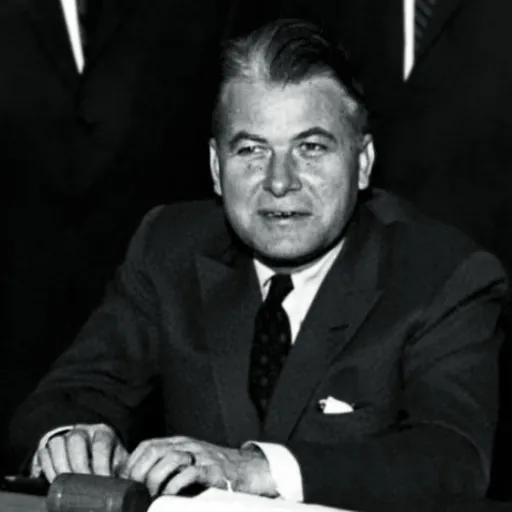
About Bert T. Combs
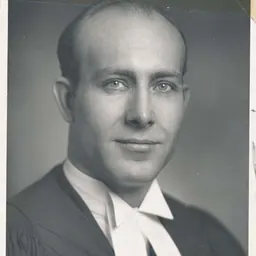
Lived 1911 – 1991 (aged 80). Bert T. Combs was an American lawyer and judge.
Bertram Thomas Combs (August 13, 1911 – December 4, 1991) was an American jurist and liberal politician from the Commonwealth of Kentucky. After serving on the Kentucky Court of Appeals, he was elected the 50th governor of Kentucky in 1959 on his second run for the office. Following his gubernatorial term, he was appointed to serve as a United States circuit judge of the United States Court of Appeals for the Sixth Circuit by President Lyndon B. Johnson, serving from 1967 to 1970.
Combs rose from poverty in his native Clay County to earn a law degree from the University of Kentucky and open a law practice in Prestonsburg. He was decorated for prosecuting Japanese war criminals before military tribunals following World War II, then returned to Kentucky and his law practice. In 1951, Governor Lawrence Wetherby appointed him to fill a vacancy on the Kentucky Court of Appeals. Later that year, he was elected to a full term on the court, defeating former governor and judge Simeon S. Willis. Kentucky's Democratic Party had split into two factions by 1955 when Earle C. Clements, the leader of one faction, chose Combs to challenge former governor and U.S. Senator A. B. "Happy" Chandler, who headed the other, in the upcoming gubernatorial primary.
Chandler, who went on to reclaim the governorship, had promised that he would not need to raise taxes to meet the state's financial obligations, but ultimately he did so. In 1959, Combs was elected governor, defeating Lieutenant Governor Harry Lee Waterfield, Chandler's choice to succeed him in office, in the primary. Early in his term, Combs secured passage of a three-percent sales tax to pay a bonus to the state's military veterans. Knowing a tax of one percent would have been sufficient, he used the excess revenue to enact a system of reforms, including expansion of the state's highway and state park systems. He also devoted much of the surplus to education.
Following his term in office, Combs was appointed to the United States Court of Appeals for the Sixth Circuit by President Johnson. He served for three years before resigning and running for governor again in 1971. He lost in the Democratic primary to Wendell Ford, his former executive secretary. In 1984, Combs agreed to represent sixty-six of the state's poor school districts in a lawsuit challenging the state's system of financing public education. The suit, Rose v. Council for Better Education, resulted in the Kentucky Supreme Court declaring the state's entire system of public schools unconstitutional. In response, the Kentucky General Assembly drafted a sweeping education measure known as the Kentucky Education Reform Act in 1991. On December 3, 1991, Combs was caught in a flash flood while driving and was killed.
Early life Bert Combs was born in the Town Branch section of Manchester, Kentucky on August 13, 1911; he was one of seven children of Stephen Gibson and Martha (Jones) Combs. Combs's father Stephen, a part-time logger and farmer, was active in local politics, despite being a Democrat in a county where a large majority of residents were Republicans. Later, Combs and his sister began riding a donkey every day to Clay County High School.
Unable to afford college tuition, Combs worked at a local drug store and did small jobs for various residents of his community. In mid-1930, he began working as a clerk for the state highway department. This was one of several patronage jobs that were usually awarded by the governor, but the Democratically controlled state legislature had stripped Republican Governor Flem D. Sampson of his statutory appointment powers, giving them instead to a three-man highway commission composed of Democratic Lieutenant Governor James Breathitt, Democratic Highway Commissioner Ben Johnson, and Dan Talbott. This allowed Combs, a Democrat, to secure the position.
Combs worked for the highway department for three years in order to earn enough money to attend the University of Kentucky College of Law in Lexington. In 1937 he graduated second in his class, earning a Bachelor of Laws degree and qualifying for the Order of the Coif, a national honor society for the top ten percent of graduating law students. He was admitted to the bar, and returned to Manchester to begin practicing law. It was also in 1937 that Combs married Mabel Hall, with whom he had two children, Lois Ann Combs and Thomas "Tommy" George Combs.
Early legal career and service in World War II Of his law practice in Manchester, Combs later noted: "I had too many kinfolks and friends in Manchester, and they all expected me to handle things as a favor ... Then they'd get their feelings hurt if I charged them. I was taking in a lot of cases, but not sending out many bills." In 1938, Combs accepted an offer from a law school classmate named LeRoy Combs (no relation) to join his father and uncle's law firm in Prestonsburg. Prestonsburg was closer to his wife's home in Knott County. After moving to Prestonsburg, Combs started a class for people with intellectual disability, in part so Tommy could attend the class. He received his basic training at Fort Knox and participated in the Volunteer Officer Candidate Program, which would have allowed him to attend Officer Candidate School (OCS) immediately after basic training. He served as president of the Junior Bar Association of Kentucky in 1946 and 1947. Later that year, Governor Lawrence Wetherby appointed him to fill a vacancy in the office of Commonwealth's Attorney for Kentucky's 31st Judicial District. Combs announced, however, that he would serve only until a new election could be held. His opponent was Simeon S. Willis, a popular former Republican governor who had previously sat on the court.
1955 gubernatorial race A. B. "Happy" Chandler, who had served as Kentucky's governor from 1935 to 1939 and was a leader of a faction of the state's Democratic Party, announced his intention to seek a second term in 1955. Members of the anti-Chandler faction scrambled to find a candidate to oppose him. The most likely candidate was Emerson "Doc" Beauchamp, the sitting lieutenant governor, but Beauchamp was not a good campaigner and his ties to Logan County – where politics were dominated by sometimes-corrupt political bosses – gave the anti-Chandler faction pause. Instead, the leader of the faction, former governor and sitting U.S. Senator Earle C. Clements, selected Combs as the faction's nominee, and Combs resigned from his position on the Court of Appeals to enter the race.
In Combs' first speech of the primary campaign, he admitted that the state needed to raise $25 million ($ million in dollars) in new revenue and that a sales tax should be considered.
With little but Combs' inexperience to run against, Chandler portrayed Combs as a pawn of former governors Clements and Wetherby, whom he derisively nicknamed "Clementine" and "Wetherbine". Though receipts later showed that carpeting for the entire first floor of the capitol had cost only $2,700 and that Wetherby's paneling had been purchased from and installed by a Kentucky contractor, Chandler's charges remained effective at keeping the Combs campaign on the defensive. Chandler defeated Combs in the primary by a vote of 259,875 to 241,754 and went on to win his second term as governor. Meanwhile, the state's need for funds compelled Chandler to raise the state sales tax and other taxes, despite his campaign promises not to do so. Consequently, Chandler lost credibility and Combs gained a reputation as a courageous, forthright, and honest politician for having acknowledged the state's financial need during the campaign. Wilson Wyatt, who had managed Adlai Stevenson's presidential campaign in 1952, was the first anti-Chandler candidate to declare his intention to seek the governorship in the 1959 election, doing so on April 9, 1958. Wyatt received several endorsements from leaders in Jefferson County, which contained his home city of Louisville and was vehemently anti-Chandler. In January 1959, Clements held an all-night meeting at the Standiford Airport Hotel in Louisville in which he brokered a deal whereby Combs would run for governor and Wyatt for lieutenant governor. Clements promised Wyatt his support in future political races. Combs was the first governor elected from Eastern Kentucky since Flem D. Sampson in 1927, and was the first veteran of World War II to hold the office.
Governor of Kentucky One of Combs' first official actions as governor was to call a special session of the legislature on December 19, 1959, to consider revising the state's constitution, which had been in effect since 1891. Calling a constitutional convention required that the General Assembly approve putting the issue of a convention on the ballot in two consecutive legislative sessions. The call then had to be approved by Kentucky voters. Despite near-universal agreement by legal scholars that the constitution was badly in need of updating, Kentucky voters had rejected calls for a constitutional convention in 1931 and 1947, and had only approved 19 amendments since 1891. Combs wanted to address the issue during his four-year term, hence the haste in calling the special legislative session. The General Assembly easily approved the call for a convention during the special legislative session and again during the subsequent regular legislative session in 1960. Combs signed the measure, and the question of a constitutional revision was put on the ballot in November 1960, when Kentucky voters defeated it by a margin of almost 18,000 votes. This was the closest Kentucky has come to replacing the 1891 constitution, which remains in effect today.
Kentucky's first billion-dollar budget During the campaign, Combs had advocated a progressive platform that included increased funding for education, highways, parks, industry, and airports. Soon after his election, he won approval for a three-percent sales tax to pay a bonus to military veterans, although he could have funded the bonuses with a one-percent tax. Fewer than half of the state's high school graduates attended college. It allocated over $5 million to the state universities for new buildings and another $10.5 million to fund completion of the Albert B. Chandler Hospital, a facility at the University of Kentucky named in honor of Combs' political foe.
The state's roads were in poor condition when Combs became governor. The Automotive Safety Foundation found that two-thirds of Kentucky's federal roads were below standards for existing traffic demands.
Combs also won approval of a $10 million bond issue to benefit the state parks, which had poor lodging and few amenities. Combs combined the bond issue with $10 million in revenue bonds and effected major renovations at all 26 of the state's parks. Though his dreams of seeing privately owned tourist facilities spring up around the parks did not come to fruition, out-of-state tourism to Kentucky more than doubled during his administration, accounting for about sixty percent of state park visitors and fifty-three percent of the overnight visitations to the parks. Journalist John Ed Pearce recounts that Kentucky natives began to complain that they could not get reservations in the parks during peak seasons and called for limitations on the number of out-of-state visitors or a reservation system that favored Kentuckians, although nothing was done to address these complaints.
On April 10, 1961, Combs appropriated $50,000 from the governor's contingency fund to construct a floral clock on the lawn of the state capitol. Combs had seen a similar clock in Edinburgh, Scotland, and believed it would be a colorful addition to the capitol grounds. In one instance, Combs ordered a state audit of Carter County school superintendent Heman McGuire, who was known to use his office for political gain. While Combs did not have the authority to remove McGuire directly, the audit showed McGuire's misappropriation of funds and abuse of power. The state school board investigated these findings and removed the county school board members from office; the replacement board members then ousted McGuire.
Some of Combs' crackdowns on corruption were politically damaging, including the so-called "truck deal". In 1961, Kyle Vance, a reporter for the Louisville Courier-Journal reported that the state was about to purchase some dump trucks from one of Combs' former campaign officials for $346,800, far more than they were worth, according to the report. The newspaper, long antagonistic toward Highway Commissioner Clements, painted the deal as a political payoff orchestrated by the highway commissioner. This angered Clements, who took Combs' action as a public rebuke. Thereafter, he worked against Combs at every opportunity, even joining with Happy Chandler to ensure Wilson Wyatt's defeat in his 1962 race for the Senate, in a reversal of his previous promise to support Wyatt.
Among Combs' other accomplishments as governor were requiring voting machines in state elections and passage of a law making the assessment of state employees for political campaign funds a felony. At the end of his term, Combs backed Edward T. Breathitt to succeed him as governor. During the administration of Combs' successor, Ned Breathitt, Republicans gained strength within the state behind the leadership of Louie Nunn, Marlow Cook, and William O. Cowger. In a later interview with historian George W. Robinson, Combs recounted that he "would have run at that time except for a personal family situation". Ward handily defeated his primary opponents, Happy Chandler and Harry Lee Waterfield, but lost in the general election to Louie Nunn.
On January 16, 1967, President Lyndon Johnson nominated Combs to the United States Court of Appeals for the Sixth Circuit, replacing the deceased Shackelford Miller Jr., and the Senate confirmed the nomination on April 5, 1967, and Combs received his commission the same day. He expressed frustration that the cases that came before the court were frequently appealed to the Supreme Court, which often gave little weight to the opinions rendered by the Court of Appeals. As soon as Combs resigned from the Court of Appeals, Democratic leaders began asking him to seek the party's gubernatorial nomination in 1971, uniting the party behind him rather than splintering it between Ford and Carroll.
Combs and Ford advocated similar platforms, but Combs encouraged the state's teachers to become more politically active, negotiating higher salaries and better benefits for themselves, while Ford was critical of educators becoming involved in politics and only advocated more spending on education if the state could afford it. In his oral history of Combs, Robinson noted that Ford, thirteen years Combs' junior, "came across better on television" and that many voters in the state felt that Combs must have had ulterior motives in leaving a judgeship that paid a salary of $42,500 for the governorship, which paid only $30,000 annually. Catholics were also upset that Combs had married his second wife, Helen Clark Rechtin, just forty-three days after his divorce from Mabel Hall was finalized on July 18, 1969. In what the Courier-Journal called a "stunning defeat", Ford defeated Combs in the Democratic primary and went on to win the governorship. On December 30, 1988, he married his law assistant, Sara M. Walter.
Rose v. Council for Better Education On October 3, 1984, leaders of the Council for Better Education asked Combs to represent them in a legal challenge to Kentucky's school financing system, which it claimed unfairly discriminated against poorer school systems in the state. Combs felt the lawsuit would be difficult to win and could cause retaliation against his other clients by state government officials. The Council eventually persuaded 66 of the 177 school boards to join. Working pro bono, Combs assembled a legal team that included Kern Alexander, a Kentucky native and education law expert who was named president of Western Kentucky University in November 1985. Governor Martha Layne Collins proposed an education reform agenda and called the legislature into special session in mid-1985 to consider it. Dissatisfied with the results of the special session, Combs and the Council filed their suit, Rose v. Council for Better Education, on November 20, 1985. Two days later, the defense announced that it would appeal the ruling to the Kentucky Supreme Court, but recently elected governor Wallace G. Wilkinson refused to join the appeal and supported Judge Corns' ruling.
Opening arguments in the appeal began December 7, 1988. The defense argued that the Council lacked standing to bring the suit; Combs rebutted this argument and cited statistics that ranked Kentucky as the most illiterate state in the nation to show how inequitable financing had adversely affected the state's students. Commenting on the ruling, Combs said "My clients asked for a thimble-full, and [instead] they got a bucket-full".
Death and legacy
On December 3, 1991, Combs left his law office during a flash flood about 5:30 pm. He was reported missing hours later, and the following day, he was found dead of hypothermia just downstream from his car in the Red River near Rosslyn, in Powell County. On April 20, 2007, two life-sized statues of Combs were dedicated—one in Stanton, near the parkway that bears his name, and another in the county courthouse in Prestonsburg. Combs' widow, Sara Walter Combs, became the first woman to serve on the Kentucky Supreme Court in 1993 and thereafter sat on the Kentucky Court of Appeals, where she was chief judge from 2004 to 2010, also a first for a woman.
The Bert Combs Building at Morehead State University in Morehead, Kentucky, has also been named in his honor.
Combs' daughter, Lois (Combs) Weinberg, unsuccessfully challenged incumbent Mitch McConnell for his Senate seat in 2002.
Don’t just read it —
keep it.
Full-length biographies made to live with: read them, listen on the way to work, watch them tonight.
- E-book
- Audio
- Video
Instant download · yours to keep · every purchase keeps this site free
Important facts
Family & relationships
People in Bert T. Combs's life
Named in this biography and alive at the same time





Related people
Same field, nearest in time



Contemporaries
People whose lives overlapped Bert T. Combs's






Frequently asked questions
Who was Bert T. Combs?
American federal judge; governor of Kentucky (1911–1991)
When was Bert T. Combs born?
Bert T. Combs was born on 13 August 1911 in Manchester.
When did Bert T. Combs die?
Bert T. Combs died on 4 December 1991 in Powell County.
What was Bert T. Combs's occupation?
Bert T. Combs was a lawyer and judge.
What nationality was Bert T. Combs?
Bert T. Combs was American.
Sources & further reading
Cite this page
APA: Biography.guide. (2026). Bert T. Combs. https://biography.guide/bert-t-combs/
MLA: "Bert T. Combs." Biography.guide, https://biography.guide/bert-t-combs/.
Chicago: "Bert T. Combs." Biography.guide. https://biography.guide/bert-t-combs/.
Data last updated: 2026-09-20 · Spot an error? Report a correction.
Page generated 2026-09-27 05:09 UTC