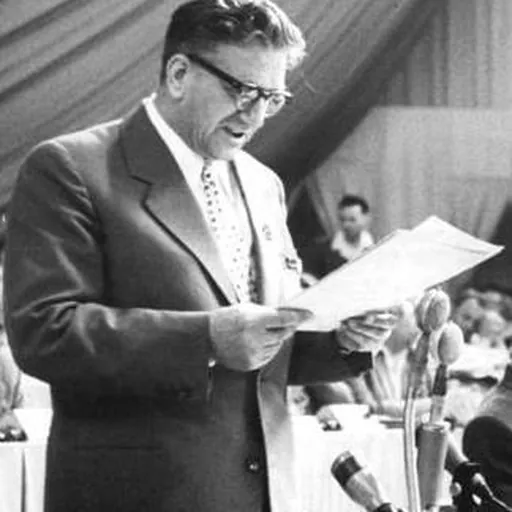
About Bernhard Quandt
Lived 1903 – 1999 (aged 96). Bernhard Quandt was a German politician.
Bernhard Quandt (14 April 1903 – 2 August 1999) was a German politician and party functionary of the Socialist Unity Party (SED).
Quandt became politically active in the waning years of the Weimar Republic for the Communist Party of Germany (KPD), spending several years in the Sachsenhausen and Dachau concentration camps during Nazi rule.
He moved to the Soviet occupation zone after the war, where he became a SED functionary. He served as the last Minister-President of Mecklenburg before its dissolution and thereafter as the longtime First Secretary of the Bezirk Schwerin SED before being forced into retirement in 1974.
Life and career Early life Quandt was born to a single mother; his father was a soldier in the Imperial German Army who died in a riding accident in Parchim four months before Quandt's birth.
The family—his mother had since married a carpenter—lived in Rostock and Wismar. At six, he attended elementary school there. In 1912, the family moved to Gielow, where his mother ran a small farm. He began training as an iron turner in 1917 and worked as a journeyman. In 1946, he became Second Secretary, also responsible for organization, of the Mecklenburg KPD, and after their forced merger with the SPD, of the Mecklenburg SED.
From February 1948, he served as Minister of Agriculture of Mecklenburg in the cabinets of Wilhelm Höcker and Kurt Bürger, the second most populous of the three Bezirke created from Mecklenburg. Quandt additionally became a full member of the Central Committee of the SED in June (V. Party Congress), serving until its collective resignation in December 1989,
In October 1973, Quandt was also elected to the State Council, the GDR's collective head of state, succeeding the deceased Walter Ulbricht.
Quandt was awarded the Patriotic Order of Merit in silver in 1955, the honor clasp to this order in 1969, the Banner of Labor in 1965, the Order of Karl Marx in 1973 and 1988 and the Star of Peoples' Friendship in 1978. On 28 January 1974, Heinz Ziegner, his Second Secretary, was appointed as the new First Secretary. called for the reintroduction of the death penalty and the summary execution of all those (the "criminal gang of the old Politburo") who had brought disgrace (referring to the loss of power due to the revolutionary events in autumn 1989) upon the party (SED). "We abolished the death penalty in the State Council. I am in favor of reintroducing it and summarily executing everyone who brought such disgrace upon our party!"
In 1990, he was elected to the Council of Elders of the now-renamed SED-PDS.
Quandt died in 1999 at the age of 96, as the last former Minister-President of a GDR state.
Don’t just read it —
keep it.
Full-length biographies made to live with: read them, listen on the way to work, watch them tonight.
- E-book
- Audio
- Video
Instant download · yours to keep · every purchase keeps this site free
Important facts
People in Bernhard Quandt's life
Named in this biography and alive at the same time


Related people
Same field, nearest in time




Contemporaries
People whose lives overlapped Bernhard Quandt's
Frequently asked questions
Who was Bernhard Quandt?
German politician (1903-1999)
When was Bernhard Quandt born?
Bernhard Quandt was born on 14 April 1903 in Rostock.
When did Bernhard Quandt die?
Bernhard Quandt died on 2 August 1999 in Schwerin.
What was Bernhard Quandt's occupation?
Bernhard Quandt was a politician.
What nationality was Bernhard Quandt?
Bernhard Quandt was German.
Sources & further reading
Cite this page
APA: Biography.guide. (2026). Bernhard Quandt. https://biography.guide/bernhard-quandt/
MLA: "Bernhard Quandt." Biography.guide, https://biography.guide/bernhard-quandt/.
Chicago: "Bernhard Quandt." Biography.guide. https://biography.guide/bernhard-quandt/.
Data last updated: 2026-09-22 · Spot an error? Report a correction.
Portrait: Wikimedia Commons · author & licence
Page generated 2026-09-27 05:02 UTC