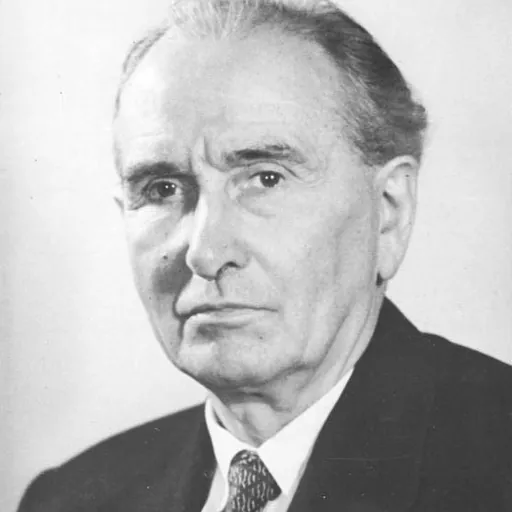
About Bernard Koenen
Lived 1889 – 1964 (aged 75). Bernard Koenen was a German politician, diplomat and resistance fighter.
Bernard Johann Heinrich Koenen (17 February 1889 – 30 April 1964) was a German communist politician and trade unionist who served in several legislative positions in the Weimar Republic and East Germany between 1919 and 1964. In the latter state, he also served as First Secretary of the Socialist Unity Party in Saxony-Anhalt from 1946 to 1952, in Bezirk Halle from 1952 to 1953 and again from 1958 to 1963, and as East German ambassador to Czechoslovakia from 1953 to 1958.
Life
Early years Koenen was born in Hamburg, the son of a carpenter-joiner and a cook. His father was a Socialist activist who participated in the founding of the Second International in Paris five months after his birth. By the turn of the century his father was a leading member of the Social Democratic Party of Germany (SPD).
On leaving school Koenen had embarked on an apprenticeship as a machine fitter and lathe operator, and in 1906 joined the German Metal Workers' Union. The next year he turned 18 and joined the SPD. His skills evidently made him readily employable and a period of travelling followed, taking in Lausanne, Brussels, Lille, and Tunisia, where, in Bizerte, he was among those who founded the Socialist Party in Tunisia. In 1923 he joined the party's national organization commission. Factionalism continued to be a feature of left-wing politics during the 1920s, and from the middle of the decade Koenen was identified with the so-called Conciliator faction (Versöhnler), which led in 1929 to his being relieved of some of his party offices by the party leader, Ernst Thälmann. For the next few months, with a warrant out for his arrest, he was concealed in a private clinic by a doctor who was sympathetic to the communist cause.
Exile In May 1933, along with several other fugitive communists, he managed to get to the Saarland,
Postwar
Koenen returned in 1945 to the Soviet occupation zone in what remained of Germany. Under the Soviet system, on which the East German constitution was modelled, the responsibilities of government ministers were restricted to implementing the decisions of the Party Central Committee, while a Single List voting system ensured that the Volkskammer, the national legislature, was also controlled by the ruling SED (that is to say, by its Central Committee). In terms of power and influence Koenen's Central Committee membership was therefore of greater significance than membership of regional or national legislatures, though in practice there were plenty of Central Committee members who simultaneously held office in national or regional legislatures and/or as government ministers. Koenen himself combined Central Committee membership with membership of the Volkskammer,
From 1946 to 1964 Koenen also held a seat in the National Legislative Assembly. However, in 1952 he lost his seat and leadership position in the regional legislature of Saxony-Anhalt when regional legislatures were abolished in the context of a wider programme of regional government reform. Partly as a consequence of those reforms, local and municipal councils became more important. Between 1952 and 1953, and again, in succession to , from 1958 to 1963 Koenen served as First Secretary to the SED Regional Leadership (Bezirksleitung) in Halle.
Outside politics, he also worked as a teacher and journalist.
Family Koenen's elder brother, Wilhelm Koenen (1886–1963), was also a German Communist politician.
Koenen married (1890–1968) during the First World War. Their sons and Alfred both joined the Red Army in order to fight Nazi Germany. Viktor (1920–1942) was killed over or in Poland in 1942. (There are conflicting reports as to how he died.) Alfred (1921–1995) survived the war and had a career as an army officer, and later as a diplomat.
Awards and honors East Germany
1958: Medal for Fighters Against Fascism 1958: Johannes R. Becher Medal in Gold Patriotic Order of Merit in Gold and Silver 1959: Order of Karl Marx
Foreign Medal "For Valiant Labour in the Great Patriotic War 1941–1945" Order of the Banner of Labour
Don’t just read it —
keep it.
Full-length biographies made to live with: read them, listen on the way to work, watch them tonight.
- E-book
- Audio
- Video
Instant download · yours to keep · every purchase keeps this site free
Important facts
People in Bernard Koenen's life
Named in this biography and alive at the same time


Related people
Same field, nearest in time





Contemporaries
People whose lives overlapped Bernard Koenen's


Frequently asked questions
Who was Bernard Koenen?
German politician (1889-1964)
When was Bernard Koenen born?
Bernard Koenen was born on 17 February 1889 in Hamburg.
When did Bernard Koenen die?
Bernard Koenen died on 30 April 1964 in East Berlin.
What was Bernard Koenen's occupation?
Bernard Koenen was a politician, diplomat and resistance fighter.
What nationality was Bernard Koenen?
Bernard Koenen was German.
Sources & further reading
Cite this page
APA: Biography.guide. (2026). Bernard Koenen. https://biography.guide/bernard-koenen/
MLA: "Bernard Koenen." Biography.guide, https://biography.guide/bernard-koenen/.
Chicago: "Bernard Koenen." Biography.guide. https://biography.guide/bernard-koenen/.
Data last updated: 2026-09-22 · Spot an error? Report a correction.
Portrait: Wikimedia Commons · author & licence
Page generated 2026-09-27 05:01 UTC