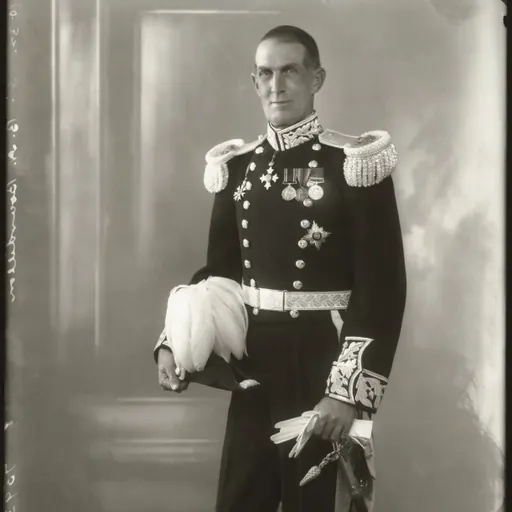
About Bernard Henry Bourdillon
Lived 1883 – 1948 (aged 64). Bernard Henry Bourdillon was a British politician.
Sir Bernard Henry Bourdillon (1883–1948) was a British colonial administrator who was Governor of Uganda (1932–1935) and of Nigeria (1935–1943).
Early years
Bourdillon was born on 3 December 1883 at Burnie, Tasmania to English parents. He married Violet Grace Billinghurst in November 1909. His three sons, Bernard Godwin Bourdillon, Henry Townsend Bourdillon and Patrick Imbert Bourdillon attended Corpus Christi College, Oxford, and they all followed their father into the Colonial Service. Bernard Godwin Bourdillon, Assistant Chief Secretary to Palestine, was later killed in the King David Hotel bombing in 1946.
In 1913, Bourdillon was appointed Under-Secretary to the Government of the United Provinces. In 1915, he was made Registrar of the High Court of Allahabad. While in India, he earned a reputation as a linguist. He was also invited to the Maldives in 1931 to advise Sultan Muhammad Shamsuddeen III on the drafting of the country's first written constitution. He recommended that the country should be run by a council of ministers led by a prime minister, however his advice was not accepted by the drafting committee.
Uganda In 1932, he was appointed Governor and Commander-in-Chief of Uganda. In Uganda, Bourdillon was said to have "gotten lucky" in that several issues arose while he was governor where he was able to make decisions that were popular with the African majority. On one occasion, there was conflict between Arab merchants in Kampala (themselves immigrants from Britain's territory of Aden) and African storekeepers in the same community. Bourdillon examined the evidence and felt it was objectively true that the Arab storekeepers had engaged in abusive practices, some of which ran counter to the laws of the Uganda Protectorate. Correspondingly, he ruled in favor of the African storekeepers.
On another occasion he was approached by leaders of the Tooro Kingdom who claimed Belgian poachers were illegally crossing over from the Belgian Congo and hunting game on lands belonging to the Tooro Kingdom. Bourdillon investigated the matter and had the Askari patrol the border to apprehend the poachers. The poachers were subsequently arrested and jailed by British authorities, despite being European. On another occasion, a Belgian resident of Entebbe was accused of beating his African servants. Bourdillon called witnesses, including the Belgian man's other employees. After hearing all of the evidence the Belgian man was made to pay a fine and was subsequently deported from the Uganda Protectorate to the Belgian Congo. In both of the aforementioned instances, Bourdillon had sided with indigenous Africans against Europeans and used his place in the colonial power structure to enforce rulings in favor of Africans against Europeans. This was notable for being exceedingly rare in colonial Africa.
There had been toll roads built through the territory of the Lango people in the center of the protectorate. Many Lango people complained about these toll roads. After "being encouraged by a District Commissioner to petition the governor with their grievances", a group of Lango people gathered together a petition explaining why they did not like the toll roads and that they wanted the tolls removed. Hundreds of Lango people signed the petition. The District Commissioner helped them bring their petition to Bourdillon. After reviewing the petition and speaking with both the DC and the Lango leaders who the DC brought to him, Bourdillon ordered the tolls to be removed immediately. The entire meeting lasted only two hours, and the return of the DC and the Lango leaders to the Lango-majority region in the center of the protectorate was "triumphant."
Nigeria In 1935, he was made Governor and Commander-in-Chief of Nigeria, holding the post until he retired in 1943.
Bourdillon has been described as being "Far ahead of his time" on issues of race. He once wrote that he "wholeheartedly reject(ed) the foolish notion that some races are inherently superior to others" saying "such claims have no basis in either science or Christianity." In some ways this made him controversial, he consistently supported African efforts to gain self-government, and in both Uganda and Nigeria undertook efforts to increase African participation in government.
Britain was wary about getting drawn into permanent expenses with the colonies and would advance loans only if the colonial government guaranteed to cover interest charges or repay the investment. This inhibited the poorer colonies from requesting support for development schemes. In 1939, Bourdillon wrote to the Secretary of State concerning the economic development of the African colonies. After describing how little had been spent on development and giving the reasons, he asked that the British government "should accept responsibility for financing the operations of the agricultural, forestry, geological survey, veterinary and co-operative departments" under a ten-year programme.
Bourdillon divided the south of Nigeria into Eastern and Western provinces in 1939.
Bourdillon recognized that the northerners were handicapped in comparison to the southerners by their lack of education and lack of English. Rather than simply expand the Legislative Council to include more northerners, he explored the idea of Regional Councils with a Central Council in Lagos that would review their findings. However, he saw these councils as strictly advisory in nature, saying "a benevolent autocracy is the form of government best suited to a people who are educationally backward and whose religion inculcates a blind obedience to authority". He died on 6 February 1948 at St Saviour, Jersey, aged 64.
Awards Bourdillon was appointed a CMG in the 1924 Birthday Honours and promoted to KCMG in the 1934 Birthday Honours and to GCMG in the 1937 Coronation Honours. He had been appointed KBE in the 1931 Birthday Honours. He was made a Knight of Grace of the Order of St John of Jerusalem and an honorary fellow of St John's College, Oxford.
Don’t just read it —
keep it.
Full-length biographies made to live with: read them, listen on the way to work, watch them tonight.
- E-book
- Audio
- Video
Instant download · yours to keep · every purchase keeps this site free
Important facts
People in Bernard Henry Bourdillon's life
Named in this biography and alive at the same time


Related people
Same field, nearest in time





Contemporaries
People whose lives overlapped Bernard Henry Bourdillon's


Frequently asked questions
Who was Bernard Henry Bourdillon?
British colonial administrator (1883-1948)
When was Bernard Henry Bourdillon born?
Bernard Henry Bourdillon was born on 3 December 1883 in Burnie.
When did Bernard Henry Bourdillon die?
Bernard Henry Bourdillon died on 16 February 1948 in Jersey.
What was Bernard Henry Bourdillon's occupation?
Bernard Henry Bourdillon was a politician.
What nationality was Bernard Henry Bourdillon?
Bernard Henry Bourdillon was British.
Sources & further reading
· Wikipedia: Bernard Henry Bourdillon
· DBpedia: Bernard Henry Bourdillon
Cite this page
APA: Biography.guide. (2026). Bernard Henry Bourdillon. https://biography.guide/bernard-henry-bourdillon/
MLA: "Bernard Henry Bourdillon." Biography.guide, https://biography.guide/bernard-henry-bourdillon/.
Chicago: "Bernard Henry Bourdillon." Biography.guide. https://biography.guide/bernard-henry-bourdillon/.
Data last updated: 2026-09-23 · Spot an error? Report a correction.
Portrait: Wikimedia Commons · author & licence
Page generated 2026-09-27 05:05 UTC