About Benjamin Vulliamy
Lived 1747 – 1811 (aged 63–64). Benjamin Vulliamy was a British watchmaker, businessperson and clockmaker.
Benjamin Vulliamy (1747 – 31 December 1811), was a British clockmaker responsible for building the Regulator Clock, which, between 1780 and 1884, was the main timekeeper of the King's Observatory Kew and the official regulator of time in London. In 1773 Vulliamy had received a Royal Appointment as the King's Clockmaker.
Biography Extract from Observations on the Transit of Venus, a manuscript notebook from the collections of George III, showing Justin and Benjamin's presence at the 1769 Transit of Venus observations at the King's Observatory in Richmond-upon-Thames. Benjamin Vulliamy was born in London, the son of Justin Vulliamy and his wife Mary. A clockmaker from Switzerland, the father had immigrated to London around 1730. Justin became an associate of Benjamin Gray, a watchmaker established in Pall Mall. He married Gray's daughter Mary in London. His talent earned him a Royal Appointment in 1773, through which he came to receive an endowment of £150 a year as George III's King's Clockmaker (the similar distinction, Royal Watchmaker, was then held by George Lindsay). The king, an enthusiast for watches and mechanical devices, was patron of Justin Vulliamy, but Benjamin was the only one of the pair to receive this significant honour.
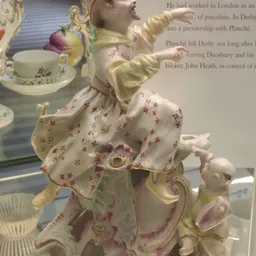
Benjamin went into business with his father in 1780 (Vulliamy & Son). Father and son worked together until Justin died on 1 December 1797. Around 1780, Vulliamy was commissioned to build the Regulator Clock, the main timekeeper of the King's Observatory Kew, which served as an unofficial Prime Meridian. It also kept official London time until 1884, when the Greenwich Royal Observatory assumed both roles. Vulliamy clocks were combined with fine porcelain figures to create artefacts that combined both science and art. The overall design was made by Vulliamy, but he employed prize-winning sculptors such as John Deare, to create the figures, which were influenced by contemporary French designs.
The Vulliamy family used Crown Derby to produce the figures from porcelain designs. One of Vulliamy's assistants, Jacques Planche, was a brother of Andrew Planche, who had been involved in the early Derby Porcelain business. The Vulliamy business also subcontracted much of the clocks' manufacture to other skilled artisans. Vulliamy oversaw and created the final adjustments before sale.
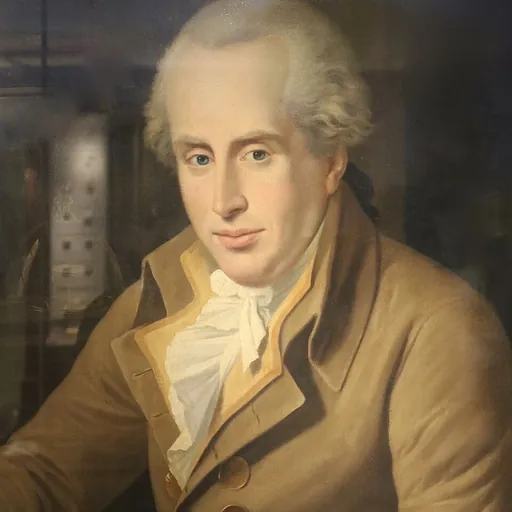
Portraits Painting by an anonymous artist, bequeathed by B. L. Vulliamy, 1854 (Clockmakers' Museum, London). Wax portrait by R. C. Lucas, 1851 (Clockmakers' Museum, London).
Don’t just read it —
keep it.
Full-length biographies made to live with: read them, listen on the way to work, watch them tonight.
- E-book
- Audio
- Video
Instant download · yours to keep · every purchase keeps this site free
Important facts
Family & relationships
People in Benjamin Vulliamy's life
Named in this biography and alive at the same time

Related people
Same field, nearest in time



Contemporaries
People whose lives overlapped Benjamin Vulliamy's




Frequently asked questions
Who was Benjamin Vulliamy?
clockmaker (1747-1811)
When was Benjamin Vulliamy born?
Benjamin Vulliamy was born in 1747 in London.
When did Benjamin Vulliamy die?
Benjamin Vulliamy died in 1811 in Westminster.
What was Benjamin Vulliamy's occupation?
Benjamin Vulliamy was a watchmaker, businessperson and clockmaker.
What nationality was Benjamin Vulliamy?
Benjamin Vulliamy was British.
Sources & further reading
· Wikipedia: Benjamin Vulliamy
Cite this page
APA: Biography.guide. (2026). Benjamin Vulliamy. https://biography.guide/benjamin-vulliamy/
MLA: "Benjamin Vulliamy." Biography.guide, https://biography.guide/benjamin-vulliamy/.
Chicago: "Benjamin Vulliamy." Biography.guide. https://biography.guide/benjamin-vulliamy/.
Data last updated: 2026-09-22 · Spot an error? Report a correction.
Portrait: Wikimedia Commons · author & licence
Page generated 2026-09-27 04:59 UTC