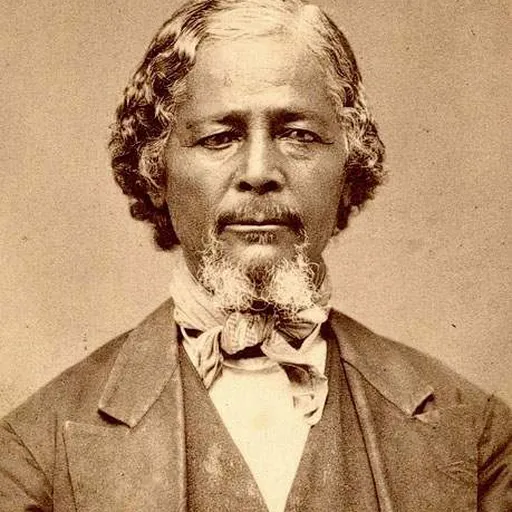
Benjamin Singleton
American activist and businessman
About Benjamin Singleton
Lived 1809 – 1892 (aged 82–83). Benjamin Singleton was an American promoter.
Benjamin "Pap" Singleton (August 15, 1809 – February 17, 1900) was an American activist and businessman best known for his role in establishing African American settlements in Kansas. A former slave from Tennessee who escaped to freedom in Ontario in 1846, he returned to the United States, settling for a period in Detroit. He became a noted abolitionist, community leader, and spokesman for African-American civil rights.
Singleton returned to Tennessee during the Union occupation in 1862 but concluded that blacks would never achieve economic equality in the white-dominated South. After the end of Reconstruction, Singleton organized the movement of thousands of black colonists, known as Exodusters, to found settlements in the free state of Kansas. A prominent voice for early black nationalism, he became involved in promoting and coordinating black-owned businesses in Kansas and developed an interest in the Back-to-Africa movement.
Early life and education Although it is known that Singleton was enslaved at birth in 1809 in Davidson County near Nashville, Tennessee, details of his early life remain scant. He was the son of a white father and an enslaved black mother. As a youth, he was trained as a carpenter but regretted never learning to read and write. Reportedly Singleton made several attempts to escape slavery but was unsuccessful.
In 1846, Singleton managed to escape to freedom. He made his way north along the Underground Railroad to Windsor, Ontario, and remained there a year before relocating to Detroit, Michigan, where he lived as a scavenger and used what resources he could to help other escaped slaves find their way to freedom in Canada. Singleton lived in Detroit until after the Civil War was underway. During this time, he worked as a carpenter.
Separatism After the Union Army occupied Middle Tennessee in 1862, Singleton returned and took up residence in Nashville, believing his freedom would be protected within Union lines. He worked as a cabinetmaker and coffin maker. As freedmen were still subject to white racial violence and political problems, Singleton concluded that blacks would have no chance for equality in the South. Disgusted by political leaders who failed to deliver on promises of equality for freedmen, in 1869 Singleton joined forces with Columbus M. Johnson, a black minister in Sumner County, and began looking for ways to establish black economic independence.
In 1874, Singleton and Johnson founded the Edgefield Real Estate Association with the goal of helping African Americans acquire land in the Nashville area. White landowners were unwilling to bargain with them and wanted too high prices for their land. Convinced that freedmen must leave the South to achieve true economic independence, in 1875 Singleton began to explore the idea of planting black colonies in the American West. His real estate organization was renamed the Edgefield Real Estate and Homestead Association. In 1876, Singleton and Johnson traveled to Kansas to scout land in Cherokee County in the southeastern corner of the state. Heartened by what he saw, Singleton returned to Nashville and began recruiting settlers for a proposed colony.
Singleton colonies In the summer of 1877, Singleton led approximately 73 black settlers to Cherokee County near Baxter Springs. Once the settlers arrived, they began negotiating with the Missouri River, Fort Scott, and Gulf Railroad for land to build their proposed Singleton Colony. Their timing was late, as rich lead deposits had been discovered in the area the previous year, which led to a mining boom and caused land prices to rise too high for their funds. Without the ability to buy land, they could not create a colony in Cherokee County. Singleton began looking elsewhere.
He searched for government land which his settlers could acquire through the 1862 Homestead Act. He found some available land on what had been the former Kaw Indian Reservation near Dunlap, Kansas, on the borders of Morris and Lyon counties. Dunlap was situated along the tracks of the Missouri-Kansas-Texas Railroad which extended into Kansas from Missouri. The land was marginal, but in the spring of 1878, Singleton's settlers left middle Tennessee for Kansas via steamboats on the Cumberland River. The following year they officially established the Dunlap colony. He is buried in Union Cemetery.
Family Benjamin Singleton married and was the father of several children. Two of his children – Emily, born about 1840 in Tennessee, and Sarah, born about 1858 in Michigan – wrote letters to their father from East Nashville, Tennessee, during the mid-1880s. An undated note regarding Singleton's testimony before the U.S. Senate Committee in 1880 quotes Singleton as saying: "I have been a slave fled to Canada when my children were small and nineteen years after when I returned they were grown."
His son Joshua W. Singleton settled in Allensworth, California, a black agricultural settlement. Joshua's grandchildren, through his married daughter Virginia Louise Williams and her husband John, were John Williams Jr., Midge Williams (1915-1952), Charles and Robert Williams. As young adults, they started singing together in the Bay Area as the Williams Quartette. In 1928 they started touring as the Williams Four. In 1933, they had a successful tour in Shanghai, China, which was a destination for increasing numbers of European refugees, and Japan. Midge Williams also sang as a swing jazz soloist in the late 1930s and 1940s. She recorded with a group as Midge Williams and Her Jazz Jesters.
Legacy and honors In 2002, American scholar Molefi Kete Asante listed "Pap" Singleton as among the 100 Greatest African Americans.
History of colonies Singleton did not establish his Real Estate Association prior to 1874 and did not make his first scouting trip to Kansas until 1876; the Singleton Colony in Cherokee County failed almost immediately after being settled. Nicodemus, Kansas, was founded independently in 1877 by black settlers from Kentucky, one year before Singleton founded his successful colony at Dunlap.
Don’t just read it —
keep it.
Full-length biographies made to live with: read them, listen on the way to work, watch them tonight.
- E-book
- Audio
- Video
Instant download · yours to keep · every purchase keeps this site free
Important facts
People in Benjamin Singleton's life
Named in this biography and alive at the same time


Related people
Same field, nearest in time

Contemporaries
People whose lives overlapped Benjamin Singleton's




Frequently asked questions
Who was Benjamin Singleton?
American activist and businessman (1809–1900)
When was Benjamin Singleton born?
Benjamin Singleton was born in 1809 in Davidson County.
When did Benjamin Singleton die?
Benjamin Singleton died in 1892 in Kansas City.
What was Benjamin Singleton's occupation?
Benjamin Singleton was a promoter.
What nationality was Benjamin Singleton?
Benjamin Singleton was American.
Sources & further reading
· Wikipedia: Benjamin Singleton
· DBpedia: Benjamin "Pap" Singleton
Cite this page
APA: Biography.guide. (2026). Benjamin Singleton. https://biography.guide/benjamin-singleton-promoter/
MLA: "Benjamin Singleton." Biography.guide, https://biography.guide/benjamin-singleton-promoter/.
Chicago: "Benjamin Singleton." Biography.guide. https://biography.guide/benjamin-singleton-promoter/.
Data last updated: 2026-09-23 · Spot an error? Report a correction.
Portrait: Wikimedia Commons · author & licence
Page generated 2026-09-27 05:08 UTC