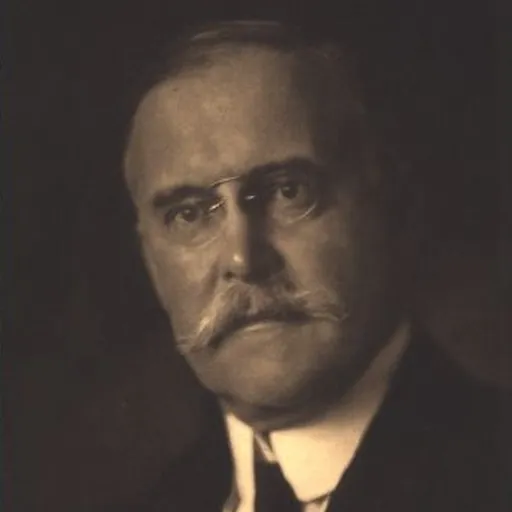
About Benjamin Ide Wheeler
Lived 1854 – 1927 (aged 72). Benjamin Ide Wheeler was an American classical philologist, linguist, university teacher, writer, philologist and historian.
Benjamin Ide Wheeler (July 15, 1854– May 2, 1927) was a professor of Greek and comparative philology at Cornell University, writer, and President of the University of California from 1899 to 1919.
Life and career
Early years Benjamin Ide Wheeler was born in Randolph, Massachusetts, on July 15, 1854, the son of the Rev. Benjamin and Mary Eliza (Ide) Wheeler. His father was successively a church pastor in Plaistow, New Hampshire; Pawtucket, Rhode Island; Randolph, Massachusetts; Haverhill, Massachusetts; Saco, Maine; Franklin, New Hampshire. His mother, Mary Eliza Ide, was born in Pawtucket, Rhode Island, daughter of Ebenezer Ide of the Ide family which had its origin in South Attleborough, then Rehoboth. Their only son, Benjamin Ide Wheeler, had his education first in the public schools of Haverhill and Saco, Maine. It was at Saco that he first entered a high school in 1866. This high school was the institution which formerly had been called Thornton Academy, and subsequently resumed that name.
Studies abroad For four years, 1881–85, Wheeler studied in German universities—for a year at Leipzig, then for two years at Heidelberg, a half year at Jena, and a half year at Berlin. In the spring of 1885, he received on examination at Heidelberg the degree of Doctor of Philosophy, summa cum laude, presenting a thesis under Hermann Osthoff entitled Der griechische Nominalaccent, afterwards published at Strassburg as a separate book. Joseph Wright, future Corpus Christi Professor of Comparative Philology at Oxford, completed his PhD the same year as Wheeler and also writing his thesis under Osthoff.
Return to America On returning to America he was for one year Instructor at Harvard, 1885–86, then for thirteen years Professor at Cornell University, holding at first the title Acting Professor of Classical Philology, 1886–87, then of Professor of Comparative Philology 1887–88, and from 1888 to 1899 that of Professor of Greek and Comparative Philology. In 1899, he became President of the University of California.
During the year 1895–96, he was Professor of Greek Literature at the American School of Classical Studies in Athens, and during the year 1909–10, Roosevelt Professor at the University of Berlin. He was member of the American Oriental Society, the American Philological Association, and the Kaiserliches Archaeologisches Institut. He received the degree of Doctor of Laws from nine different universities, Princeton, 1896; Harvard, 1900; Brown, 1900; Yale, 1901; Johns Hopkins, 1902; University of Wisconsin, 1904; Dartmouth, 1905; Columbia, 1906; and a degree of Doctor of Letters from the University of Athens in Greece. brought suspicion upon him and he retired as President of the University of California after the armistice. Wheeler had previously nominated the kaiser for the Nobel Peace Prize.
Under Wheeler the University of California underwent one of its periods of greatest growth. He also expanded the powers of the president, gaining the power to appoint all faculty.
Legacy The University of California, Berkeley named Wheeler Hall in his honor. The Liberty ship SS Benjamin Ide Wheeler was named in his honor. The Benjamin Ide Wheeler Medal was created in 1929. Founding member of the Commonwealth Club of California in 1903.
Benjamin Ide Wheeler Medal Since 1929, the award has been given to members of the community of Berkeley for exhibited outstanding contributions. Since 1994, the Berkeley Community Fund has been granting "Berkeley's Most Useful Citizen" award. Until 1991, it was bi-annual but changed to annual in 1994. Several notable people have received the award:
1929 William H. Waste 1931 August Vollmer 1933 Robert Gordon Sproul 1935 Chester R. Rowell 1937 William B. Herms 1939 Monroe E. Deutsch 1941 Louise Marks 1943 Lester W. Hink 1945 E.O. Lawrence 1947 Vere V. Loper 1949 Emery Stone 1951 Clarence A. Bullwinkel 1953 Galen M. Fisher 1955 Walter A. Gordon 1957 Lilly M. Whitaker 1959 Robert R. Porter 1961 Redmond C. Staats, Jr. 1963 Claude B. Hutchison 1965 Katherine Towle 1967 Wallace J.S. Johnson 1969 Roger W. Heyns 1971 Wilmont Sweeny 1973 Carol Sibley 1975 Thomas B. Shaw 1977 Sylvia C. McLaughlin 1979 Robert W. Ratcliff 1981 Paul E. Harberts 1983 Robert G. Eaneman 1985 Robert A. Rice 1987 Margaret S. Gordon 1989 Fred S. Stripp 1991 Mary Lee Jefferds 1994 Ira Michael Heyman 1995 Alba and Bernard Witkin 1996 John A. Martin, Jr. 1997 Chang-Lin Tien 1998 David R. Brower 1999 Marian Cleeves Diamond 2000 Thelton E. Henderson 2001 Jeffrey Shattuck Leiter 2002 Alice Waters 2003 Kent Nagano 2004 Arthur Rosenfeld, Ph.D. 2005 Davida Coady, M.D. 2006 Mal Warwick 2007 Robert Cole 2008 Helen Meyer 2008 John Meyer 2009 Steven H. Oliver 2010 Denny Abrams 2010 Richard Millikan 2011 Narsai M. David 2012 Susan Medak 2013 Wavy Gravy 2014 Arlene Blum 2015 Archana Horsting 2016 Skip Battle 2017 Vicki Alexander 2018 Susan Muscarella 2019 Frances Dinkelspiel, Lance Knobel and Tracey Taylor
Works Wheeler authored Analogy in Language (1887); Introduction to the Study of the History of Language (1890); Organization of the Higher Education in the United States (1896), published in Munich; Dionysos and Immortality (1899); Life of Alexander the Great (1900); Instruction and Democracy in America (1910) (published in Strassburg, Germany). and Art in Language was published in the December 1900 issue.
Publications Der griechische Nominalaccent (1885) Analogy, and the Scope of its Application in Language (1887) Principles of Language Growth (1891) Introduction to the Study of the History of Language (1891) The Organization of Higher Education in the United States (1897) Dionysos and Immortality (the Ingersoll Lecture for 1898) Alexander the Great: The Merging of East and West in Universal History (1900) The Whence and Whither of the Modern Science of Language (1905)
Don’t just read it —
keep it.
Full-length biographies made to live with: read them, listen on the way to work, watch them tonight.
- E-book
- Audio
- Video
Instant download · yours to keep · every purchase keeps this site free
Important facts
People in Benjamin Ide Wheeler's life
Named in this biography and alive at the same time




Related people
Same field, nearest in time


Contemporaries
People whose lives overlapped Benjamin Ide Wheeler's




Frequently asked questions
Who was Benjamin Ide Wheeler?
American linguist (1854-1927)
When was Benjamin Ide Wheeler born?
Benjamin Ide Wheeler was born on 15 July 1854 in Randolph.
When did Benjamin Ide Wheeler die?
Benjamin Ide Wheeler died on 2 May 1927 in Vienna.
What was Benjamin Ide Wheeler's occupation?
Benjamin Ide Wheeler was a classical philologist, linguist, university teacher, writer, philologist and historian.
What nationality was Benjamin Ide Wheeler?
Benjamin Ide Wheeler was American.
Sources & further reading
· Wikipedia: Benjamin Ide Wheeler
· DBpedia: Benjamin Ide Wheeler
Cite this page
APA: Biography.guide. (2026). Benjamin Ide Wheeler. https://biography.guide/benjamin-ide-wheeler/
MLA: "Benjamin Ide Wheeler." Biography.guide, https://biography.guide/benjamin-ide-wheeler/.
Chicago: "Benjamin Ide Wheeler." Biography.guide. https://biography.guide/benjamin-ide-wheeler/.
Data last updated: 2026-09-22 · Spot an error? Report a correction.
Portrait: Wikimedia Commons · author & licence
Page generated 2026-09-27 05:04 UTC