
Benjamin Feigenbaum
Polish born Yiddish socialist, newspaper editor, translator, and satirist
About Benjamin Feigenbaum
Lived 1860 – 1932 (aged 72). Benjamin Feigenbaum was an editor.
Benjamin Feigenbaum (August 12, 1860 – November 10, 1932) was a Polish-born Jewish socialist, newspaper editor, translator, and satirist. Feigenbaum was an associate editor of the Yiddish language The Forward, its predecessor Di Arbeter Tsaytung, and the literary monthly Di Tsukunft, co-founder of the Workmen's Circle, and a pioneer of the Socialist Party of America.
Early life Benjamin Feigenbaum was born to a prominent Chassidic family in Warsaw, Poland. He went to Yeshivah, but became a free-thinker. According to colleague Israel Joshua Singer, Feigenbaum's "conversion" to secularism happened when his teacher, the Gerer rebbe discovered that Feigenbaum was not wearing tsitsit, a ritual garb. The rebbe beat him as a punishment. He contributed to the local Flemish socialist newspaper .
On December 25, 1886, his wife Matilda (née: Kaminsky) gave birth to their son William Morris Feigenbaum, who also later became a prominent socialist. Benjamin had two daughters and two sons, named Kanin, R. Ganetkin, William, and Henry.
During the Jewish Holiday of Yom Kippur in 1888, Feigenbaum hosted the first public Yom Kippur Ball. In 1889 at another Yom Kippur Ball, Feigenbaum famously declared "If there is a God and if he is Almighty as the clergy claims he is, I give him just two minutes' time to kill me on the spot, so that he may prove his existence!". After two minutes he declared "See! There is no God!". He then announced a location for the workers to eat instead of fasting, as traditionally done during Yom Kippur.
New York
"B. Feigenbaum, the most observant Marxist". Below caption says "Dedicated to extremist, blasphemous B. Feigenbaum, who rejects all gods except his own, Karl Marx.", 1912. Feigenbaum immigrated to New York in 1891 to work on New York's first Yiddish-language socialist weekly, He contributed to Forward and Morgen Zhurnal.
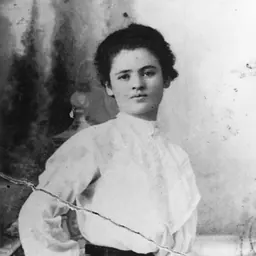
In 1909, Feigenbaum chaired a meeting of predominantly Jewish women shirtwaist workers on whether to strike, held inside the Great Hall of Cooper Union. After hours and multiple speakers cautioned against striking, a Yiddish-speaking shirtwaist worker named Clara Lemlich made her way to the podium and declared "I move that we go on a general strike!" to which the crowd roared enthusiastically. Feigenbaum asked the crowd to take an biblically inspired oath "If I turn traitor to the cause I now pledge, may my hand wither from the arm I now raise", which subsequently led to the largest women's strike in US history.
Feigenbaum was frequently a candidate for public office on the Socialist ticket, running for State Assembly seven times between 1906 and 1918, in addition to State Senate once in 1912. In his last election, he ran alongside his son William, who was also a candidate for the Assembly in a neighboring district.
Police retaliation Feigenbaum was arrested during a brawl with the police on October 29, 1892, shortly after giving a speech in Philadelphia. He was charged with inciting to riot, assaulting an officer and breaching the peace after allegedly hitting an officer with his cane. He was held on $600 bail.
In Providence, he was charged with inciting to riot, charges which were later dismissed by a judge during trial in a higher court. In January, 1905, Providence police received a tip that an "anarchist provocateur" was scheduled to speak. Police surrounded the designated venue, disabled the gas and cited the lack of permit to shut the event down. The sponsors of the lecture, the Providence branch of the Workmen's Circle obtained the relevant permits and scheduled another venue for Feigenbaum to speak at. Hyman Goldsmith was a Yiddish-speaking undercover police officer assigned to Feigenbaum. Had Feigenbaum mentioned anything related to "Emma Goldmanism" or "bomb throwing", Goldsmith would have had the halls cleared immediately by the other undercover police in the crowd. Instead, Feigenbaum orated for two hours and 15 minutes about the compatibility of religion and socialism, in sharp contrast with his past anti-theist recitals. The police were ridiculed the following day by The Daily Journal, The Evening Bulletin, and The Providence Telegram.
Criticism of Zionism and religion
Feigenbaum was highly critical of Zionism and the usage of biblical scriptures in promoting "socialist spiritualization". In the Yiddish article, 'Materialism in Judaism or Religion and Life' (1896), Feigenbaum criticized using the Bible as "propaganda", noting that if Jeremiah did not know Marx, then it was disingenuous to claim that Marxism is part of a prophetic tradition. In 'Vi Kumt a yid tsu sotsyialismus''' (How does a Jew come to socialism?), Feigenbaum wrote "Yes, brothers, socialism is redemption for us, the Jews. Socialism will rescue all the unfortunate people, Jews as well, and give them equal rights... Socialism's victory would spell the only effective defeat of the forces of antisemitism". He further maintained that he met socialist Gentiles who "ridded themselves of antisemitism upon discovering socialism. The enemy is the capitalist, whether Gentile or Jewish; and the Jewish poor are his friend."
Feigenbaum rejected Zionism as utopian and urged Jews to reject the notion of Goles'' as exile from Palestine. Instead, exile should be understood as the state of persecution, from which socialism can redeem them.
Written works
Authored
Translated
Don’t just read it —
keep it.
Full-length biographies made to live with: read them, listen on the way to work, watch them tonight.
- E-book
- Audio
- Video
Instant download · yours to keep · every purchase keeps this site free
Important facts
Family & relationships
People in Benjamin Feigenbaum's life
Named in this biography and alive at the same time


Related people
Same field, nearest in time


Contemporaries
People whose lives overlapped Benjamin Feigenbaum's



Frequently asked questions
Who was Benjamin Feigenbaum?
Polish born Yiddish socialist, newspaper editor, translator, and satirist
When was Benjamin Feigenbaum born?
Benjamin Feigenbaum was born on 12 August 1860 in Warsaw.
When did Benjamin Feigenbaum die?
Benjamin Feigenbaum died on 10 November 1932 in New York City.
What was Benjamin Feigenbaum's occupation?
Benjamin Feigenbaum was an editor.
Sources & further reading
· Wikipedia: Benjamin Feigenbaum
· DBpedia: Benjamin Feigenbaum
Cite this page
APA: Biography.guide. (2026). Benjamin Feigenbaum. https://biography.guide/benjamin-feigenbaum/
MLA: "Benjamin Feigenbaum." Biography.guide, https://biography.guide/benjamin-feigenbaum/.
Chicago: "Benjamin Feigenbaum." Biography.guide. https://biography.guide/benjamin-feigenbaum/.
Data last updated: 2026-09-20 · Spot an error? Report a correction.
Page generated 2026-09-27 05:33 UTC