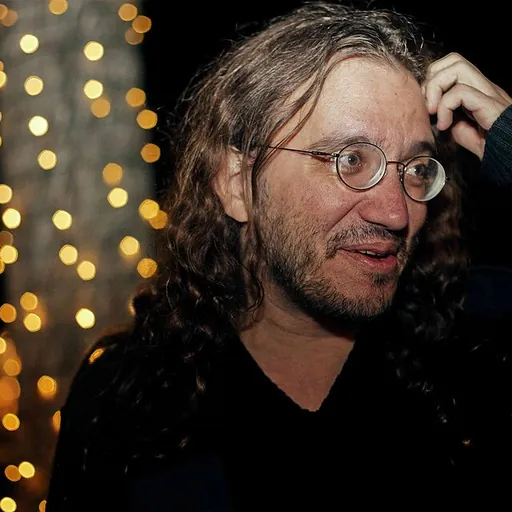
Ben Goertzel
Author and researcher in the field of Artificial Intelligence
About Ben Goertzel
Born 1966. Ben Goertzel is an American and Brazilian artificial intelligence researcher, computer scientist, mathematician and bioinformatician.
Ben Goertzel is a computer scientist, artificial intelligence (AI) researcher, and businessman. He helped popularize the term artificial general intelligence (AGI).
Early life and education Three of Goertzel's Jewish great-grandparents immigrated to New York from Lithuania and Poland (in the Russian Empire). Goertzel's father is Ted Goertzel, a former professor of sociology at Rutgers University. Goertzel left high school after the tenth grade to attend Bard College at Simon's Rock, where he graduated with a bachelor's degree in Quantitative Studies. Goertzel graduated with a PhD in mathematics from Temple University under the supervision of Avi Lin in 1990, at age 23.
Career 7 November 2017; Sophia the Robot, Chief Humanoid, Hanson Robotics & SingularityNET, and Ben Goertzel, Chief Scientist, Hanson Robotics & SingularityNET, at a press conference during the opening day of Web Summit 2017 at Altice Arena in Lisbon. Goertzel is the founder and CEO of SingularityNET, a project which was founded to distribute artificial intelligence data via blockchains. He is a leading developer of the OpenCog framework for artificial general intelligence.
Goertzel was an associate and grant recipient of Jeffrey Epstein. He received a $100,000 grant from the Jeffrey Epstein Foundation for artificial general intelligence research in 2001. When interviewed by The New York Times about Epstein in 2019, Goertzel said, "I have no desire to talk about Epstein right now... The stuff I'm reading about him in the papers is pretty disturbing and goes way beyond what I thought his misdoings and kinks were. Yecch."
Sophia the Robot
Goertzel was the Chief Scientist of Hanson Robotics, the company that created the Sophia robot. As of 2018, Sophia's architecture includes scripting software, a chat system, and OpenCog, an AI system designed for general reasoning. Experts in the field have treated the project mostly as a PR stunt, stating that Hanson's claims that Sophia was "basically alive" are "grossly misleading" because the project does not involve AI technology, while computer scientist Yann LeCun, then Meta's chief AI scientist, made several unflattering remarks including calling the project "complete bullshit".
Views on AI
In May 2007, Goertzel spoke at a Google tech talk about his approach to creating artificial general intelligence. He defines intelligence as the ability to detect patterns in the world and in the agent itself, measurable in terms of emergent behavior of "achieving complex goals in complex environments". A "baby-like" artificial intelligence is initialized, then trained as an agent in a simulated or virtual world such as Second Life to produce a more powerful intelligence. Knowledge is represented in a network whose nodes and links carry probabilistic truth values as well as "attention values", with the attention values resembling the weights in a neural network. Several algorithms operate on this network, the central one being a combination of a probabilistic inference engine and a custom version of evolutionary programming.
The 2012 documentary The Singularity by independent filmmaker Doug Wolens discussed Goertzel's views on AGI.
In 2023, Goertzel postulated that within "the next few years" artificial intelligence could "probably obsolete [and replace] maybe 80 percent of jobs that people do, without having an AGI, by my guess. Not with ChatGPT exactly as a product. But with systems of that nature". At the Web Summit 2023 in Rio de Janeiro, Goertzel spoke out against efforts to curb AI research and that AGI is only a few years away. Goertzel's belief is that AGI will be a net positive for humanity by assisting with societal problems such as, but not limited to, climate change.
In June 2026, Goertzel said that he believed human-level artificial general intelligence could be achieved sometime between 2027 and 2030. He continued to advocate open-source and decentralised development of AGI, arguing that advanced AI should not be controlled by a small number of companies or governments.
Don’t just read it —
keep it.
Full-length biographies made to live with: read them, listen on the way to work, watch them tonight.
- E-book
- Audio
- Video
Instant download · yours to keep · every purchase keeps this site free
Important facts
People in Ben Goertzel's life
Named in this biography and alive at the same time


Related people
Same field, nearest in time

Contemporaries
People whose lives overlapped Ben Goertzel's



Frequently asked questions
Who is Ben Goertzel?
author and researcher in the field of Artificial Intelligence
When was Ben Goertzel born?
Ben Goertzel was born on 8 December 1966 in Rio de Janeiro.
What is Ben Goertzel's occupation?
Ben Goertzel is an artificial intelligence researcher, computer scientist, mathematician and bioinformatician.
What nationality is Ben Goertzel?
Ben Goertzel is American and Brazilian.
Sources & further reading
Cite this page
APA: Biography.guide. (2026). Ben Goertzel. https://biography.guide/ben-goertzel/
MLA: "Ben Goertzel." Biography.guide, https://biography.guide/ben-goertzel/.
Chicago: "Ben Goertzel." Biography.guide. https://biography.guide/ben-goertzel/.
Data last updated: 2026-09-22 · Spot an error? Report a correction.
Portrait: Wikimedia Commons · author & licence
Page generated 2026-09-27 04:59 UTC