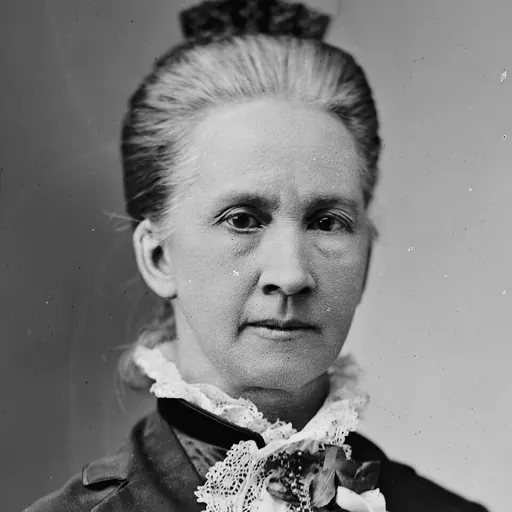
About Belva Ann Lockwood
Lived 1830 – 1917 (aged 86). Belva Ann Lockwood was an American politician, teacher, lawyer, peace activist, suffragist and pedagogue.
Belva Ann Bennett Lockwood (October 24, 1830 – May 19, 1917) was an American lawyer, politician, educator, and author who was active in the women's rights and women's suffrage movements. She was one of the first women lawyers in the United States. In 1879, she became the first woman to be admitted to practice law before the U.S. Supreme Court. Lockwood ran for president in 1884 and 1888 on the ticket of the Equal Rights Party and was the first woman to appear on official ballots. She supported the movement for world peace and was a proponent of the temperance movement.
Early and personal life
Belva Ann Bennett was born in Royalton, New York, daughter of Lewis Johnson Bennett, a farmer, and his wife, Hannah Green. Bennett spent some of her childhood at her aunt's house, which still stands at 5070 Griswold Street. In front of the house is a memorial to her with a plaque that gives a brief biography of her life. By age 14, she was teaching at the local elementary school. In 1848, by age 18, she married Uriah McNall, a farmer local to the area.
McNall died of tuberculosis in 1853, three years after their daughter Lura was born.
Education Lockwood realized she needed a better education to support herself and her daughter. In 1854, she enrolled at Genesee Wesleyan Seminary, in Lima, NY, to prepare for college. Her plan, as she explained to Lippincott's Monthly Magazine, was not well received by many of her friends and colleagues, since most women did not seek higher education, and it was especially unusual for a widow to do so. After one semester at the seminary, she persuaded the administration at Genesee College, also in Lima, to admit her.
It was during her studies at Genesee College that Lockwood first became attracted to the law, although the school had no law department. Since a local law professor was offering private classes, she became one of his students. It made her want to learn more. Belva Lockwood graduated with honors from Genesee College in June 1857. Lockwood's educational philosophy was gradually changing, particularly after she met women's rights activist Susan B. Anthony. Lockwood agreed with many of Anthony's ideas about society's restrictions on women. Anthony was concerned about the limited education girls received. Courses at most girls' schools chiefly prepared female students for domestic life and possibly for temporary work as teachers. Not only did Rev. Lockwood have progressive ideas about women's roles in society, but he also helped raise Belva's daughter from her first marriage, Lura McNall. Ezekiel Lockwood died in late April 1877. In July 1879, Lockwood's daughter Lura McNall married DeForest Orme, a pharmacist.
Legal education According to Lockwood's later account to the Chicago Tribune, about 1870, she applied to the Columbian Law School in the District of Columbia. The trustees refused to admit her, fearing she would distract the male students. She and several other women were finally admitted to the new National University School of Law (now the George Washington University Law School). Although she completed her coursework in May 1873, the law school refused to grant her a diploma because of her gender.
Without a diploma, Lockwood could not gain admittance to the District of Columbia Bar. After a year, she wrote a letter to the President of the United States, Ulysses S. Grant, appealing to him as president ex officio of the National University Law School. She asked him for justice, stating she had passed all her courses and deserved to be awarded a diploma. In September 1873, within a week of having sent the letter, Lockwood received her Bachelor of Laws. She was 43 years old.
Law practice
The District of Columbia Bar admitted her, although several judges told Lockwood they had no confidence in her, a reaction she repeatedly had to overcome. She also applied to the Court of Claims to represent veterans and their families, but was denied. She applied to the United States Supreme Court bar after having practiced for the minimum three years and secured Albert G. Riddle as a sponsor, but her motion was also denied on gender grounds.
Lockwood thus struggled against both social practice and the limited legal standing accorded women. Under English Common Law, Lockwood was considered a "feme covert" (English version of medieval Anglo-Norman legal term), that is, a married woman. Her status under the law differed from that of an unmarried woman, as a wife was considered strictly subordinate to her husband. Even in 1873, many states refused to allow a married woman to individually own or inherit property, nor did she have the right to make contracts or keep money earned unless her husband gave his permission.
Nonetheless, Lockwood began to build a practice and won some cases. Even her detractors acknowledged her competence. She became known as an advocate for women's issues; she spoke on behalf of an 1872 bill for equal pay for federal government employees. Lockwood also remained active in several women's suffrage organizations and testified before Congress in support of legislation to give married women and widows more legal protection. Lockwood was then sworn in as the first woman member of the U.S. Supreme Court bar on March 3, 1879.
Late in 1880, Lockwood became the first female lawyer to argue a case before the U.S. Supreme Court, arguing Kaiser v. Stickney. In 1906, Lockwood represented the Cherokee Nation in United States v. Cherokee Nation. She was successful in ensuring the payment of the five million dollar suit, one of the largest made to that date to a Native American tribe for land ceded to the government. She also represented hundreds of family members of Civil War veterans in their pension claims. Notable American Women stated she received about 4,100 votes. Since women could not vote, and most newspapers were opposed to her candidacy, it was unusual that she received any votes. In an 1884 article, the Atlanta Constitution referred to her as "old lady Lockwood" and warned male readers of the dangers of "petticoat rule".
On January 12, 1885, Lockwood petitioned the United States Congress to have her votes counted. She told newspapers and magazines that she had evidence of voter fraud. She asserted that supporters had seen their ballots ripped up and that she had "received one-half the electoral vote of Oregon, and a large vote in Pennsylvania, but the votes in the latter state were not counted, simply dumped into the waste basket as false votes".
Later years Lockwood was a well-respected writer, who frequently wrote essays about women's suffrage and the need for legal equality for women. Among the publications in which she appeared in the 1880s and 1890s were Cosmopolitan (then a journal of current issues), the American Magazine of Civics, Harper's Weekly, and Lippincott's. In addition to being active in the National American Woman Suffrage Association and the Equal Rights Party, Lockwood served as president of the Woman's National Press Association. The organization for women journalists also advocated for equal rights for women. Her other feminist activities included being appointed Attorney General of the American Woman's Republic, an organization founded by Marietta Stowe and dedicated to preparing women for the rights and responsibilities of full citizenship. She continued to speak on behalf of peace and disarmament to the year of her death. She was likely disappointed as the United States prepared to enter the war in Europe.
Legacy
Syracuse University awarded Lockwood an honorary Doctor of Laws in 1908.
During World War II, a merchant marine ship, the Liberty Ship USS Belva Lockwood, was named after her.
The National Portrait Gallery in Washington, D.C., has a portrait of Lockwood by Nellie Mathes Horne. It was painted in 1908, when she received an honorary doctorate in law from Syracuse University.
In 1983, Lockwood was inducted into the National Women's Hall of Fame in Seneca Falls, New York. The statement about her noted:
Using her knowledge of the law, she worked to secure woman suffrage, property law reforms, equal pay for equal work, and world peace. Thriving on publicity and partisanship and encouraging other women to pursue legal careers, Lockwood helped to open the legal profession to women.
In 1986, she was honored by the United States Postal Service with a 17¢ Great Americans series postage stamp.
In 2016, she was honored by the Green Bag with a bobblehead doll.
Don’t just read it —
keep it.
Full-length biographies made to live with: read them, listen on the way to work, watch them tonight.
- E-book
- Audio
- Video
Instant download · yours to keep · every purchase keeps this site free
Important facts
more
Belva A. BennettFamily & relationships
People in Belva Ann Lockwood's life
Named in this biography and alive at the same time

Related people
Same field, nearest in time



Contemporaries
People whose lives overlapped Belva Ann Lockwood's




Frequently asked questions
Who was Belva Ann Lockwood?
Suffragist (1830–1917)
When was Belva Ann Lockwood born?
Belva Ann Lockwood was born on 24 October 1830 in Royalton.
When did Belva Ann Lockwood die?
Belva Ann Lockwood died on 19 May 1917 in Washington, D.C..
What was Belva Ann Lockwood's occupation?
Belva Ann Lockwood was a politician, teacher, lawyer, peace activist, suffragist and pedagogue.
What nationality was Belva Ann Lockwood?
Belva Ann Lockwood was American.
Sources & further reading
· Wikipedia: Belva Ann Lockwood
Cite this page
APA: Biography.guide. (2026). Belva Ann Lockwood. https://biography.guide/belva-ann-lockwood/
MLA: "Belva Ann Lockwood." Biography.guide, https://biography.guide/belva-ann-lockwood/.
Chicago: "Belva Ann Lockwood." Biography.guide. https://biography.guide/belva-ann-lockwood/.
Data last updated: 2026-09-21 · Spot an error? Report a correction.
Portrait: Wikimedia Commons · author & licence
Page generated 2026-09-27 04:59 UTC