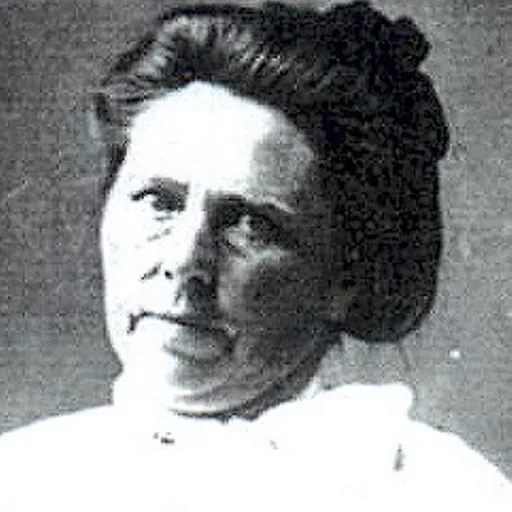
About Belle Gunness
Lived 1859 – 1908 (aged 48). Belle Gunness was a Norwegian and American criminal, farmer, murderer and serial killer.
Belle Gunness (born Brynhild Paulsdatter Størseth; November 11, 1859 – possibly April 28, 1908), nicknamed Hell's Belle, Gunness is thought to have killed at least fourteen people (most of whom were men she enticed to visit her rural Indiana property through personal advertisements), while some sources speculate her involvement in as many as forty murders, making her one of the most prolific female serial killers in history. Gunness seemingly died in a fire in 1908, although her actual fate is unconfirmed.
Early life Belle Gunness was born Brynhild Paulsdatter Størseth in Selbu Municipality in Søndre Trondhjem county, Norway, on November 11, 1859, She moved to the United States in 1881.
Deaths associated with Gunness Mads Sørensen and children Gunness married Mads Ditlev Anton Sørensen in 1884. The couple owned a candy store which later burned to the ground. Their home had also burned down, and both instances granted the couple insurance payouts. both policies were active at the same time, as one would expire that day and the other would enter into force. Sørensen died of cerebral hemorrhage that day. Gunness explained he had come home with a headache and she provided him with quinine powder for the pain; she later checked on him and he was dead. Gunness collected money from both the expiring life insurance policy, and the one that went into effect that day, making a total of $5,000. Further investigation unearthed the partial remains of at least eleven additional people on the Gunness property. Among the first victims identified was Jennie Olson, whose body was identified so positively that the coroner issued a death certificate; Gunness had told neighbors that Olson had gone to Los Angeles.
After the fire at the Gunness homestead led to the discovery of bodies believed to be Gunness and her children, La Porte police authorities were contacted by Asle Helgelien, who had found correspondence between his brother, Andrew Helgelien, and Gunness; the letters included petitions for him to relocate to La Porte, to bring money, and to keep the move a secret. A visit by Asle Helgelien to the Gunness farm with a former hired hand led to attention being paid to "soft depressions" in what had been made into a pen for hogs; after briefly digging one of the depressions in the lot, a gunny sack was found that contained "two hands, two feet, and one head", which Helgelien recognized to be those of his brother. The brother of one victim had warned Gunness that he might arrive at the farm shortly to investigate his brother's disappearance. The second confession was made to Reverend Edwin Schell, who was minister of the Methodist church of LaPorte, Indiana, who was personally requested by Lamphere to visit him at the Indiana State Prison in Michigan City, Indiana, where he was being held. Realizing the importance of this confession, Reverend Schell recorded Lamphere's verbal confession on paper, had him sign it, and then sealed it and locked it in his personal safe. However, a separate newspaper published a story with speculation regarding the second Lamphere confession. Schell offered the confession to Bechly, which was later published. The publication of Lamphere's confession resulted in the subsequent arrest of his accomplice Elisabeth Smith.
Three rings found on a charred hand of the body initially suggested near-conclusive identification: two were gold bands, one set with a diamond that had been given to Gunness by her first husband Mads Sorenson on their wedding day. Investigators noted, however, that the rings were not fully conclusive evidence; given Gunness's reputation for cunning, it was suggested she could have placed the rings on a planted corpse specifically to create the impression of her own death. Gunness was pronounced dead, even though Dr. Harry Long of La Porte, who had known Gunness personally, stated unequivocally on May 9 that the body was not hers: it weighed approximately 160 pounds against Gunness's 325 or more, was nearly five inches shorter, had well-formed and rounded arms unlike Gunness's, and, most tellingly, had carefully manicured fingernails, something Gunness was not known to do. "It is not that of Mrs. Gunness," he said. "I am sure of that." Gunness's dentist, identified as Innorton, positively identified a gold crown found in the ruins as one he had placed in her mouth, which some investigators took as conclusive proof of her death. After Gunness' crimes came to light, the Gunness farm became a tourist attraction. Spectators came from across the country to see the mass graves, and concessions and souvenirs were sold. Stewart H Holbrook wrote a short account of Gunness' murders in 'Belle of Indiana', in his book From Murder Out Yonder, in 1941, which was also published in All Mystery Magazine in 1950. Method, a 2004 film, stars Elizabeth Hurley as Rebecca who portrays Gunness in a film within the film, shot in Romania. In 2017, true crime podcast My Favorite Murder released a live episode detailing Gunness' crimes. The Farm, a 2021 film starring Traci Lords, is based on Gunness.
Hell's Princess: The Mystery of Belle Gunness, Butcher of Men is a 2018 non-fiction book by Harold Schechter on the life of Gunness. In the Garden of Spite: A Novel of the Black Widow of LaPorte is a 2021 novel by Camilla Bruce based on Gunness. It was published in the UK with the title Triflers Need Not Apply. My Men, a 2023 Norwegian novel by Victoria Kielland, is a fictionalized account of Gunness's life. In 2024, the novel Bajo tierra seca by César Pérez Gellida, which was awarded the Spanish Premio Nadal, was inspired by Gunness.
Don’t just read it —
keep it.
Full-length biographies made to live with: read them, listen on the way to work, watch them tonight.
- E-book
- Audio
- Video
Instant download · yours to keep · every purchase keeps this site free
Important facts
People in Belle Gunness's life
Named in this biography and alive at the same time



Related people
Same field, nearest in time

Contemporaries
People whose lives overlapped Belle Gunness's
Frequently asked questions
Who was Belle Gunness?
Norwegian-American serial killer
When was Belle Gunness born?
Belle Gunness was born on 11 November 1859 in Innbygda.
When did Belle Gunness die?
Belle Gunness died on 28 April 1908 in La Porte.
What was Belle Gunness's occupation?
Belle Gunness was a criminal, farmer, murderer and serial killer.
What nationality was Belle Gunness?
Belle Gunness was Norwegian and American.
Sources & further reading
Cite this page
APA: Biography.guide. (2026). Belle Gunness. https://biography.guide/belle-gunness/
MLA: "Belle Gunness." Biography.guide, https://biography.guide/belle-gunness/.
Chicago: "Belle Gunness." Biography.guide. https://biography.guide/belle-gunness/.
Data last updated: 2026-09-22 · Spot an error? Report a correction.
Portrait: Wikimedia Commons · author & licence
Page generated 2026-09-27 05:04 UTC