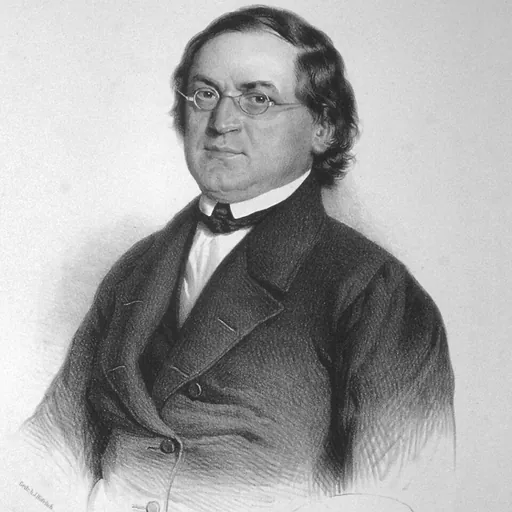
About Beda Weber
Lived 1798 – 1858 (aged 59). Beda Weber was an Austrian poet, politician, writer, catholic priest and catholic theologian.
Johann Chrysanth "Beda" Weber (26 October 1798 – 28 February 1859) was a German Benedictine professor, author, and member of the Frankfurt Parliament.
Biography Weber was born at Lienz in the county of Tyrol. He completed coursework at Bozen in four years, and studied philosophy at Innsbruck for two years. His father wished him to learn a trade as well as the ordinary work of a peasant, and thus Weber became a shoemaker. He then entered the Benedictine Abbey of Marienberg in Vinschgau, near Mals, taking the name of Beda. In the autumn of 1821, he began to study theology at the University of Innsbruck, and on the abolition of the theological faculty there, he continued his course at Brixen.
Weber was ordained in 1824, and went for a short time to the episcopal seminary at Trento to prepare himself for pastoral work; in 1825 he returned to his monastery. After a short time spent in the pastorate, he began to teach at the high school at Meran, where he remained for twenty years. He received calls to professorships from the University of Innsbruck, from the Benedictine Lyceum at Augsburg, and from the crown-prince of Hohenzollern-Sigmaringen, but remained at Meran until he was called away by the political events of 1848. His parliamentary labours attracted attention.
When the town priest of Frankfurt died, Weber succeeded him. His bishop made him canon of the diocese of Limburg, episcopal commissary, spiritual councillor, and member of the diocesan court at Frankfurt and of the school commission, as well as inspector of the cathedral school.
Weber died of apoplexy on 28 February 1859 at Frankfurt am Main. A fresco was painted in his honor in the Imperial Cathedral, the restoration of which he initiated.
Literary works Weber's chief works are:
several poems for a poetical annual, the "" a translation of Chrysostom's "On the Priesthood" (1833) studies upon Oswald von Wolkenstein, which led also to the discovery of a manuscript containing "" and the "" "" (1837–38) "" (1845) "" (1849) "" (1851), containing an account of Andreas Hofer and the Tyrolean Rebellion "" (1838) "" (1841) "" (1842), a selection of his poems "" "" "" (1847) "" (1850). ""
Weber founded a weekly paper, "" (1853), which two years later became the Sunday supplement of a large Catholic paper, the "". He issued a selection of his contributions to this paper under the title of "" (1858); five years earlier he had collected his contributions to the "" and to the "" in book form under the title "".
Don’t just read it —
keep it.
Full-length biographies made to live with: read them, listen on the way to work, watch them tonight.
- E-book
- Audio
- Video
Instant download · yours to keep · every purchase keeps this site free
Important facts
People in Beda Weber's life
Named in this biography and alive at the same time
Related people
Same field, nearest in time

Contemporaries
People whose lives overlapped Beda Weber's





Frequently asked questions
Who was Beda Weber?
Austrian writer (1798-1858)
When was Beda Weber born?
Beda Weber was born on 26 October 1798 in Lienz.
When did Beda Weber die?
Beda Weber died on 28 February 1858 in Frankfurt.
What was Beda Weber's occupation?
Beda Weber was a poet, politician, writer, catholic priest and catholic theologian.
What nationality was Beda Weber?
Beda Weber was Austrian.
Sources & further reading
Cite this page
APA: Biography.guide. (2026). Beda Weber. https://biography.guide/beda-weber/
MLA: "Beda Weber." Biography.guide, https://biography.guide/beda-weber/.
Chicago: "Beda Weber." Biography.guide. https://biography.guide/beda-weber/.
Data last updated: 2026-09-23 · Spot an error? Report a correction.
Portrait: Wikimedia Commons · author & licence
Page generated 2026-09-27 05:06 UTC