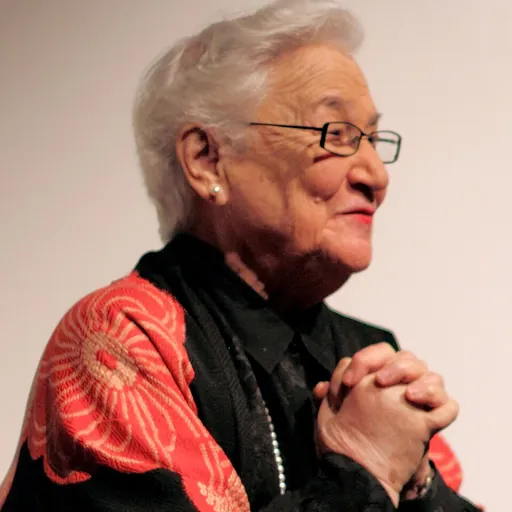
Beate Sirota Gordon
Austrian-born performing arts producer and women's rights activist
About Beate Sirota Gordon
Lived 1923 – 2012 (aged 89). Beate Sirota Gordon was an American human rights defender, artist, cultural manager and feminist.
Beate Sirota Gordon (; October 25, 1923 – December 30, 2012) was an Austrian and American performing arts presenter and women's rights advocate. Born in Vienna, Austria, she moved to the Empire of Japan in 1929 with her father, the pianist Leo Sirota. After graduating from the American School in Japan, she moved to Oakland, California, where she enrolled at Mills College. Being one of the few people not of Japanese descent who was fluent in Japanese, she obtained work at the Office of War Information in the Foreign Broadcast Information Service of the Federal Communications Commission.
Sirota Gordon returned to Japan after the end of the war, assigned as translator to Douglas MacArthur, Supreme Commander for the Allied Powers. She later was recruited to be one of the writers of Japan's postwar constitution, where she played an integral role in its mandating of equality between the sexes.
Following Sirota Gordon's return to the United States in 1948, she married and eventually became the performing arts director of the Japan Society and the Asia Society. In this role, she fomented interest in Japanese art and artists in the United States. She retired in 1991.
Early life, family and education Born in Vienna on October 25, 1923, Beate Sirota was the only child of the pianist Leo and Augustine Sirota (née Horenstein), Russians of Jewish descent. Leo had emigrated from Russia because of the country's anti-Semitic violence and settled in Austria-Hungary. Beate's maternal uncle was the conductor Jascha Horenstein.
Sirota's family emigrated to Japan in 1929, when Leo Sirota accepted an invitation to become a professor at the Imperial Academy of Music (which became Tokyo University of the Arts). Her childhood education was in Tokyo: first at the German School of Tokyo for six years until age twelve, and then at the American School in Japan because her parents determined the German School was "too Nazi". During the war, she worked for the Office of War Information in the Foreign Broadcast Information Service of the Federal Communications Commission. She also worked for Time magazine.
Sirota, as interpreter on MacArthur's staff, was the only woman present during the negotiations between the Japanese Steering Committee and the American team.
In 1947, Sirota was a target of Major General Charles A. Willoughby's year-long investigation of leftist infiltration, in which he tried to construct a case against Sirota, charging her with advancing the communist cause within the new government of Japan.
Performing arts After returning to the US with her parents
Jeff Gottesfeld published a 2020 book for children, celebrating Gordon's activism and documenting the historical struggle for equal rights.
Death Gordon died of pancreatic cancer at her home in Manhattan, New York City on December 30, 2012, at the age of 89. Her last public statement was to urge that the peace and women's rights clauses of the Japanese Constitution be preserved. Her husband, Joseph Gordon, had died four months earlier, on August 29, 2012, at the age of 93.
Selected works In a statistical overview derived from writings by and about Gordon, OCLC/WorldCat encompasses roughly 150+ works in 150+ publications in 4 languages and 1,000+ library holdings.
Introduction to Asian Dance (1964) An Introduction to the Dance of India, China, Korea [and] Japan (1965) 1945年のクリスマス: 日本国憲法に「男女平等」を書いた女性の自伝 (1995) The Only Woman in the Room: A Memoir (1997)
Oral histories The Reminiscences of Faubion Bowers by Faubion Bowers (1960), with Beate Gordon The reminiscences of Cyrus H. Peake by Cyrus Peake (1961), with Beate Gordon The Reminiscences of Esther Crane by Esther Crane (1961), with Beate Gordon Occupation of Japan Project by Eugene Dooman (1970), with Beate Gordon The Japanese Reminiscences of Roger Baldwin by Roger Nash Baldwin (1974), with Beate Gordon The Reminiscences of Burton Crane by Burton Crane (1974), with Beate Gordon The Reminiscences of Douglas W. Overton by Douglas Overton (1974), with Beate Gordon The Reminiscences of Joseph Gordon by Joseph Gordon (1974), with Beate Gordon The Reminiscences of Harold G. Henderson by Harold Gould Henderson (1976), with Beate Gordon The Reminiscences of Dr. Lauren V. Ackerman by Lauren Ackerman (1976), with Beate Gordon The Reminiscences of John R. Harold by John R. Harold (1976), with Beate Gordon
Don’t just read it —
keep it.
Full-length biographies made to live with: read them, listen on the way to work, watch them tonight.
- E-book
- Audio
- Video
Instant download · yours to keep · every purchase keeps this site free
Important facts
Family & relationships
People in Beate Sirota Gordon's life
Named in this biography and alive at the same time







Related people
Same field, nearest in time

Contemporaries
People whose lives overlapped Beate Sirota Gordon's

Frequently asked questions
Who was Beate Sirota Gordon?
Austrian-born performing arts producer and women's rights activist
When was Beate Sirota Gordon born?
Beate Sirota Gordon was born on 25 October 1923 in Vienna.
When did Beate Sirota Gordon die?
Beate Sirota Gordon died on 30 December 2012 in New York City.
What was Beate Sirota Gordon's occupation?
Beate Sirota Gordon was a human rights defender, artist, cultural manager and feminist.
What nationality was Beate Sirota Gordon?
Beate Sirota Gordon was American.
Sources & further reading
· Wikipedia: Beate Sirota Gordon
· DBpedia: Beate Sirota Gordon
Cite this page
APA: Biography.guide. (2026). Beate Sirota Gordon. https://biography.guide/beate-sirota-gordon/
MLA: "Beate Sirota Gordon." Biography.guide, https://biography.guide/beate-sirota-gordon/.
Chicago: "Beate Sirota Gordon." Biography.guide. https://biography.guide/beate-sirota-gordon/.
Data last updated: 2026-09-22 · Spot an error? Report a correction.
Portrait: Wikimedia Commons · author & licence
Page generated 2026-09-27 05:02 UTC