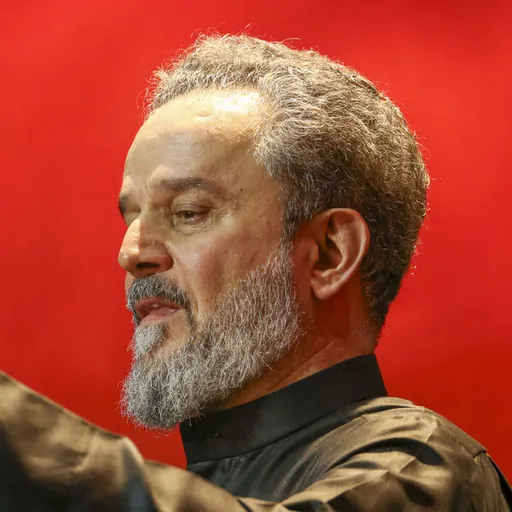
About Basim al-Karbalaei
Born 1966. Basim al-Karbalaei is an Iraqi composer, singer and maddah.
Haj Basim Ismail Muhammad-Ali al-Karbalaei (; born 11 November 1966), commonly known as Basim Karbalaei is an Iraqi Shi'ite eulogy reciter.
Al-Karbalaei's voice and performance is considered particularly distinctive, the former is considered one of the most compelling instruments in the history of lamentations for the Ahl al-Bayt. His vocal abilities have allowed him to be identified as one of the greatest voices in the Arab world, widely heard by audiences all across the globe.
His choice of poetry, melodies, performances, were able to attract millions of listeners, allowing them to abandon the types of music that are religiously forbidden. Al-Karbalaei managed to fill a void for them, by continuously introducing new methods and styles in his recitations. He has also produced works in languages other than Arabic, like Persian, Urdu and English. Al-Karbalaei, for the most of it, has been apolitical with his elegies, trying to keep his elegies exclusively about the Ahl al-Bayt and their memory.
In 2019, al-Karbalaei was gifted with a crown made of pure gold, and dubbed Sultan al-Minbar al-Hussaini (sultan of the Husayni pulpit), by the Hussaini Reciters Association in Kadhimiya. He later donated the crown to the Abbas shrine museum.
Early life Al-Karbalaei was born in Karbala, to Ismail al-Karbalaei, and Siddiqa al-Tukmachi. He is the fourth of seven children. Whilst in Karbala, he was inspired by senior eulogy reciter Hamza al-Zighayir, and participated in his majalis (plu. mourning gatherings), until he died in 1976.
In 1980, al-Karbalaei and his family emigrated to Iran, fleeing Bathist persecution. He lived in Isfahan, near his mother's family, and it was his uncle Rasool al-Tukmachi, who discovered al-Karbalaei's talent and began to encourage him to recite praises and lamentations in memory of the Ahl al-Bayt. He was then taken under the wing of a Mulla Taqi, who began taking him to the Husayniya; established by the people of Karbala who resided in Isfahan, to participate in. The first ever eulogy he recited was Taj al-Sa'ada Lel Yiwali Haidar , by renowned late poet, Kadhim Manthoor.
Al-Karbalaei, then began to recite in different cities across Iran, at Husayniyya established by the Iraqi community. In Isfahan, he learns the Quran and its sounds well for five years. Then he goes to a person named Mullah Taghi Karbalaei to ask him for help. Bassem learns some poems from Mullah Taghi Karbalaei. His name quickly spread between the congregations, and began to attract the youth to his majalis, and through listening to him, they would cultivate pious sensibilities.
Al-Karbalaei began reciting eulogies mainly written by Muhammad-Ridha Fatthallah. However, after the death of Fatthallah, he was introduced to Jaber al-Kadhimi. al-Karbalaei and al-Kadhimi got on very well, and whilst the former was considered to be a talented reciter, the latter was considered one of the best poets of that time. It was here that a long relationship began, where they would produce modern melodies and lyrics, straying away from the traditional tunes and poetry that were recited before them.
The first ten nights of Muharram (that are spent retelling the story of the murder of Hussain, his family and his companions on Ashura) are considered second only to Ramadan in its significance, and its considered the largest in congregation compared to other mourning seasons, and every Shia eulogy reciter dreams of hosting these ten nights, and al-Karbalaei's first ten night function was in 1988, in Qom. That year witnessed the beginning of al-Karbalaei's recognition as a capable reciter.
In 2020 due to the COVID-19 pandemic, he was infected with the virus and he could not read for the first ten nights of Muharram because of the pandemic, but in Muharram 2021, he started reading again after he recovered and the COVID-19 crisis receded.
Career In 1994, al-Karbalaei was invited to recite for the first ten nights of Muharram in Kuwait. His majalis were recorded onto tape cassettes and distributed across the Islamic world. This allowed exposure on a much larger scale, and gained him international recognition. He also began to receive invitations in other countries, as close as Lebanon and as far as Australia. He took residence in Kuwait, moving with his family.
Following the advice of his mentor, Muhammad Ridha al-Shirazi, he formed a group of aspiring reciters, called Shabab al-Thaqalayn, which was an ensemble of eighty youth, similar to a choir. This group often participated in auspicious functions celebrating the births of the Ahl al-Bayt. The group produced a notable amount of senior reciters.
Upon many invitations, al-Karbalaei's visited Bahrain for the first time in 2002, for the first ten nights of Muharram. This was also the first time al-Karbalaei he was going to leave Kuwait in Muharram, after performing there for eight consecutive years. This proved a new challenge for al-Karbalaei, since the people of Bahrain had a slightly different approach when it came to the culture of latom (chest beating). He managed to quickly cope and accommodate to their metre, earning the recognition as a true innovator in the eulogy reciter's world.
After the invasion of Iraq in 2003, al-Karbalaei visited Iraq, after being separated from his homeland for just over twenty-three years. He was welcomed greatly by his fellow countrymen. Majalis were hosted for him, in each of the holy sites, with crowds reaching up to hundreds of thousands. However, al-Karbalaei did not remain in Iraq for too long and returned to Kuwait, whilst still focusing on his performances across the globe. He spent the next couple of years of between Manama and London for Muharram, and other Arab and Western countries for the other seasons. Eventually in 2007, he left Kuwait altogether, to settle in his wife's hometown, in Oman.
Media al-Karbalaei is the first Shia eulogy reciter to produce a qasida (elegy) in a studio. His first production was a feature in a project with Dawood Hussein, called al-mubahila. After that, he went to produce over sixty albums, consisting of seven to ten tracks each. Gradually, al-Karbalaei's media presence and following became huge, his YouTube channel began to show for this, with more than eight million subscribers and over two billion video views.
al-Karbalaei has appeared on numerous state television channels, such as Bahrain, Lebanon and Iraq, and his sound tracks are constantly aired. He frequently appears on satellite channels.
Works Al-Karbalaei has authored three volumes of his book Hatha Ma Qara't (This Is What I Have Recited), which is a compilation of the elegies he has recited across his career.
Personal life Al-Karbalaei is married to an Omani woman. He has four children, a son (Ali) and three daughters (Fatimeh, Rayhoneh and Roghayeh). His daughter Fatima, participated in his album Sawad al-Layl, in 2007, while his son Ali and daughter Roghayeh, began participating in albums with their father in 2013 until 2017.
Muharram Participations +Muharram Participation's Gregorian Year Lunar Year Organisation Location Highlight Eulogy (Video on YouTube) 1988 1409 Masjid al-Imam al-Husayn Qom, Iran Yikfi al-Hadhum Wil Nowh 1989 1410 al-Husayniya al-Zaynabiya Qom, Iran Lo Ridit Husn al-Aqiba 1990 1411 Husayniat al-Imam Ali Damascus, Syria Kilmen Yihasib Dhamira 1991 1412 al-Husayniya al-Zaynabiya Qom, Iran Goom Irwiha 1992 1413 al-Husayniya al-Zaynabiya Qom, Iran Ma Nidri Ya Walina 1993 1414 al-Husayniya al-Zaynabiya Qom, Iran Mahla al-Wida' al-Yawm 1994 1415 Husayniyat al-Rasool al-Adham - al-Karbalaeia / Husayniyat Sayid Muhammad Kuwait Dhal Yijri Dam' al-Eyn 1995 1416 Husayniyat al-Rasool al-Adham - al-Karbalaeia Kuwait Hayarni al-Wakit 1996 1417 Husayniyat al-Rasool al-Adham - al-Karbalaeia Kuwait Tikshifha Tikshifha 1997 1418 Husayniyat al-Rasool al-Adham - al-Karbalaeia Kuwait al-Akbar Nisim'a 1998 1419 Husayniyat al-Rasool al-Adham - al-Karbalaeia Kuwait Zilim Wikhyool 1999 1420 Husayniyat al-Rasool al-Adham - al-Karbalaeia Kuwait al-Alam Al Gaa' Ya Haidar 2000 1421 Husayniyat al-Rasool al-Adham - al-Karbalaeia Kuwait Gabul Metrooh Withajir 2001 1422 Husayniyat al-Rasool al-Adham - al-Karbalaeia Kuwait Ilak Galbi Infija'''] 2002 1423 Husayniyat al-Qasab Manama, Bahrain Rayhanat al-Mustafa 2003 1424 Husayniyat al-Qasab London, UK Ma A'lam Ibya Yawm 2006 1427 Al-Hussaini Association London, UK Hatha Inta Yabn al-Kerrar|- 2007 1428 Al-Hussaini Association London, UK Ya Galbi Ya Sabir 2008 1429 Husayniyat al-Qasab Manama, Bahrain Ilahi Rid Gharib al-Dar 2009 (Jan) 1430 Husayniyat al-Rasool al-Adham - al-Karbalaeia Kuwait Yahssain Awal Ma Habeyna 2009 (Dec) 1431 Husayniyat al-Rasool al-Adham - al-Karbalaeia London, UK Ashofak Kil Fajir 2010 1432 Husayniyat al-Rasool al-Adham - al-Karbalaeia Kuwait ِ Ana al-Qahir|- 2011 1433 Husayniyat Dawood al-Ashoor Basra, Iraq Dumti Karbala 2012 1434 Husayniyat Ashor Kuwait Ghadhab Rab al-Ibad|- 2013 1435 Husayniyat Dawood al-Ashoor Basra, Iraq La Tinsa al-Wasiya 2014 1436 Husayniyat Dawood al-Ashoor Basra, Iraq Kil Ma Ashoofak 2015 1437 Husayniyat Dawood al-Ashoor Basra, Iraq Gooman Banat al-Nabi 2016 1438 Husayniyat Dawood al-Ashoor Basra, Iraq Yuma Atamnich Alaya 2017 1439 Husayniyat Dawood al-Ashoor Basra, Iraq Yabu Fadhil 2018 1440 Al-Akbar Foundation London, UK Beyn al-Mehdi Wil Abbas 2019 1441 Al-Akbar Foundation/Dewan al-Kafeel London, UK Ballah Ya Nahar 2021 1443 Hey'at Jawad al-A'immah Al-Aziziyah, Iraq Solaf Waya Chaffa|- 2022 1444 Qa'at Baghdad al Kubra Baghdad, Iraq Tijaz Ya May|}
Discography Studio albums Wa Fatimatah (O Fatima) (1993) [Um al-Banin FoundationWa Tabqa Lana (It Remains For Us) (2000) [Um al-Banin Foundation]Ya Hussain (O' Husayn) (2002) [Karbala Records]Labayk Ya Husayn (Here We Are O' Husayn) (2003) [Karbala Records]al-Razaya (The Tragedies) (2003) [Karbala Records]al-Imam al-Hassan al-Masmoom (Imam Hassan the Poisoned) [Fadak Records]al-Zahra Fi Karbala (Zahra in Karbala) (2004) [Karbala Records]Al-Adl al-Samawi (Justice of the Skies) (2004) [Aniss al-Nofoss]Ya Fatima (O' Fatima) (2004) [Karbala Records]Bintu Muhammad (Muhammad's Daughter) (2004) [al-Thaqalayn Records]Wali Allah (Guardian of Allah) (2004) [al-Thaqalayn Records]Awdat al-Sabaya (Return of the Captives) (2004) [Karbala Records]Nowh Iw Dami (Wails and Tears) (2004) [al-Thaqalayn Records]Karbala (2005) [Karbala Records]Mata al-Multaqa (When Is The Meeting) (2005) [al-Thaqalayn Records]Uqsuduni (Come to Me) (2005) [Karbala Records]Baad Ma Ashufak (I Will Not See You Again) (2006) [Anwar al-Huda Records]Wahi al-Qawafi (Soul of the Words) (2006) [al-Thaqalayn Records]Qaws al-Sama' (Bow of the Sky) (2006) [Karbala Records]Ya Bab Fatima (O' Door of Fatima) (2006) [Karbala Records]Usali Alayka (I Pray Upon You) (2007) [al-Hayat Media]Kalim al-Husayn (He Who Speaks to Husayn) (2007) [Thulfqiar Centre]Sawad al-Layl (The Blackness of the Night) (2007) [al-Faqih Library]Wujudun Li Wujudi (Presence To My Presence) (2007) [ِAnwar al-Huda]Sarab (Oasis) (2007) [al-Thaqalayn Records]Lahn al-Dima (The Melody of Blood) (2008) [al-Hayat Media]Lil Bukaa Baqiya (There Is Still Time To Mourn) (January 2008) [al-Hayat Media]Kahf al-Wara (The Cave of the World) (January 2008) [al-Thaqalayn Records]Sawt al-Rayah (The Voice of the Banner) (February 2008) [al-Raya al-Imamiya]Bani Hashim (January 2009) [al-Thaqalayn Records]Ayat al-Sabr (The Verses of Patience) (January 2009) [Anwar al-Huda]al-Mahkamah (The Court) (February 2009) [al-Raya al-Imamiya]Shajar al-Arak (Tree of Arak) (December 2009) [al-Faqih Library]Inaha Taqool (She Says) (December 2009) [BK Media]Qul Ma Tasha (Say What You Like) (December 2010) [al-Thaqalayn Records]Ra'ayt al-Husayn (I Saw Husayn) (December 2010) [Anwar al-Huda]Uthama (Greats) (June 2010) [Thulfiqar Centre]Tezuruni (You Visit Me) (January 2011) [Karbala Records]Shams (Sun) (November 2011) [al-Ahrar Media]Laka Antami (I Belong To You) (November 2011) [ِAnwar al-Huda]Yisajelny (He Registers Me) (December 2011) [BK Media]Majaninak (Your Insanes) (November 2012) [BK Media]Kuntu Wala Zilt (I Was, And I Remain) (November 2012) [BK Media]Uthama 2 (Greats 2) (July 2013) [Thulfiqar Centre]Hathihi al-Hikaya (This Story) (November 2013) [BK Media]Tilka al-Sarkha (That Scream) (November 2013) [BK Media]Qaedona al-Husayn (Our Leader is Husayn) (October 2014) [BK Media]Salla al-Mawt (Death Prayer) (October 2014) [BK Media]Maat al-Maa (Water is Dead) (October 2015) [BK Media]Yawm al-Arbaeen (The Day of Arbaeen) (November 2015) [BK Media]Banat al-Nabi (Daughters of the Prophet) (September 2016) [BK Media]Basim (September 2017) [BK Media]1440 (September 2018) [BK Media]1443 (July 2021) [BK Media]1444 (July 2022) [BK Media]
Don’t just read it —
keep it.
Full-length biographies made to live with: read them, listen on the way to work, watch them tonight.
- E-book
- Audio
- Video
Instant download · yours to keep · every purchase keeps this site free
Important facts
People in Basim al-Karbalaei's life
Named in this biography and alive at the same time


Related people
Same field, nearest in time



Contemporaries
People whose lives overlapped Basim al-Karbalaei's


Frequently asked questions
Who is Basim al-Karbalaei?
Iraqi Shi'ite eulogy reciter
When was Basim al-Karbalaei born?
Basim al-Karbalaei was born on 11 November 1966 in Karbala.
What is Basim al-Karbalaei's occupation?
Basim al-Karbalaei is a composer, singer and maddah.
What nationality is Basim al-Karbalaei?
Basim al-Karbalaei is Iraqi.
Sources & further reading
· Wikipedia: Basim al-Karbalaei
Cite this page
APA: Biography.guide. (2026). Basim al-Karbalaei. https://biography.guide/basim-al-karbalaei/
MLA: "Basim al-Karbalaei." Biography.guide, https://biography.guide/basim-al-karbalaei/.
Chicago: "Basim al-Karbalaei." Biography.guide. https://biography.guide/basim-al-karbalaei/.
Data last updated: 2026-09-21 · Spot an error? Report a correction.
Portrait: Wikimedia Commons · author & licence
Page generated 2026-09-27 04:58 UTC