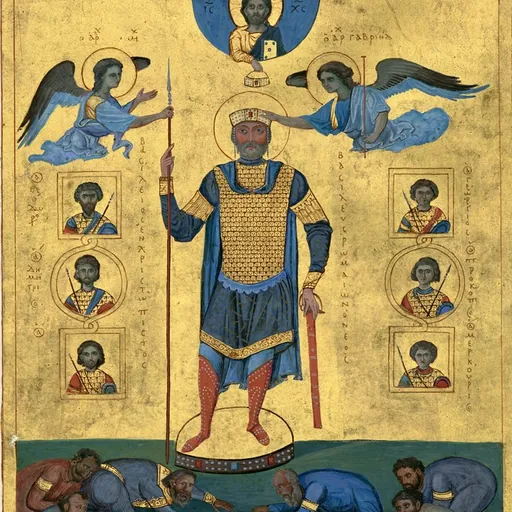
Basil II
Byzantine Emperor from the Macedonian dynasty
About Basil II
Lived 958 – 1025 (aged 66–67). Basil II was a Byzantine emperor.
Basil II Porphyrogenitus (; 958 – 15 December 1025), given the epithet the Bulgar Slayer, was the senior Byzantine emperor from 976 to 1025. He and his brother Constantine VIII were crowned before their father Romanos II died in 963, but they were too young to rule. The throne thus went to two generals, Nikephoros Phokas (963–969) and John Tzimiskes (r. 969–976) before Basil became senior emperor, though his influential great-uncle Basil Lekapenos remained as the de facto ruler until 985. His reign of 49 years and 11 months was the longest of any Roman emperor. (Basil II technically "ruled" as senior emperor for 5 months in 963, between the death of Romanos II (15 March) and the coronation of Nikephoros II .) This would give him a total reign of 50 years and 4 months, although these months in 963 are usually not counted as part of his actual reign. He was a porphyrogennetos ("born into the purple"), as were his father Romanos II and his grandfather Constantine VII; this was the appellation used for children who were born to a reigning emperor. Basil was the eldest son of Romanos and his Laconian Greek second wife Theophano, who was the daughter of a poor tavern-keeper named Krateros and may have originated from the city of Sparta. He may have had an elder sister named Helena (born 955). Romanos succeeded Constantine VII as sole emperor upon the latter's death in 959. Basil's father crowned him as co-emperor on 22 April 960, Only two days after the birth of his youngest child Anna, Romanos II died on 15 March 963 at 24 years of age. His unexpected death was commonly thought at the time to be the result of poisoning with hemlock; the chroniclers Leo the Deacon and John Skylitzes imply that Theophano was responsible,
Basil and Constantine were too young to rule in their own right when Romanos died in 963. Therefore, although the Byzantine Senate confirmed them as emperors with their mother as the nominal regent, de facto power passed for the time into the hands of the parakoimomenos Joseph Bringas. Nikephoros II and John I were brilliant military commanders but proved to be poor administrators. Towards the end of his reign, John had belatedly planned to curb the power of the great landowners; his death, which occurred soon after he spoke out against them, led to rumors that he had been poisoned by Lekapenos, who had illegally acquired vast estates and feared an investigation and punishment. At the start of his reign, the failures of his immediate predecessors left Basil II with a serious problem: Bardas Skleros and Bardas Phokas, members of the wealthy military elite of Anatolia, had sufficient means to undertake open rebellion against his authority.
Skleros and Phokas, both of whom were experienced generals, wanted to assume the Imperial position that Nikephoros II and John I had held, and thus return Basil to the role of impotent cypher. Basil, showing a penchant for ruthlessness, took to the field himself and suppressed the rebellions of both Skleros (979) and Phokas (989) with the help of 12,000 Georgians of Tornikios and David III Kuropalates of Tao. The fall of Lekapenos occurred between the rebellions in 985; he was accused of plotting with the rebels and was punished with exile and the confiscation of his property. Clash between the armies of Bardas Skleros and Bardas Phokas at Pankaleia, miniature from the Madrid Skylitzes. The relationship between the two generals was complicated; Phokas was instrumental in defeating the rebellion of Skleros but when Phokas later rebelled, Skleros returned from exile to support him. When Phokas died in battle, Skleros, whom Phokas had imprisoned, assumed the leadership of the rebellion. Basil's brother Constantine—who had no interest in politics, statecraft, or the military–led troops alongside Basil; this was the only military command Constantine would hold. The campaign ended without combat when Skleros was forced to surrender to Basil in 989. Skleros was allowed to live but he died blind, either through disease or from being blinded as punishment for his insurrection.
These rebellions had a profound effect on Basil's outlook and methods of governance. Psellos describes the defeated Skleros giving Basil the following advice, which he took to heart: "Cut down the governors who become over-proud. Let no generals on campaign have too many resources. Exhaust them with unjust exactions, to keep them busied with their own affairs. Admit no woman to the imperial councils. Be accessible to no-one. Share with few your most intimate plans."
To defeat these dangerous revolts, Basil formed an alliance with Prince Vladimir I of Kiev, who in 988 had captured Chersonesos, the Empire's main base in the Crimean Peninsula. Vladimir offered to evacuate Chersonesos and to supply 6,000 of his soldiers as reinforcements to Basil. In exchange, he demanded to be married to Basil's younger sister Anna. At first, Basil hesitated. The Byzantines viewed all of the peoples of Northern Europe—namely Franks and Slavs—as barbarians. Anna objected to marrying a barbarian ruler because such a marriage would have no precedent in Imperial annals.
Vladimir had researched various religions, having sent delegates to various countries. Marriage was not his main reason for choosing Christianity. When Vladimir promised to baptize himself and to convert his people to Christianity, Basil finally agreed. Vladimir and Anna were married in Crimea in 989. The Rus' warriors taken into Basil's army were instrumental in ending the rebellion; they were later organized into the Varangian Guard. This marriage had important long-term implications, marking the beginning of the process by which the Grand Duchy of Moscow many centuries later would proclaim itself "The Third Rome", and claim the political and cultural heritage of the Byzantine Empire.
Campaigns against the Fatimid Caliphate Once the internal strife was quelled, Basil turned his attention to the Empire's other enemies. The Byzantine civil wars had weakened the Empire's position in the east, and the gains of Nikephoros II and John I had nearly been lost to the Fatimid Caliphate. In 987–988, a seven-year truce with the Fatimids was signed; it stipulated an exchange of prisoners, the recognition of the Byzantine emperor as protector of Christians under Fatimid rule and of the Fatimid Caliph as protector of Muslims under Byzantine rule, and the replacement of the name of the Abbasid caliph with that of the Fatimid caliph in the Friday prayer in the mosque at Constantinople. This lasted until the long-time vizier Yaqub ibn Killis died in 991. Fatimid caliph Al-Aziz Billah chose to pursue a more aggressive stance in Syria and appointed Manjutakin as governor of Damascus.
Manjutakin's attacks, and Basil's first expedition to Syria Encouraged by the defectors after the death of emir Sa'd al-Dawla, Al-Aziz decided to renew his attacks on the Hamdanid Emirate of Aleppo, a Byzantine protectorate, perhaps expecting Basil would not interfere. Manjutakin invaded the emirate, defeated a Byzantine force under the doux of Antioch Michael Bourtzes in June 992, and laid siege to Aleppo. The city easily resisted. In early 993, after thirteen months of campaigning, a lack of supplies forced Manjutakin to return to Damascus.
In 994, Manjutakin resumed his offensive and in September scored a major victory at the Battle of the Orontes against Bourtzes. Bourtzes' defeat forced Basil to intervene personally in the East; with his army, he rode through Asia Minor to Aleppo in sixteen days, arriving in April 995. Basil's sudden arrival and the exaggeration of his army's strength circulating in the Fatimid camp caused panic in the Fatimid army, especially because Manjutakin, expecting no threat, had ordered his cavalry horses to be dispersed around the city for pasture. Despite having a considerably larger and well-rested army, Manjutakin was at a disadvantage. He burned his camp and retreated to Damascus without battle. The Byzantines besieged Tripoli unsuccessfully and occupied Tartus, which they refortified and garrisoned with Armenian troops. Al-Aziz now prepared to take to the field in person against the Byzantines and initiated large-scale preparations but they were abandoned upon his death.
Second expedition to Syria, and peace Warfare between the two powers continued as the Byzantines supported an anti-Fatimid uprising in Tyre. In 998, the Byzantines under Damian Dalassenos, the successor of Bourtzes, launched an attack on Apamea but the Fatimid general Jaysh ibn al-Samsama defeated them in battle on 19 July 998. This defeat drew Basil back into the conflict; he arrived in Syria in October 999 and remained there for three months. Basil's troops raided as far as Heliopolis, placed a garrison at Larissa, and burnt three minor forts in the vicinity of Abu Qubais, Masyath and Arca. The siege of Tripoli in December failed while Emesa was not threatened. Basil's attention was diverted to developments in Georgia following the murder of David III Kuropalates; he departed for Cilicia in January and dispatched another embassy to Cairo.
In 1000, a ten-year truce was concluded between the two states. For the remainder of the reign of Al-Hakim bi-Amr Allah ( 996–1021), relations remained peaceful as al-Hakim was more interested in internal affairs. Even the acknowledgement of Fatimid suzerainty by Abu Muhammad Lu'lu' al-Kabir of Aleppo in 1004 and the Fatimid-sponsored installment of Aziz al-Dawla as the city's emir in 1017 did not lead to a resumption of hostilities, especially because al-Kabir continued to pay tribute to the Byzantines and al-Dawla quickly began acting as an independent ruler. Al-Hakim's persecution of Christians in his realm and especially the 1009 destruction of the Church of the Holy Sepulchre at his orders strained relations and, along with Fatimid interference in Aleppo, provided the main focus of Fatimid–Byzantine diplomatic relations until the late 1030s.
Conquest of Bulgaria
Basil sought to restore former territories of the Byzantine Empire. At the start of the second millennium, he fought Samuel of Bulgaria, his greatest adversary. Bulgaria had been partly subjugated by John I after the invasion of Svyatoslav I of Kiev but parts of the country had remained outside Byzantine control under the leadership of Samuel and his brothers.
Because the Bulgars had been raiding Byzantine lands since 976, the Byzantine government sought to cause dissension among them by allowing the escape of their captive emperor Boris II of Bulgaria. This ploy failed so Basil used a respite from his conflict with the nobility to lead a 30,000-strong army into Bulgaria and besiege Sredets (Sofia) in 986. Taking losses and worried about the loyalty of some of his governors, Basil lifted the siege and returned for Thrace but he fell into an ambush and suffered a serious defeat at the Battle of the Gates of Trajan. Basil escaped with the help of his Varangian Guard and attempted to recover his losses by turning Samuel's brother Aron against him. Aron was tempted by Basil's offer of his sister Anna in marriage, but the negotiations failed when Aron discovered the bride he was sent was an imposter. By 987, Samuel had eliminated Aron. Another brother of Samuel, called David, was killed in 976 by the Vlachs, the guards of caravans, between Prespa and Kastoria. Although the titular emperor Roman of Bulgaria was captured in 991, Basil lost Moesia to the Bulgarians. The Armenian prince Gregory Taronites is ambushed by the Bulgarians near Thessalonica. While Basil was distracted with internal rebellions and recovering the military situation on his eastern frontier, Samuel had extended his rule from the Adriatic Sea to the Black Sea, recovering most of the territory that was controlled by Bulgaria before the invasion of Svyatoslav. He also conducted damaging raids into Byzantine territory as far as central Greece. In 996, the Byzantine general Nikephoros Ouranos defeated a Bulgarian army raid at the Battle of Spercheios in Thessaly. Samuel and his son Gabriel narrowly escaped capture.
Beginning in 1000, Basil was free to focus on a war of conquest against Bulgaria, which he fought with grinding persistence and strategic insight. In 1000, the Byzantine generals Nikephoros Xiphias and Theodorokanos took the former Bulgarian capital Great Preslav, and the towns Lesser Preslav and Pliskova. In 1001, Basil, operating from Thessalonica, regained control of Vodena, Verrhoia and Servia. The following year, he based his army in Philippopolis and occupied the length of the military road from the western Haemus Mountains to the Danube, cutting off communications between Samuel's Macedonian heartland and Paristrion (the lands south of the lower Danube). Following this success, Basil laid siege to Vidin, which fell after a prolonged resistance. Samuel reacted to the Byzantine campaign by launching a large-scale raid into the heart of Byzantine Thrace and took the major city of Adrianople by surprise.
After turning homeward with his extensive plunder, Samuel was intercepted near Skopje by a Byzantine army commanded by Basil, whose forces stormed the Bulgarian camp, defeating the Bulgarians and recovering the plunder from Adrianople. Skopje surrendered shortly after the battle, and Basil treated its governor Romanos with overt kindness. In 1005, the governor of Dyrrhachium Ashot Taronites surrendered his city to the Byzantines. The defection of Dyrrhachium completed the isolation of Samuel's core territories in the highlands of western Macedonia. Samuel was forced into an almost entirely defensive stance; he extensively fortified the passes and routes from the coastlines and valleys held by the Byzantines to the territory remaining in his possession. During the next few years, the Byzantine offensive slowed and no significant gains were made, although an attempt by the Bulgarians to counter-attack in 1009 was defeated at the Battle of Kreta, to the east of Thessalonica.
In 1014, Basil was ready to launch a campaign aimed at destroying Bulgarian resistance. On 29 July 1014, in the Battle of Kleidion, he and his general Nikephoros Xiphias outmaneuvered the Bulgarian army, which was defending one of the fortified passes. Samuel avoided capture through the valor of his son Gabriel. Having crushed the Bulgarians, Basil exacted his vengeance cruelly—he was said to have captured 15,000 prisoners and fully blinded 99 of every 100 men, leaving one one-eyed man in each cohort to lead the rest back to their ruler. A possible reason for this vengeance was that, in Byzantine eyes, the Bulgarians were rebels against their authority, and blinding was the usual punishment meted out to rebels. Samuel was struck down by the sight of his blinded army and died two days later on 6 October 1014 after suffering a stroke.
Bulgaria fought on for four more years, its resistance fired by Basil's cruelty, but it submitted in 1018. This submission was the result of continued military pressure and a successful diplomatic campaign aimed at dividing and suborning the Bulgarian leadership. This victory over the Bulgarians and the later submission of the Serbs fulfilled one of Basil's goals; the Empire regained its ancient Danubian frontier for the first time in 400 years.
The rulers of neighbouring Croatia, Krešimir III and Gojslav, who were previously allies of Bulgaria, accepted Basil's supremacy to avoid the same fate as Bulgaria; Basil warmly received their offers of vassalage and awarded them the honorary title of patrikios. Croatia remained a tributary state to Basil until his death in 1025. Before returning to Constantinople, Basil celebrated his triumph in Athens. He showed considerable statesmanship in his treatment of the defeated Bulgarians, giving many former Bulgarian leaders court titles, positions in provincial administration, and high commands in the army. In this way, he sought to absorb the Bulgarian elite into Byzantine society. Because Bulgaria did not have a monetary economy to the same extent as Byzantium, Basil decided to accept Bulgarian taxes in kind. Basil's successors reversed this policy, a decision that led to considerable Bulgarian discontent and rebellion later in the 11th century.
Khazar campaign The Pontic steppes. The areas in blue are those possibly still under Khazar control. The positioning of the rump of the Bulgarian state in 1015 is incorrect on this map.
Although the Kievan Rus' had broken the power of the Khazar Khaganate in the 960s, the Byzantines had not been able to fully exploit the power vacuum and restore their dominion over Crimea and other areas around the Black Sea. In 1016, Byzantine armies in conjunction with Mstislav of Chernigov attacked the Crimea, much of which had fallen under the control of the Khazar successor kingdom of George Tzoul based at Kerch. Kedrenos reports that Tzoul was captured and the Khazar successor kingdom was destroyed. Subsequently, the Byzantines occupied southern Crimea.
Campaigns against Georgia
The integrity of the Byzantine Empire was threatened after a full-scale rebellion led by Bardas Skleros broke out in 976. After winning a series of battles, the rebels conquered Asia Minor. In the urgency of the situation, Georgian prince David III of Tao aided Basil; after a decisive loyalist victory at the Battle of Pankaleia, he was rewarded by lifetime rule of key imperial territories in eastern Asia Minor. David's rebuff of Basil in Bardas Phokas' revolt of 987, however, evoked Constantinople's distrust of the Georgian rulers. After the revolt's failure, David was forced to make Basil the legatee of his extensive possessions. In 1001, after the death of David of Tao, Basil inherited Tao, Phasiane and Speri. These provinces were then organized into the theme of Iberia with the capital at Theodosiopolis. This forced the successor Georgian Bagratid ruler Bagrat III to recognize the new rearrangement. Bagrat's son George I, however, inherited a longstanding claim to David's succession. George, who was young and ambitious, launched a campaign to restore the Kuropalates's succession to Georgia and occupied Tao in 1015–1016. He entered in an alliance with the Fatimid caliph of Egypt, al-Hakim, forcing Basil to refrain from an acute response to George's offensive. The Byzantines were also involved in a relentless war with the Bulgarians, limiting their actions to the west. As soon as Bulgaria was conquered in 1018 and al-Hakim was dead, Basil led his army against Georgia. Preparations for a larger-scale campaign against the Kingdom of Georgia were set, beginning with the re-fortification of Theodosiopolis.
A miniature depicting the defeat of the Georgian king George I ("Georgios of Abasgia") by the Basil II. Madrid Skylitzes, fol. 195v.
In late 1021, Basil, at the head of a large Byzantine army reinforced by the Varangian Guard, attacked the Georgians and their Armenian allies, recovering Phasiane and continuing beyond the frontiers of Tao into inner Georgia. King George burned the city of Oltisi to prevent it falling to the enemy and retreated to Kola. A bloody battle was fought near the village Shirimni at Lake Palakazio on 11 September; the emperor won a costly victory, forcing George I to retreat northwards into his kingdom. Basil plundered the country and withdrew for winter to Trebizond.
Several attempts to negotiate the conflict failed. George received reinforcements from the Kakhetians and allied himself with the Byzantine commanders Nikephoros Phokas Barytrachelos and Nikephoros Xiphias in their abortive insurrection in the emperor's rear. In December, George's ally the Armenian king Senekerim of Vaspurakan, who was being harassed by the Seljuk Turks, surrendered his kingdom to the emperor. During early 1022, Basil launched a final offensive, defeating the Georgians at the Battle of Svindax. Menaced both by land and sea, George agreed to a treaty that handed over Tao, Phasiane, Kola, Artaan and Javakheti, and left his infant son Bagrat as Basil's hostage.
Fiscal policies
Seeking to protect the lower and middle classes, Basil made ruthless war upon the system of immense estates in Asia Minor—which his predecessor Romanos I had endeavored to check—by executing a legal decree in January 996 that limited rights to property ownership. If the owner of an estate could prove that he claimed his estate prior to the Novels of Romanos, he would be allowed to keep it. If a person had illegally seized an estate following the Novels of Romanos, he would have his rights to the estate declared null and the legal owners could reclaim it. In 1002, Basil also introduced the allelengyon tax as a specific law obliging the dynatoi (wealthy landholders) to cover for the arrears of poorer tax-payers. Though it proved unpopular with the wealthier sections of Byzantine society, Basil did not abolish the tax; the emperor Romanos III abolished the allelengyon in 1028. By 1025, Basil—with an annual revenue of 7 million nomismata—was able to amass 14.4 million nomismata (or 200,000 pounds/90 tonnes of gold) for the Imperial treasury due to his prudent management. Despite his attempts to control the power of the aristocracy, they again took control of the government following his death.
Military policies Basil II was praised by his army because he spent most of his reign campaigning with it rather than sending orders from Constantinople, as had most of his predecessors. This allowed his army to be largely supportive of him, often making his stance in political and church matters unquestionable. He lived the life of a soldier to the point of eating the same daily rations as the rest of the army. He also took the children of dead army officers under his protection and offered them shelter, food and education. Many of these children became his soldiers and officers, taking the places of their fathers. One of them, Isaac Komnenos, later became emperor himself.
Basil did not innovate in terms of military organization: in the conquered territories he introduced both the small themes or strategiai, centred around a fortress town, that were such a common feature of the 10th-century reconquests of the East under Phokas and Tzimiskes, as well as the extensive regional commands under a doux or katepano (Iberia in 1000, Asprakania or Upper Media in 1019/22, Paristrion in 1000/20, Bulgaria in 1018, and Sirmium in 1019). The exact size of the army under Basil II is unknown, but estimates put it as high as 110,000 men, excluding the imperial tagmata in Constantinople; a considerable force, compared with the nominal establishment force of 120,000 in the 9th–10th centuries, or the 150,000–160,000 of the field armies under Justinian I. At the same time, however, under Basil the practice began of relying on allied states—most notably Venice—for naval power, beginning the slow decline of the Byzantine navy during the 11th century.
Later life, death and burial
Basil II later secured the annexation of the sub-kingdoms of Armenia and a promise that its capital and surrounding regions would be willed to Byzantium following the death of its king Hovhannes-Smbat. In 1021, he also secured the cession of the Kingdom of Vaspurakan by its king Seneqerim-John, in exchange for estates in Sebasteia. Basil created a strongly fortified frontier in those highlands. Other Byzantine forces restored much of Southern Italy, which had been lost during the previous 150 years.
Basil was preparing a military expedition to recover the island of Sicily when he died on 15 December 1025, (This is the universally accepted date for Basil's death.)
Genealogy
Don’t just read it —
keep it.
Full-length biographies made to live with: read them, listen on the way to work, watch them tonight.
- E-book
- Audio
- Video
Instant download · yours to keep · every purchase keeps this site free
Important facts
Family & relationships
People in Basil II's life
Named in this biography and alive at the same time



Related people
Same field, nearest in time




Contemporaries
People whose lives overlapped Basil II's
Frequently asked questions
Who was Basil II?
Byzantine Emperor from the Macedonian dynasty
When was Basil II born?
Basil II was born in 958 in Constantinople.
When did Basil II die?
Basil II died on 15 December 1025 in Constantinople.
What was Basil II's occupation?
Basil II was an emperor.
What nationality was Basil II?
Basil II was Byzantine.
Sources & further reading
Cite this page
APA: Biography.guide. (2026). Basil II. https://biography.guide/basil-ii/
MLA: "Basil II." Biography.guide, https://biography.guide/basil-ii/.
Chicago: "Basil II." Biography.guide. https://biography.guide/basil-ii/.
Data last updated: 2026-09-22 · Spot an error? Report a correction.
Portrait: Wikimedia Commons · author & licence
Page generated 2026-09-27 05:02 UTC