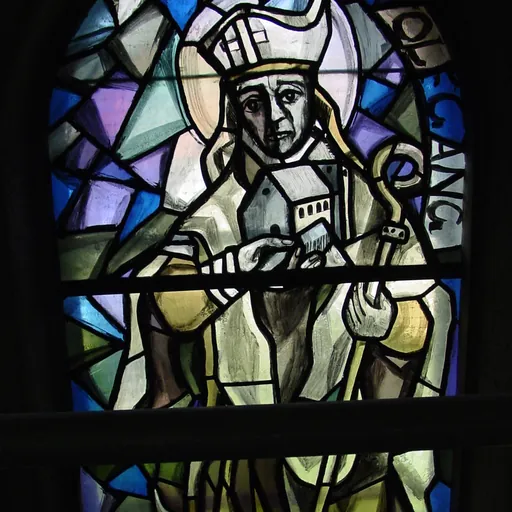
Wolfgang of Regensburg
German monk, bishop and saint
About Wolfgang of Regensburg
Lived 924 – 994 (aged 69–70). Wolfgang of Regensburg was a German catholic priest, catholic bishop, missionary and bishop.
Wolfgang of Regensburg (; 934 – 31 October 994 AD) was bishop of Regensburg in Bavaria from Christmas 972 until his death. He is a saint in the Catholic and Eastern Orthodox churches. He is regarded as one of the three great German saints of the 10th century, the other two being Ulrich of Augsburg and Conrad of Constance. Towards the end of his life Wolfgang withdrew as a hermit to a solitary spot, in the Salzkammergut region of Upper Austria. Soon after Wolfgang's death many churches chose him as their patron saint, and various towns were named after him.
Early life Wolfgang was descended from the family of the Swabian Counts of Pfullingen. When seven years old, he had an ecclesiastic as a tutor at home; later he attended the celebrated monastic school at Reichenau Abbey. Here he formed a strong friendship with Henry of Babenberg, brother of Bishop Poppo of Würzburg, whom he followed to Würzburg in order to attend the lectures of the noted Italian grammarian Stephen of Novara at the cathedral school.
After Henry was made Archbishop of Trier in 956, he summoned Wolfgang, who became a teacher in the cathedral school of Trier, and also labored for the reform of the archdiocese,
He was followed by other missionaries sent by Piligrim, Bishop of Passau, under whose jurisdiction the new missionary region came. Poppe, son of Margrave Luitpold, Archbishop of Trier (1018), and Tagino, Archbishop of Magdeburg (1004–1012), also had him as their teacher.
Hermitage and death
Apparently on account of a political dispute between Duke Henry II of Bavaria and Emperor Otto II, Wolfgang spent a year at Mondsee in 976. From there he withdrew as a hermit to a solitary spot, now the Wolfgangsee ("Wolfgang's Lake") in the Salzkammergut region of Upper Austria. He was discovered by a hunter and brought back to Regensburg.
While travelling on the Danube to Pöchlarn in Lower Austria, he fell ill at the village of Pupping, which is between Eferding and the market town of Aschach near Linz, and at his request was carried into the chapel of Saint Othmar at Pupping, where he died.
In Christian art he has been especially honoured by the medieval Tyrolean painter Michael Pacher (1430–1498), who created an imperishable memorial to him, the high altar of St. Wolfgang. In the panel pictures which are now exhibited in the Old Pinakothek at Munich are depicted in an artistic manner the chief events in the saint's life. The Kefermarkt altarpiece in Kefermarkt in Upper Austria is another monumental Late Gothic piece of art dedicated to the saint.
The oldest portrait of Wolfgang is a miniature, painted about the year 1100 in the Evangeliary of Saint Emmeram, now in the library of the castle cathedral at Kraków.
A modern picture by Schwind is in the Schack Gallery at Munich. This painting represents the legend of Wolfgang forcing the devil to help him to build a church.
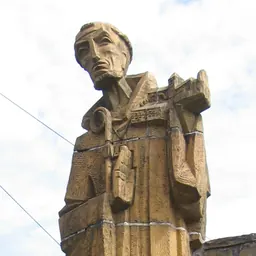
In other paintings he is generally depicted in episcopal dress, an axe in the right hand and the crozier in the left, or as a hermit in the wilderness being discovered by a hunter.
The axe refers to an incident in the life of the saint. After having selected a solitary spot in the wilderness, he prayed and then threw his axe into the thicket; the spot on which the axe fell he regarded as the place where God intended he should build his cell. This axe is still shown in the little market town of St. Wolfgang which sprang up on the spot of the old cell.
Literature At the request of the Abbey of St. Emmeram, the life of Wolfgang was written by Otloh, a Benedictine monk of St. Emmeram about 1050. This life is especially important for the early medieval history both of the church and of civilization in Bavaria and Austria, and it forms the basis of all later accounts of the saint.
The oldest and best manuscript of this Vita is in the library of Einsiedeln Abbey in Switzerland (MS. No. 322), and has been printed with critical notes in Mon. Germ. His.: Script., IV, 524–542.
Don’t just read it —
keep it.
Full-length biographies made to live with: read them, listen on the way to work, watch them tonight.
- E-book
- Audio
- Video
Instant download · yours to keep · every purchase keeps this site free
Important facts
People in Wolfgang of Regensburg's life
Named in this biography and alive at the same time


Related people
Same field, nearest in time

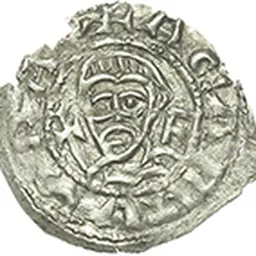

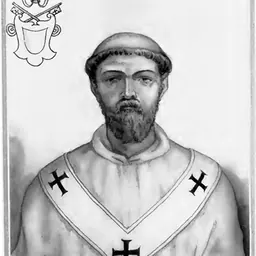
Contemporaries
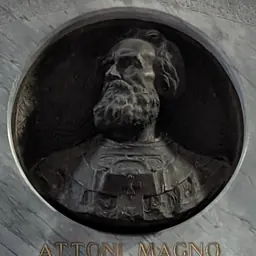
People whose lives overlapped Wolfgang of Regensburg's


Frequently asked questions
Who was Wolfgang of Regensburg?
German monk, bishop and saint
When was Wolfgang of Regensburg born?
Wolfgang of Regensburg was born in 924 in Pfullingen.
When did Wolfgang of Regensburg die?
Wolfgang of Regensburg died on 31 October 994 in Pupping.
What was Wolfgang of Regensburg's occupation?
Wolfgang of Regensburg was a catholic priest, catholic bishop, missionary and bishop.
What nationality was Wolfgang of Regensburg?
Wolfgang of Regensburg was German.
Sources & further reading
· Wikipedia: Wolfgang of Regensburg
· DBpedia: Wolfgang of Regensburg
Cite this page
APA: Biography.guide. (2026). Wolfgang of Regensburg. https://biography.guide/wolfgang-of-regensburg/
MLA: "Wolfgang of Regensburg." Biography.guide, https://biography.guide/wolfgang-of-regensburg/.
Chicago: "Wolfgang of Regensburg." Biography.guide. https://biography.guide/wolfgang-of-regensburg/.
Data last updated: 2026-09-22 · Spot an error? Report a correction.
Portrait: Wikimedia Commons · author & licence
Page generated 2026-09-27 05:02 UTC