About Nikephoros Ouranos
Lived 1000 – 1100. Nikephoros Ouranos was a Byzantine military personnel and writer.
Nikephoros Ouranos (; fl. c. 980 – c. 1010), Latinized as Nicephorus Uranus, was a high-ranking Byzantine official and general during the reign of Emperor Basil II (r. 976–1025). One of the emperor's closest associates, he was active in Europe in the wars against the Bulgarians, scoring a major victory at Spercheios, and against the Arabs in Syria, where he held command during the first decade of the 11th century as Basil's virtual viceroy. A well-educated man, he wrote a military manual (Taktika) and composed several surviving poems and hagiographies.
Biography The Byzantine emperor Basil II (r. 976–1025). Nikephoros Ouranos was one of his closest and most trusted collaborators.
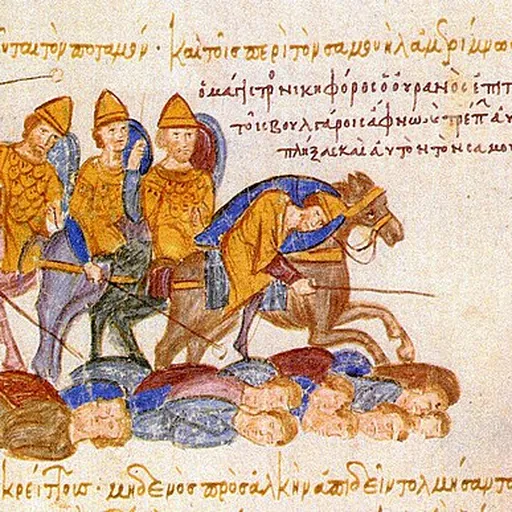
Very little is known of Ouranos's origin, his early years, or his family, and the chronicles represent him very much as a "new man". A prōtospatharios and asēkrētis Basil Ouranos, possibly an elder relative, is attested, and we know from Nikephoros's letters that he had a brother named Michael. Nikephoros Ouranos himself first enters history in the early 980s, during negotiations between Byzantium and the Buyid ruler of Baghdad for the return of the renegade rebel general Bardas Skleros. After the first Byzantine embassy in 980, an Arab embassy under Ibn Shahram visited Constantinople in 982, and Ouranos is mentioned in its report as a confidant of the young Basil II, holding the high court position of epi tou kanikleiou (keeper of the kanikleion, the imperial inkstand). Ibn Shahram further mentioned that Ouranos's close association with the emperor made him an enemy to the powerful eunuch parakoimomenos, Basil Lekapenos, who had supervised the affairs of state for decades. During the negotiations, Ouranos functioned as the intermediary between the Arabs and the emperor, and he was subsequently chosen by the parakoimomenos to head a Byzantine delegation to Baghdad, which would take custody of Skleros. Following their success, the Bulgarians had penetrated deep into Greece, raiding and pillaging even unto Corinth in the Peloponnese. In 997, Ouranos assembled his forces at Thessalonica and marched south to meet them, while the Bulgarian Tsar Samuel, upon hearing of his coming, turned north. The two armies eventually met on the banks of the river Spercheios in Central Greece, which was flooded due to heavy rainfall in the preceding days, rendering it impassable. Both armies thus encamped on opposite shores of the river. The Bulgarians, confident that the Byzantines could not cross the river, neglected to station guards. Ouranos, however, found a ford further upstream, took his army across during the night and attacked the Bulgarian camp. The battle was a rout, as the majority of the Bulgarians, caught unawares, were either killed or captured. Even Tsar Samuel and his son were wounded and only escaped by lying among the slain.
Ouranos continued campaigning in the area over the next years, although no information about his operations is provided by the chronicler Skylitzes, the main source. In December 999, Ouranos was appointed doux of Antioch in Syria, one of the most important Byzantine regional military commands. Following the death of the previous doux, Damian Dalassenos, in the battle against the Fatimids in 998, Emperor Basil himself had campaigned in the area in the previous year, hoping to stabilize the eastern frontier to enable him to devote his resources in the West against Bulgaria. In the spring of 1000, Ouranos accompanied Basil in his campaign, which led to the annexation of the Georgian principality of Tao, and defended this new possession from attacks by Gurgen of Iberia in 1001–1002. In 1000–1001, Ouranos quelled an uprising by two Syrian Bedouin tribes, the Noumeritai and the Ataphitai. In 1005–1007, he was engaged in operations against the Arab rebel Al-Asfar, whom he finally defeated in 1007. and were written while he was governor of Antioch.
Chapters 1–55 are a paraphrase of the Tactica of Emperor Leo VI the Wise (r. 886–912). Chapters 56–62 are a paraphrase of the Praecepta Militaria of Emperor Nikephoros II Phokas (r. 963–969), while the appended chapters 63–65 reflect Ouranos's own experience and are emendations of earlier texts reflecting the new circumstances of Byzantine warfare in the early 11th century. Chapters 66–74 are derived from the 1st-century author Onasander. Chapters 75–175 and 176–178 likewise are derived from ancient authors.
Of Ouranos's additions, chapter 63 deals with raids into enemy territory. Chapter 64 discusses the problem of breaking camp and setting to march when the enemy is nearby, as well as the forced passing of a defile held by the enemy (drawn from earlier authors). Chapter 65 concerns itself with siegecraft.
The latter is especially notable for the importance given to psychological and diplomatic factors during a siege. For instance, he notes the importance of taking precautions even against Christian subjects supplying a Muslim enemy with grain, cheese, or livestock because the high price offered will otherwise prove tempting. Likewise, he suggests alternating between gracious offers of clemency and harsh threats of reprisals (especially against Armenian and Syriac Christians, apostates to Islam (Greek: μαγαρίται), and other heretics) whether one plans to honor these or not, as such vacillation will produce dissension among the defenders.
Oddly enough, though Ouranos refers to trebuchets, it appears he (and by extension the Byzantines) used them against the defenders along the walls, and not against the walls themselves. Apparently in ignorance of the destructive power at his command, he writes: "The men of old, in their pursuit of siege warfare, constructed many devices such as battering rams, wooden towers, scaling ladders with various features, tortoises, and all kinds of other things which our generation can hardly imagine. It has, however, tried all these devices and found that out of all of them, the most effective way, one the enemy cannot match, is undermining the foundations."
Other works Ouranos was also a pious man, attempting to live a monkish life without disengaging from worldly affairs. As mentioned above, he was entrusted with the upkeep of the Great Lavra monastery, and in his youth he was apparently a friend of Saint Symeon Metaphrastes, on whose death he wrote a poem in lament.
He authored two known hagiographical texts, the metaphrasis The Life of Symeon of the Wondrous Mountain and The Passion of Theodore the Recruit.
Don’t just read it —
keep it.
Full-length biographies made to live with: read them, listen on the way to work, watch them tonight.
- E-book
- Audio
- Video
Instant download · yours to keep · every purchase keeps this site free
Important facts
Related people
Same field, nearest in time



Contemporaries
People whose lives overlapped Nikephoros Ouranos's



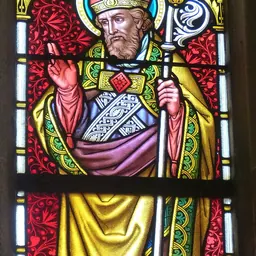
Frequently asked questions
Who was Nikephoros Ouranos?
Byzantine general
When was Nikephoros Ouranos born?
Nikephoros Ouranos was born in 1000.
When did Nikephoros Ouranos die?
Nikephoros Ouranos died in 1100 in Antioch.
What was Nikephoros Ouranos's occupation?
Nikephoros Ouranos was a military personnel and writer.
What nationality was Nikephoros Ouranos?
Nikephoros Ouranos was Byzantine.
Sources & further reading
· Wikipedia: Nikephoros Ouranos
Cite this page
APA: Biography.guide. (2026). Nikephoros Ouranos. https://biography.guide/nikephoros-ouranos/
MLA: "Nikephoros Ouranos." Biography.guide, https://biography.guide/nikephoros-ouranos/.
Chicago: "Nikephoros Ouranos." Biography.guide. https://biography.guide/nikephoros-ouranos/.
Data last updated: 2026-09-22 · Spot an error? Report a correction.
Portrait: Wikimedia Commons · author & licence
Page generated 2026-09-27 05:02 UTC