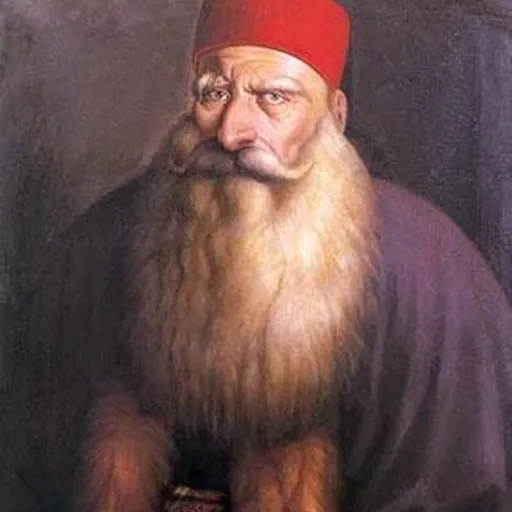
About Bashir Shihab II
Lived 1767 – 1850 (aged 82–83). Bashir Shihab II was a Turkish politician.
Bashir Shihab II (, also spelled Bachir Chehab II; 2 January 1767 – 1850) was a Lebanese emir who ruled the Emirate of Mount Lebanon between 1788 –1840. Born to a branch of the Shihab family which had converted from Sunni Islam, the religion of previous Shihabi emirs, he was the only Maronite ruler of the Mount Lebanon Emirate.
Early life and family
Bashir was born in 1767 in Ghazir, a village in the Keserwan region of Mount Lebanon. He was the son of Qasim ibn Umar ibn Haydar ibn Husayn Shihab of the Shihab dynasty, which had been elected to the super tax farm of Mount Lebanon by Druze nobility, also known as the Mount Lebanon Emirate, when their Druze kinsmen, the Ma'an dynasty died heirless in 1697. Although the Shihab family was ostensibly Sunni Muslim, some members of the family had converted to the Maronite Catholic Church. Bashir was among the first members of his extended family to be born a Christian.
In 1768, when Bashir was still an infant, his father Qasim died. who sought to install Bashir at the head of the emirate. When probed on the subject by the Jumblatt sheikhs, Bashir was noncommittal but left room for negotiations; his hesitance was a result of his financial destitution. the son of Najm Shihab, leader of the Sunni Muslim, Hasbaya-based branch of the clan. As a result of his marriage to Shams, Bashir II gained considerable wealth. Afterward, a friend of Bashir from Sidon named Ibrahim al-Jawhari set out to find a new wife for Bashir. Al-Jawhari already knew a Circassian slave girl named Hisn Jihan in Istanbul. Jihan was a Muslim and Bashir had her convert to the Maronite Church before the marriage.
According to contemporary chroniclers of the time, Jihan was seclusive and only left her residence fully veiled, was a loving wife to Bashir, wielded significant influence over him and was reputed for her enchantment and charitable efforts with Mount Lebanon's inhabitants. In that dispute, Bashir backed emirs Isma'il and Sayyid-Ahmad Shihab against Emir Yusuf, who ultimately prevailed when the powerful Ottoman governor of Sidon, Ahmad Pasha al-Jazzar, confirmed his control of the Mount Lebanon tax farms after Yusuf promised him a bribe of 1 million qirsh. Bashir traveled to al-Jazzar's headquarters in Acre, where he was officially transferred the Mount Lebanon tax farms in September 1789. Not long after, Jirji Baz, the mudabbir (manager) of Yusuf's sons Husayn and Sa'ad ad-Din, persuaded Qa'dan and Haydar to grant Yusuf's sons the tax farm of Jubail.
Conflict with al-Jazzar In 1797, Baz reestablished good offices with al-Jazzar, bringing him Yusuf's sons to pay their respects. Al-Jazzar wielded his potential support for Yusuf's sons as a way to leverage Bashir into paying more taxes or risk losing his Mount Lebanon tax farms. At the same time, Emir Bashir decided to eliminate his Abi Nakad opponents and to that end, he conspired with the Jumblatts and Imads. According to a contemporary source, the killings effectively meant that the "Nakad name was obliterated". He subsequently forced Bashir to depart Mount Lebanon by sending an expeditionary force to help Baz oust Bashir from Deir al-Qamar. Baz agreed to meet Bashir in secret and the two reached a deal without al-Jazzar's knowledge, whereby Bashir would control the Druze areas of Mount Lebanon and Maronite-dominated Keserwan, while Yusuf's sons would control the northern areas, such as Jubail and Batroun. Bashir promised to uphold the agreement, swearing an oath on both the Quran and the Gospel. Bashir also hired Baz to be his mudabbir, replacing the Maronite Dahdah clan as his traditional provider of mudabbirs. Baz, meanwhile, had been asserting his influence in Mount Lebanon and often acted out of concert with Bashir, bypassing the latter's authority. In 1810, Sulayman Pasha gave Bashir a leasehold for life over the Chouf and Keserwan tax districts, Moreover, Sulayman Pasha would thereafter address Bashir in their correspondence with the honorary title of "pride of noble princes, authority over great lords, our noble son, Emir Bashir al-Shihabi". The Maronite peasantry became frustrated with Emir Bashir because of the additional taxes imposed on them, while the Maronite Church was becoming increasingly angry at Emir Bashir's concealment of his Maronite Catholic faith. Bashir understood this to be an attempt by Abdullah to foment a conflict between him and the inhabitants of Mount Lebanon, and he sought to defuse tensions with Abdullah Pasha. At Antelias, the peasants agreed to reject Bashir's additional impositions, and appointed wukala (delegates; sing. wakil) from each of their villages to represent their interests. The Yazbaki faction, with Abdullah Pasha's blessing, proceeded to appoint two Sunni Muslim emirs from the Rashayya branch of the Shihab clan, Hasan and Salman, as Emir Bashir's successors on 14 April 1819.
By 1820, the Ottoman Empire was entering into war with Russia and attempting to quell a Greek uprising in Morea, prompting the Sublime Porte (Ottoman imperial government) to issue orders to Abdullah Pasha to fortify Syria's coastal cities and disarm Christians in his province.
The Sublime Porte was troubled by Abdullah Pasha and Emir Bashir's actions against Damascus, and dispatched Mustafa Pasha, the governor of Aleppo Eyalet, to reinforce Dervish Pasha and help him defeat Abdullah Pasha. From there, Sheikh Bashir began preparations for war with Emir Bashir. Patriarch Yusuf Hubaysh greatly welcomed the aforementioned developments. In effect, Maronite clergymen, who had long dominated the religious and secular aspects of Maronite life, acquired the privileges that the Druze muqata'jis had previously maintained with Bashir and his Shihabi predecessors. The latter had the mufti of Istanbul issue a fatwa (Islamic edict) that declared Muhammad Ali an infidel, while Muhammad Ali had the Sharif of Mecca issue a fatwa that condemned Mahmud II for violating the Sharia and promoted Muhammad Ali as Islam's savior, subsequently setting the stage for war between Egypt and Istanbul. Under the command of Muhammad Ali's son Ibrahim Pasha, Egyptian forces began their conquest of Syria on 1 October 1831, capturing much of Palestine before besieging Abdullah Pasha in Acre on 11 November. Meanwhile, under the Sublime Porte's orders, the mutasallims of Beirut and Sidon and the walis of Tripoli and Aleppo stood by Abdullah Pasha, and issued warnings to Mount Lebanon's notables to do likewise. Instead, they joined the Ottoman army mobilizing in Damascus under the command of the serasker (commander-in-chief), Mehmed Izzet Pasha.
The alignment of the major Druze clans with the Ottomans compelled Bashir to further rely on his growing Maronite power base. However, through his close alliance with Muhammad Ali, preventing it from being subject to the Egyptian bureaucracy that centralized power in the rest of Syria. the northern tax district of Koura and the port cities of Sidon and Beirut. As such, he appointed Khalil to Shahhar, Qasim to Chouf, Amin in Jubail, his brother Hasan's son Abdullah in Keserwan, his cousin Bashir in Tuffah and his associate Haydar Abu'l Lama in Matn. during which Muhammad Ali sent orders to Bashir to advance against Safad, one of the centers of the rebellion. Accordingly, Bashir led his troops toward the town, but before reaching it, he issued an ultimatum to the rebels demanding their surrender. Between 1834 and 1835, Bashir's forces commanded by Khalil and his relatives also participated in the suppression of revolts in Akkar, Safita, the Krak des Chevaliers and an Alawite revolt in the mountainous region of Latakia. With the various rebellions quelled, resistance to disarmament and conscription by Muhammad Ali's administration was stifled for a few years. Bashir acceded to Ibrahim Pasha's levy request, organizing a force under the leadership of his grandson Mahmud, which subsequently was sent to reinforce Ahmad and Sa'd ad-Din in Hasbaya. Bashir's troops were ambushed by Druze forces commanded by rival Shihab emirs, Bashir Qasim and Ali of Rashaya. Bashir's Druze and Christian rivals and dissidents to his rule in Mount Lebanon were courted and armed in an initiative by the British Foreign Secretary, Lord Palmerston. With British–Ottoman support, an alliance of sheikhs in Mount Lebanon, including the Abu Nakad, Abu'l Lama, Khazen, Shihab, Hubaysh and Dahdah clans, Khanjar al-Harfush, Ahmad Daghir, Yusuf al-Shantiri and Abu Samra Ghanim, launched a rebellion against Bashir and Ibrahim Pasha on 27 May 1840. Most Druze did not join the revolt in its early stage due to its mostly Maronite or pro-Christian leadership based in Matn, Keserwan and the Sahil. By 13 July, Bashir informed the Egyptian authorities that the revolt was suppressed, and handed over 57 of the revolt's leaders and participants, including Haydar Abu'l Lama and Fransis al-Khazen, who were exiled to Upper Egypt. This was after Wood, who had been accorded responsibility over settling Mount Lebanon's affairs by the Ottomans, had won over Patriarch Hubaysh with guarantees that the Ottomans would respect the privileges of the Maronite Church in Mount Lebanon. Abu Samra and the Maronites of Batroun, Jubail, Bsharri and Koura also defected from the Ottomans. Ibrahim Pasha fled, while Bashir surrendered to the Ottomans on 11 October. Bashir offered the Ottomans four million piasters to be exiled to France, but his offer was rejected. Instead, he was given the choice between exile in Malta or London. Bashir overturned the traditional system of governance in Mount Lebanon by nearly eliminating the feudal authority of the Druze and Maronite muqata'jis, and/or with Bashir's elimination of Bashir Jumblatt and subsequent cultivation of the Maronite clergy as a new power base to replace the mostly Druze muqata'jis. Historian William Harris summarizes that Bashir contributed to the creation of the modern state of Lebanon, writing: For good or bad, and whatever his personal responsibility, Bashir II's half-century bequeathed the beginnings of modern Lebanon. These included the idea of an autonomous Lebanese entity, popular identification with sectarian community above loyalty to local lords, popular communal political representation, and sectarian tensions. Historian Caesar E. Farah asserts, Without the domestic schemes of Bashir, which facilitated the Egyptian occupation of Syria, the Lebanon presumably would not have become in 1840 the cockpit of the great powers. While he may not have created the question, Bashir did convert the country into the fulcrum for the disruption of Ottoman rule in the Syrian provinces. He not only ended the primacy of his house, but also prepared the country to be the apple of discord cast to the nations of the West. as was former Prime Minister Khaled Chehab, who descended from the Hasbaya-based, Sunni Muslim branch of the family. Descendants of Bashir II live in Turkey and are known as the Paksoy family due to Turkish restrictions on non-Turkish surnames.
Monuments
One of the most remarkable of Bashir's monuments is Beiteddine Palace in Beit ed-Dine, which he started building immediately after taking power in 1788. Legend has it that Bashir rewarded the architect by cutting his hands off in order to keep his palace a one-of-a-kind.
Don’t just read it —
keep it.
Full-length biographies made to live with: read them, listen on the way to work, watch them tonight.
- E-book
- Audio
- Video
Instant download · yours to keep · every purchase keeps this site free
Important facts
People in Bashir Shihab II's life
Named in this biography and alive at the same time


Related people
Same field, nearest in time



Contemporaries
People whose lives overlapped Bashir Shihab II's





Frequently asked questions
Who was Bashir Shihab II?
Emir of Lebanon (1767–1850)
When was Bashir Shihab II born?
Bashir Shihab II was born on 2 January 1767 in Ghazir.
When did Bashir Shihab II die?
Bashir Shihab II died in 1850 in Istanbul.
What was Bashir Shihab II's occupation?
Bashir Shihab II was a politician.
What nationality was Bashir Shihab II?
Bashir Shihab II was Turkish.
Sources & further reading
Cite this page
APA: Biography.guide. (2026). Bashir Shihab II. https://biography.guide/bashir-shihab-ii/
MLA: "Bashir Shihab II." Biography.guide, https://biography.guide/bashir-shihab-ii/.
Chicago: "Bashir Shihab II." Biography.guide. https://biography.guide/bashir-shihab-ii/.
Data last updated: 2026-09-20 · Spot an error? Report a correction.
Page generated 2026-09-27 05:09 UTC