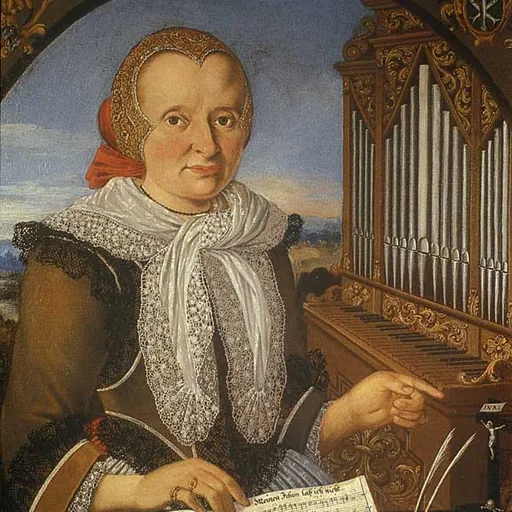
About Barbara Kluntz
Lived 1661 – 1730 (aged 69). Barbara Kluntz was a German composer, christian nun, writer and musician.
Barbara Kluntz (born 5 February 1661 in Ulm; buried 22 May 1730 in Ulm) was a German composer and music teacher. On all of her book titles, she calls herself "Barbara Kluntz, Lover of the Noble Art of Music", in order to explicitly emphasize her position: She did not consider herself a professional musician.
Biography Barbara Kluntz, called "Schneiderbärbele", was the daughter and third child of the tailor Peter Kluntz and his wife Katharina Kluntz, née Messerschmid. She joined the charitable Third Order of the Ulm Collection Women who were evangelicals after the Reformation. The monastery-like association also owned several villages around Ulm and was located on Ulmer Frauenstrasse at the corner of Sammlungsgasse. The building was destroyed in World War II.
Since the women who entered the order did not have to take any vows, Barbara Kluntz was not a nun.
Entry into the Ulm Collection Foundation Location of the Ulm collection. Detail from the bird's eye view plan 1597. When she entered the collection, Barbara Kluntz was widely known as a “piano virtuoso, organ player and poet”, according to older research. Excerpts from her will, which no longer exists, show that she had her own organ, a clavichord, many books, and music.
How Barbara Kluntz came to her skills and what position her father had as a tailor within the Ulm tailors' guild is not yet known. Until then, only patrician women had been included in the collection. Why Barbara Kluntz only joined the collection at the age of 44 remains to be explored. Her musical activities can only be documented when she joined the collection in 1704. So far, no evidence can be found about her childhood, early and late adolescence.
Barbara Kluntz was not married; she moved into the collection under her maiden name and as a "maid". Her vocal and instrumental music making was probably dedicated to purely religious purposes. She also taught her colleagues, their students and many patrician daughters, in "clavier-playing". Her great role model was the French poet Georgette de Montenay, whose portrait she had included in her chorale book from 1711.
Contacts and concerts Barbara Kluntz maintained contacts in Berlin through correspondence and probably had the latest musical works sent from there so that she could study and perform them. She probably accompanied herself and others herself on the clavichord and on the organ. Since the Ulm collection women were free to move around the city and in the monastery, it can be assumed that the Ulm collection was a center of Ulm music practice alongside the permanently employed Ulm city performers and the emerging theater business.
Poetry In addition to music, Barbara Kluntz also wrote many poems that she published in her chorale books, including a work that expresses her joy and vitality:
„Deß Davids Harpff in Himel klingt, wol dem, der mit mir frölich singt. Lutherus singt uns allen vor, Nach Gottes Wort führt den Tenor. Wir singen nach und zwitzern mit, Und Gott nimt an solch Lob und Bitt. Wer nun Gott fürcht und hat mich gern der singt mit mir zu Gott dem Herrn.“ (Choralbuch 1711)
Barbara Kluntz quoted the French poet Georgette de Montenay in her 1711 chorale book.
Choralbuch 1711 The 245 chorales of the handwritten Choral Music book from 1711 are recorded only with title and partly without text. The melodies are set to chords with up to six voices, whereby the settings can suddenly switch between full voices and two-part passages. Occasionally, Barbara Kluntz also offers alternative suspensions to a chorale melody on the same page.
In her works, Barbara Kluntz often used the fifths and octaves in parallel, and the third is just as often missing in the movements despite four and five voices. This could be an indication that she learned her art auto-didactically, since the use of the third had long been common at this point in music history.
At the end of her first chorale book, Barbara Kluntz puts her happiest credo, her way of viewing music:
„Ich waiß nit z’sagen, wie vil Gut, In Musica ist verborgen; Gott und Menschen sie g’fallen thut, Music vertreibt die Sorgen, Music verjagt die Traurigkeit, Music den Geist erneüet, Music macht Lust, und kürzt die Zeit, und ewig uns erfreüet. Music lieb’ ich, so lang ich leb, und frölich meine Stimm’ erheb, und sing: O Music! Himmels Kunst, du bist wehrt aller Ehr’ und Gunst.“ (Choralbuch 1711)
Posthumous situation It remains to be researched what happened to Barbara Kluntz's further legacy, such as the instruments and sheet music; a resolution of the city council of Ulm forbade the collection women to bequeath goods to one another in order to give them as little power and financial influence in the city as possible. Only a surviving excerpt from a (no longer preserved) artefact from the Ulm Collection Foundation, dated 10 December 1728, from the back of Barbara Kluntz's oil portrait, shows that she wrote a lost will at least two years before her death. Barbara Kluntz bequeathed her music (sheet music and clavichord) to the in-house chapel and decided that her organ should go to the Protestant church in Ersingen. However, after the Ulm collection was dissolved, the organ was (according to Ilse Schulz) taken to a "German school". Barbara Kluntz's music was probably destroyed in the Second World War by the bombing raids on Ulm, which destroyed the Ulm collection.
Archives Barbara Kluntz's grave is also considered lost. Only her two remaining chorale books and her portrait in oil by an unknown artist are preserved. There are also two pages of her second, missing chorale book from 1717. Barbara Kluntz was portrayed in the typical collection uniform of that time. With her left hand she points to a small cross; as she writes in almost all of her songs and poems, her music, which she holds in front of her as a chorale book, comes from God. Writing implements refer to her work as a poet and composer; a lemon in the foreground, which was a luxury item (shown in the original oil portrait, Ulmer Museum), signifies a high status. Her own organ is likely in the background.
The diverse activities of Barbara Kluntz as a collector, music teacher, composer, organist, and piano player are unparalleled for the Ulm area and in general for her age.
Works
3 Chorale books from 1711, 1717 (lost) und 1720; with a total of more than 500 individual compositions of sacred songs, chants and arias (Stadtarchiv Ulm). General Bass Büchlein (c. 1720?), lost. Laudet Jehova Te Ulma – Nine-strophic Latin hymn with the melody of Nun alle Gott as a hymn to Barbara Kluntz's hometown (Choralbuch 1711). Totenlied von Anna Maria Reiser (Sammlungsfrau) auf den Tod Barbara Kluntz‘, publiziert von Daniel Ringmacher in einem verschollenen Sammelband. Porträt der Barbara Kluntz von einem unbekannten Künstler (Ulmer Museum Inv.-Nr. 1928.6048).
Don’t just read it —
keep it.
Full-length biographies made to live with: read them, listen on the way to work, watch them tonight.
- E-book
- Audio
- Video
Instant download · yours to keep · every purchase keeps this site free
Important facts
Related people
Same field, nearest in time


Contemporaries
People whose lives overlapped Barbara Kluntz's




Frequently asked questions
Who was Barbara Kluntz?
German composer
When was Barbara Kluntz born?
Barbara Kluntz was born on 5 February 1661 in Ulm.
When did Barbara Kluntz die?
Barbara Kluntz died on 22 May 1730 in Ulm.
What was Barbara Kluntz's occupation?
Barbara Kluntz was a composer, christian nun, writer and musician.
What nationality was Barbara Kluntz?
Barbara Kluntz was German.
Sources & further reading
Cite this page
APA: Biography.guide. (2026). Barbara Kluntz. https://biography.guide/barbara-kluntz/
MLA: "Barbara Kluntz." Biography.guide, https://biography.guide/barbara-kluntz/.
Chicago: "Barbara Kluntz." Biography.guide. https://biography.guide/barbara-kluntz/.
Data last updated: 2026-09-21 · Spot an error? Report a correction.
Portrait: Wikimedia Commons · author & licence
Page generated 2026-09-27 04:59 UTC