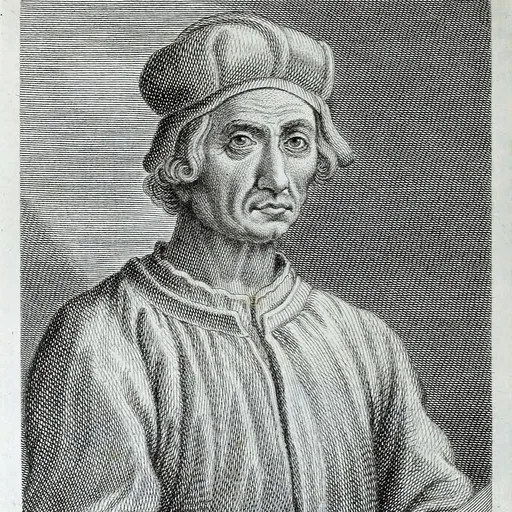
About Baccio d'Agnolo
Lived 1462 – 1543 (aged 80). Baccio d'Agnolo was an architect, sculptor and wood carver.
Baccio d'Agnolo (19 May 14626 March 1543 ), born Bartolomeo Baglioni, was an Italian woodcarver, sculptor, and architect from Florence.
Biography "Baccio" is an abbreviation of Bartolomeo, and "d'Agnolo" refers to Angelo, his father's name. He was the son of a hosier turned woodworker. He started as a wood-carver, and between 1491 and 1502 did much of the decorative carving in the church of Santa Maria Novella and the Palazzo Vecchio in Florence. The wooden structure of Santissima Annunziata, an elaborate double-sided altarpiece, was "begun in 1500 on a design by Baccio D'Agnolo". Having made his reputation as a sculptor he appears to have turned his attention to architecture, and to have studied at Rome, though the precise date is uncertain; but at the beginning of the sixteenth century he was engaged with the architect Simone del Pollaiolo in restoring the Palazzo Vecchio, and in 1506 he was commissioned to complete the drum of the cupola of the church of Santa Maria del Fiore. The latter work, however, was interrupted on account of adverse criticisms from Michelangelo, and it remained unexecuted.
In 1496 he began a long association with the Palazzo della Signoria for the fabric and decoration works. He gradually assumed a dominant role. In 1499 he became the head of the office of the works, a position he occupied until the end of his life.
Baccio d'Agnolo also designed, among others, the Palazzo Borgherini-Rosselli del Turco and the Palazzo Bartolini Salimbeni. The Bartolini palace was the first house to be given frontispieces of columns to the door and windows, previously confined to churches. This is "the oldest example of the explicit use of window frames in secular architecture". He was ridiculed by the Florentines for this innovation. Another much-admired work of his was the campanile of the church of Santo Spirito. His studio was the resort of some of the most celebrated artists of the day: Michelangelo, Andrea Sansovino, the brothers Antonio da Sangallo the Elder and Giuliano da Sangallo, and the young Raphael. He died at Florence in 1543, leaving three sons, all architects, the best-known being Giuliano d'Agnolo.
Giorgio Vasari included Baccio in volume IV of his Vite.
Don’t just read it —
keep it.
Full-length biographies made to live with: read them, listen on the way to work, watch them tonight.
- E-book
- Audio
- Video
Instant download · yours to keep · every purchase keeps this site free
Important facts
more
BaglioniPeople in Baccio d'Agnolo's life
Named in this biography and alive at the same time




Related people
Same field, nearest in time


Contemporaries
People whose lives overlapped Baccio d'Agnolo's



Frequently asked questions
Who was Baccio d'Agnolo?
Italian woodcarver, sculptor and architect (1462–1543)
When was Baccio d'Agnolo born?
Baccio d'Agnolo was born on 19 May 1462 in Florence.
When did Baccio d'Agnolo die?
Baccio d'Agnolo died on 6 March 1543 in Florence.
What was Baccio d'Agnolo's occupation?
Baccio d'Agnolo was an architect, sculptor and wood carver.
What nationality was Baccio d'Agnolo?
Baccio d'Agnolo's recorded nationality: Duchy of Florence.
Sources & further reading
Cite this page
APA: Biography.guide. (2026). Baccio d'Agnolo. https://biography.guide/baccio-d-agnolo/
MLA: "Baccio d'Agnolo." Biography.guide, https://biography.guide/baccio-d-agnolo/.
Chicago: "Baccio d'Agnolo." Biography.guide. https://biography.guide/baccio-d-agnolo/.
Data last updated: 2026-09-21 · Spot an error? Report a correction.
Portrait: Wikimedia Commons · author & licence
Page generated 2026-09-27 04:59 UTC