
Ba Than
Burmese physician and educator
About Ba Than
Lived 1895 – 1971 (aged 76).
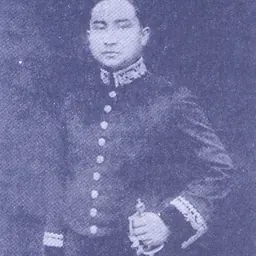
Thiri Pyanchi Ba Than FRCS FACS FICS (, ; 9 May 18954 November 1971) was a Burmese medical surgeon, educator and administrator. The first Burmese police surgeon in British Burma, Ba Than founded and ran the main hospital in Rangoon (Yangon) as well as the wartime medical and nursing schools during the Japanese occupation of the country (1942–1945). After the country's independence in 1948, Ba Than served several terms as dean and rector of the main medical universities in Rangoon and Mandalay until two months before his death in 1971.
He is also known for his autopsies of famous politicians, including those of Aung San and Tin Tut. His daughter Khin May Than, third wife of General Ne Win, was the First Lady of Burma from 1962 to 1972.
Early life and career St. Paul's High School where Ba Than graduated from in the 1910s
Ba Than was born to U Kinn and Daw Swei in May 1895 in Pyuntaza, a small town about northeast of Yangon (Rangoon), in what was then British Burma. His parents were apparently well-to-do as he graduated from Rangoon's St. Paul's English High School, and went on to study medicine at the University of Calcutta where he received an MB in 1922. ) He started out as a Civil Assistant Surgeon (CAS) in the Health Department in 1922, and received his FRCS certification from the Royal College of Surgeons of Edinburgh in 1932.
By then, Ba Than was part of the tiny colonial era medical community made up mainly of foreign-born physicians and specialists that existed primarily in Rangoon. Known for his extreme work ethic—his motto was "zwe" (ဇွဲ, lit. "perseverance, persistence"), the surgeon by the late 1930s had risen to be the deputy head of the surgery department at Rangoon General Hospital (RGH) and the first Burmese police surgeon. His first high-profile case came in 1938 when he led the autopsy of Aung Kyaw, a student leader killed by the colonial police, amidst nationwide protests against the colonial government.
In 1937, Ba Than also began teaching at Rangoon Medical College as a lecturer in forensic medicine. were the only two surgeons of indigenous Burmese descent he knew of at the time. three years before Ba Than. Another FRCS surgeon was Dr. Saw Sa, who became the first woman legislator in the colonial parliament in 1937. )
Japanese occupation period (1942–1945) Rangoon General Hospital was taken over by the Imperial Japanese Army (1942–1945).
Ba Than is best remembered for founding the main hospital in Rangoon to serve non-Japanese patients during the Japanese occupation of Burma (1942–1945) during World War II. The hospital served Burma Independence/Defence Army (BIA/BDA) and Indian National Army (INA) officers and troops as well as the general public. He also founded the wartime medical and nursing schools.
Wartime hospital Ba Than came to found the hospital out of sheer necessity in wartime Burma. He was one of the few physicians, and of even fewer specialists, who had not evacuated the country along with the British administration. Furthermore, the city lost its main hospital when the Imperial Japanese Army seized and reserved Rangoon General Hospital only for the Japanese (soon after the IJA and their allies Burma Independence Army (BIA) took the city on 7 March 1942). The incoming Japanese administration sent Dr. T. Suzuki to ask Ba Than to found a new hospital for the BIA.
Ba Than faced several challenges from the outset. The most pressing was staffing. With most trained personnel gone, he had to resort to taking in final year medical students and nurse trainees. To be sure, not everyone who remained joined. Myint Swe, who joined the hospital as a resident in April 1942, recounted an exchange in English between Ba Than and a former colleague of Ba Than who came to see the "hospital": the man reportedly remarked that "a handful of fellows can't do anything" to which Ba Than responded "it's the determined few that command the crowd."
Ba Than was determined to prove his skeptics wrong. He worked tirelessly at the hospital, often sleeping at the hospital throughout the years. In the early days of the hospital, he handled all types of cases, not just surgery ones. Over the next six months, he pieced together the staff, equipment, and supplies to have a semblance of a functioning hospital. Under his leadership, the hospital became the main to-go place for all non-Japanese patients, not only the BIA/BDA and INA brass but also the ordinary servicemen and the general public. Founded as the BIA Hospital, the hospital was renamed as the Public General Hospital of Rangoon on 1 November 1942, and placed under the Ministry of Health.
One constant headache for Ba Than was Japanese surveillance and interference. The hospital operated under the watchful eye of Japanese agents, who planted themselves as longterm patients till the end. However, the bigger issue for the staff was the constant disruption by the Japanese troops from the nearby barracks, who would barge in and mistreat patients and staff, nurses in particular. Ba Than himself was interrogated by the soldiers on a whim. In 1943, the Japanese began sending doctors from the hospital to work on the Death Railway at the Thai-Burmese border, which most people took as a death sentence. According to Myint Swe, everyone felt powerless and humiliated but no one could do anything about it.
What Ba Than did do was to keep his overworked staff motivated and entertained by organizing musical performances. Ba Than was an avid pianist and Burmese xylophonist, and he found time to organize small musical and opera performances by his staff for the patients. His two young children, Katie and Georgie, who were accomplished pianists, also performed at the shows.
The wedding of Gen. Aung San and Khin Kyi was held at the wartime hospital on 6 September 1942. The photo was taken at the easternmost hall of the hospital.
The hospital was the place where historically important people were treated, including Aung San, Ne Win, Bo Letya, Bo Setkya, Thakin Than Tun, Thakin Mya, Thakin Po Hla Gyi, Ba Cho, Kyaw Nyein, S. C. Bose, and J. R. Bhonsle. It was also the place where Gen. Aung San met his future wife Khin Kyi during his brief hospitalization in mid 1942. Ba Than organized the wedding reception at the hospital, and even gave a song-and-piano performance.
Wartime medical and nursing schools Ba Than also restarted the country's medical and nursing schools in 1943. The schools were to address the severe staff shortage throughout the country, including the Burmese military, which had only a skeleton medical staff. Although the hospital had attracted more physicians and nurses by November 1942, the patient load had also increased even faster. Ba Than recruited a few specialists/professors (Drs. Asahi, Suji, Horibe, and Shikuma) directly from Japan to join the hospital and the medical school. Even then, the wartime school could offer only an accelerated two and a half year LSMP (Licensed Surgery and Medical Practitioner) program, not a full-fledged MBBS program. ) The nursing school's classes were held in the evening at the hospital and were taught initially by two senior nurses (Mi Mi Gyi and Tin Nu), and later by the graduates of the program. The program was overseen by Drs. Ba Than, Sen, and Yin May, who also graded exam papers.
Post-WWII
After Allied forces returned to Rangoon in May 1945, Ba Than was repeatedly questioned by the British as to why he stayed behind and cooperated with the Japanese. In the end, the British reprimanded Ba Than only for the terrible conditions at the hospital, which they shut down in July 1945. The British also restarted RMC as the Faculty of Medicine of Rangoon University in 1946, installing Dr. W. Burridge as its first dean, and later Lt. Col. Dr. Min Sein (husband of Dr. Yin May) in 1947. (Ba Than would not be dean until after the British left in 1948.)
Nonetheless, Ba Than was the "top surgeon" in the country by then. The assassinated nine are commemorated each year on Martyrs' Day in the country. In September 1948, he performed the post-mortem of Tin Tut, the first Foreign Minister of the newly independent country. Tin Tut had survived the July 1947 assassination but did not survive the second attempt. )
After independence, Ba Than increasingly focused on expanding medical education in the country. From 1948 onwards, he and Min Sein took turns being the dean of the medical school for the next 11 years. Ba Than served three terms: 1948–1949, 1951–1953, and 1955–1957 while Min Sein served three more: 1949–1951, 1953–1955, and 1957–1959, (in addition to his 1947–1948 term before independence.) Ba Than was instrumental in starting a medical school in Mandalay, serving as the first dean of the Faculty of Medicine of Mandalay University from 1960 to 1963.
Ba Than finished out his long career in Rangoon. In 1964, the 69-year-old became the first rector of the Institute of Medicine 1, Rangoon which had just been carved out of Rangoon University as an independent institution. According to his former students, the professor was still preaching about the importance of zwe (perseverance) to his students, and organizing musical troupes and shows at the school in which he would perform a song about zwe.
Personal life
Although best known for his driven nature, Ba Than had other interests. He loved music, and liked playing the piano and the pattala in his free time. According to historian Robert Taylor, Ba Than was a "bon vivant known to enjoy the Turf Club and sports, as well as ladies". He was married to Khin Kyi, Khin May Than (Katherine "Katie" or "Kitty") (16 August 1927 – 30 September 1972): Wife of Gen. Ne Win (1951–1972) and First Lady of Burma (1962–1972). Died of brain hemorrhage in London in 1972. She was earlier married to Dr. Taung Gyi and had three daughters. With Gen. Ne Win, she had two daughters and a son. Khin May Aye (Amy): Wife of Aung Than, rector, Institute of Dental Medicine, Rangoon (1964–1982).
Don’t just read it —
keep it.
Full-length biographies made to live with: read them, listen on the way to work, watch them tonight.
- E-book
- Audio
- Video
Instant download · yours to keep · every purchase keeps this site free
Important facts
Family & relationships
People in Ba Than's life
Named in this biography and alive at the same time






Contemporaries
People whose lives overlapped Ba Than's

Frequently asked questions
Who was Ba Than?
Burmese physician and educator
When was Ba Than born?
Ba Than was born on 9 May 1895 in Pyuntaza.
When did Ba Than die?
Ba Than died on 4 November 1971 in Myanmar, Yangon, Yangon Region.
Sources & further reading
Cite this page
APA: Biography.guide. (2026). Ba Than. https://biography.guide/ba-than-1895/
MLA: "Ba Than." Biography.guide, https://biography.guide/ba-than-1895/.
Chicago: "Ba Than." Biography.guide. https://biography.guide/ba-than-1895/.
Data last updated: 2026-09-25 · Spot an error? Report a correction.
Page generated 2026-09-27 05:11 UTC