
About B. V. Sreekantan
Lived 1925 – 2019 (aged 94). B. V. Sreekantan was an Indian astrophysicist, astronomer and physicist, known for Proton decay.
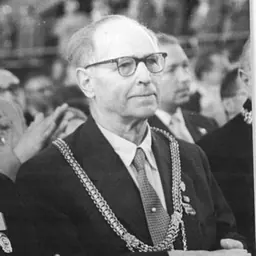
Badanaval Venkatasubba Sreekantan (30 June 1925- 27 October 2019) was an Indian high-energy astrophysicist and a former associate of Homi J. Bhabha at the Tata Institute of Fundamental Research (TIFR). He was also a Dr. S. Radhakrishnan Visiting Professor at the National Institute of Advanced Studies, Bangalore.
Known for his studies in the fields of cosmic rays, elementary particles, and high-energy X-ray astronomics, Sreekantan was an elected fellow of all the three major Indian science academies namely, the Indian Academy of Sciences, the Indian National Science Academy and the National Academy of Sciences, India as well as the Maharashtra Academy of Sciences. He was also an associate of Bruno Rossi at Massachusetts Institute of Technology. The Government of India awarded him the Padma Bhushan, India's third highest civilian honour, in 1988.
Biography
Sreekantan hailed from a family of temple priests; he was born to Laxmi Devi and Badanaval Venkata Pandit on 30 June 1925, in the small hamlet of Nanjangud, located in the erstwhile Mysore state (present day Karnataka). He was the fifth of eight sons and three daughters born to the Pandit couple, whose Telugu speaking ancestors had migrated from Andhra Pradesh to Karnataka. B. V. Pandit, an Ayurvedic physician by profession and the formulator of Nanjagud Ayurvedic Dental Powder, was scholastically inclined and maintained a home library that helped Sreekantan develop a reading habit from an early age. Sreekantan attended the local high school in Nanjangud and completed his intermediate degree course at Mysore. He secured his graduate degree in physics, with honours, in 1946 and completed his master's degree the following year, specializing in Wireless communication, from Mysore University. He continued his studies as a research scholar at the Indian Institute of Science, Bangalore, but moved to Mumbai in 1948 to the Tata Institute of Fundamental Research (TIFR) when Homi J. Bhabha invited him for advanced research in cosmic ray physics. His research at TIFR earned him a PhD from the University of Mumbai in 1954.
Sreekantan resided in Malleswaram, a suburb of the south Indian city of Bengaluru. He married Ratna, a classical musician, in 1953; she died in 2006.
Career and legacy
Sreekantan stayed at TIFR for 39 years, and before his retirement from TIFR service in 1987, he served as the director of the institute from 1975. At TIFR, he initiated many research streams in cosmic ray physics and astrophysics and the research team he established for studies in high energy cosmic rays is still active. One of his early assignments at TIFR was the study of cosmic-ray-produced muons detected deep underground and Sreekantan conducted experiments at Kolar Gold Mines in Karnataka, for the detection of the elementary particles at 2760 m deep. Though his experiments failed to find cosmic ray produced muons, he continued his search, which resulted in the detection of cosmic ray produced neutrinos, reportedly the first detection of the subatomic particles at such depth. A noted Italian experimental physicist, Bruno Rossi of Massachusetts Institute of Technology, examined the thesis and Mumbai University awarded him PhD in 1954.
Sreekantan was known to have furthered the studies of Homi Bhabha and Damodar Dharmananda Kosambi on the lifespan and decay spectrum of muons. He set up his laboratory using war-surplus goods from World War II procured by TIFR as well as from other sources and with the assistance of H. L. N. Murthy, an expert in glass work, who helped him in the development of Geiger counters, he measured the lifespan of the positive muons as 2.24±0.15 microseconds. His findings were published in the Indian journal, Proceedings of Indian Academy of Sciences in 1951. He was also a member of the team that worked on the Grand Unification Theory, to detect the decay of protons in subterranean environment, in the 1970s, the other members of the team included M. G. K. Menon. He assisted Homi Bhabha in the installation of two cloud chambers, Rani and Maharani at the cosmic ray laboratory in Ooty in 1954. Later, a larger cloud chamber, the largest one in India till then, and an air shower array were also set up there, with his assistance. He also designed, together with Subramanian and Ramamurthy, a total absorption spectrometer and an air Cherenkov counter, and the experiments revealed to Sreekantan and his associate, S. C. Tonwar, that increase in energy was an influential factor in the increase of nucleon-anti nucleon production cross section. Their findings have been published in Palau International Coral Reef Center (PICRC) journal in 1979. Along with R. H. Vatcha, he measured charged to neutral (C/N) ratio for high energy hadrons in showers of 1014–1016 eV energy range and arrived at the conclusion that copious production of baryons in high energy interactions is inevitable. These experiments confirmed baryon production in hadron-air nucleus collisions at 1015 eV.
Sreekantan was associated with several notable scientific personalities such as Homi Bhabha, M. G. K. Menon, Raja Ramanna, S. Naranan, R. L. Kapur, Ramanath Cowsik, V. S. Narasimham, S. V. Damle and G. S. Gokhale. mentored many scientists in their doctoral research and was the author of over 300 scientific papers. He was also credited with the publication of five books, either as the author or editor.
His studies have been documented by way of one book, Extensive Air Showers and a number of articles. He wrote a monograph on Cosmic Rays : Current Status and Future Directions for Homi Bhabha Fellowships Council (unknown if finished before his death). Interdisciplinary Perspectives on Consciousness and the Self and Nature’s Longest Threads: New Frontiers in Mathematics and Physics of Information in Biology as well as several articles on general science topics for the propagation of science.
Positions The Indian Institute of Astrophysics (IIA), established in 1786 by William Petrie, was modernised in 1960 by Vainu Bappu, the renowned Indian astronomer, and Sreekantan became associated with the institute during this time. The institute, functioning under the Ministry of Civil Aviation, was brought under the jurisdiction of the Department of Science and Technology in 1985 with the efforts of Raja Ramanna and Sreekantan, when it was made an autonomous institution. He is also credited with assisting Ramanath Cowsik with the establishment of a new campus for IIA at Hoskote in Karnataka and in the construction of housing for the staff of the institute. He was an editorial fellow of the Project of History of Indian Science, Philosophy and Culture and chaired the Gandhi Centre for Science and Human Values of Bharatiya Vidya Bhavan. founded by his father. Much of his later scientific work involved the study of the phenomenon of consciousness and its relationship with the physical sciences.
Awards and honours Sreekantan was an elected fellow of four major science academies in India; the Indian Academy of Sciences (1965), the Indian National Science Academy (1976), the National Academy of Sciences, India (1989) and the Maharashtra Academy of Sciences. The University Grants Commission of India awarded him the C. V. Raman Award in 1977 and selected him as the UGC National Lecturer in 1978, the same year as he delivered the PMS Blackett Memorial Award Lecture of INSA–Royal Society of London. The Indian Institute of Science Distinguished Alumni Award and six years later, the government followed it up with the Sir M. Visvesvaraya Senior Scientist State Award in 2004.
General publications Books
Articles
Don’t just read it —
keep it.
Full-length biographies made to live with: read them, listen on the way to work, watch them tonight.
- E-book
- Audio
- Video
Instant download · yours to keep · every purchase keeps this site free
Important facts
People in B. V. Sreekantan's life
Named in this biography and alive at the same time


Related people
Same field, nearest in time



Contemporaries
People whose lives overlapped B. V. Sreekantan's



Frequently asked questions
Who was B. V. Sreekantan?
Indian astrophysicist
When was B. V. Sreekantan born?
B. V. Sreekantan was born on 30 June 1925 in Nanjangud.
When did B. V. Sreekantan die?
B. V. Sreekantan died on 27 October 2019 in Bengaluru.
What was B. V. Sreekantan's occupation?
B. V. Sreekantan was an astrophysicist, astronomer and physicist.
What was B. V. Sreekantan known for?
B. V. Sreekantan was known for Proton decay.
What nationality was B. V. Sreekantan?
B. V. Sreekantan was Indian.
Sources & further reading
Cite this page
APA: Biography.guide. (2026). B. V. Sreekantan. https://biography.guide/b-v-sreekantan/
MLA: "B. V. Sreekantan." Biography.guide, https://biography.guide/b-v-sreekantan/.
Chicago: "B. V. Sreekantan." Biography.guide. https://biography.guide/b-v-sreekantan/.
Data last updated: 2026-09-20 · Spot an error? Report a correction.
Page generated 2026-09-27 05:26 UTC