
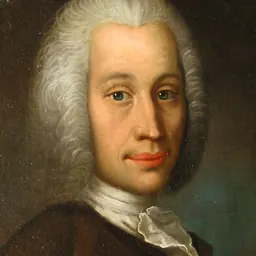
Axel Fredrik Cronstedt
Swedish mineralogist and chemist
About Axel Fredrik Cronstedt
Lived 1722 – 1765 (aged 42). Axel Fredrik Cronstedt was a Swedish fortifications officer, scientist, mineralogist and chemist, known for Nickel and Tungsten.
Baron Axel Fredrik Cronstedt (/kroonstet/ 23 December 1722 – 19 August 1765) was a Swedish mineralogist and chemist who discovered the element nickel in 1751 as a mining expert with the Bureau of Mines. for introducing the blowpipe as a tool for mineralogists, and for proposing that the mineral kingdom be organized on the basis of chemical analysis in his book Försök til mineralogie, eller mineral-rikets upställning ("An attempt at mineralogy or arrangement of the Mineral Kingdom", 1758).
Life Axel Fredrik Cronstedt was born on 23 December 1722, on the estate of Ströpsta, His father, Gabriel Olderman Cronstedt (1670–1757), was a military engineer.
Beginning in 1738, Axel Cronstedt was an unregistered student at the University of Uppsala, hearing lectures
Research
Cronstedt initiated the use of the blowpipe for the analysis of minerals. Originally a goldsmith's tool, it became widely used for the identification of small ore samples, particularly in Sweden where his contemporaries had seen Cronstedt use it. Use of the blowpipe enabled mineralogists to discover eleven new elements, beginning with Cronstedt's discovery of nickel.
In 1756, Cronstedt coined the term zeolite after heating the mineral stilbite with a blowpipe flame. He was the first to describe its distinctive properties, having observed the "frothing" when heated with a blowpipe.
Cronstedt's book Försök til mineralogie, eller mineral-rikets upställning ("An attempt at mineralogy or arrangement of the Mineral Kingdom", 1758) was originally published anonymously. In it, Cronstedt proposed that minerals be classified on the basis of chemical analysis of their composition. He was surprised that others supported his ideas and put them into practice. It was translated into English by Gustav Von Engeström (1738-1813) as An essay towards a system of mineralogy (1770).
Cronstedt noted in Försök til mineralogie, eller mineral-rikets upställning that he had observed an "unidentified earth" in a heavy red stone from the Bastnäs mine in Riddarhyttan. Forty-five years later, Jöns Jacob Berzelius and Wilhelm Hisinger isolated the first element of the lanthanide series of the rare earth elements, cerium, in ore from the mine.
Awards and honors In 1753, Cronstedt was elected a member of the Royal Swedish Academy of Sciences.
Don’t just read it —
keep it.
Full-length biographies made to live with: read them, listen on the way to work, watch them tonight.
- E-book
- Audio
- Video
Instant download · yours to keep · every purchase keeps this site free
Important facts
Contemporaries
People whose lives overlapped Axel Fredrik Cronstedt's





Frequently asked questions
Who was Axel Fredrik Cronstedt?
Swedish mineralogist and chemist (1722-1765)
When was Axel Fredrik Cronstedt born?
Axel Fredrik Cronstedt was born on 23 December 1722 in Turinge.
When did Axel Fredrik Cronstedt die?
Axel Fredrik Cronstedt died on 19 August 1765 in Säter.
What was Axel Fredrik Cronstedt's occupation?
Axel Fredrik Cronstedt was a fortifications officer, scientist, mineralogist and chemist.
What was Axel Fredrik Cronstedt known for?
Axel Fredrik Cronstedt was known for Nickel and Tungsten.
What nationality was Axel Fredrik Cronstedt?
Axel Fredrik Cronstedt was Swedish.
Sources & further reading
· Wikipedia: Axel Fredrik Cronstedt
· DBpedia: Axel Fredrik Cronstedt
Cite this page
APA: Biography.guide. (2026). Axel Fredrik Cronstedt. https://biography.guide/axel-fredrik-cronstedt/
MLA: "Axel Fredrik Cronstedt." Biography.guide, https://biography.guide/axel-fredrik-cronstedt/.
Chicago: "Axel Fredrik Cronstedt." Biography.guide. https://biography.guide/axel-fredrik-cronstedt/.
Data last updated: 2026-09-20 · Spot an error? Report a correction.
Page generated 2026-09-27 05:21 UTC