
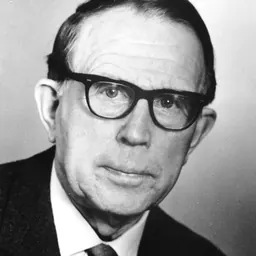
Austen Angell
Chemist. Known for his research on the physics of glasses and glass-forming liquids.
About Austen Angell
Lived 1933 – 2021 (aged 87). Austen Angell was an Australian and American chemist and researcher, known for Angell-plot, Fragility (glass physics) and Glass.
Charles Austen Angell (14 December 1933 – 12 March 2021) was an Australian and American physical chemist known for his prolific and highly cited research on the chemistry and physics of glasses and glass-forming liquids. He was internationally recognized as a luminary in the fields of glasses, liquids, water and ionic liquids.
His best known contribution is probably the development of the fragility concept and the "strong–fragile" classification of viscous liquids in general. The plot of logarithm of viscosity of liquids of all types to be placed on the same diagram by using the reduced temperature scale with the glass transition temperature Tg as scaling parameter, is widely known as the "Angell plot".
He was a pioneer of discovering the extraordinary behavior of supercooled water and launched the modern era of exploring the anomalies of water, which transformed the understanding of the most common substance on Earth in modern physics and chemistry. He was one of the first scientists to embrace molecular simulations for gaining insights into the amorphous materials and liquids. He was a "visionary explorer of glasses and the limits of the liquid state".
After high school, he went to University of Melbourne for undergraduate studies in Chemical Metallurgy. After graduation, he worked on molten salts with electrochemist John Bockris at the University of Pennsylvania. He went on to Imperial College London as the Stanley Elmore Fellow to pursue a PhD degree working with a physical chemist John Tomlinson. After two and half years working on metal-molten salt solution, he wrote his PhD thesis on self-diffusion in molten Cd-CdCl2 solution and TlCl, which earned him the biennial Armstrong Medal for graduate research. Before he returned to Australia, he embarked on a six-month adventure in a Volkswagen Beetle across Africa from Liberia to Sudan, venturing through the Sahara Desert, and back to the UK through Egypt and the east coast of Mediterranean Sea (via Jordan, Syria and Turkey). He often alluded to this trip nostalgically, as 6 months of bliss in "the most human place," and always encouraged others to travel and visit the world and its people.
After about 20 years at Purdue, Angell moved to Arizona State University in 1989, while his concept of fragility had been popularizing in the scientific field, becoming widely recognized as a fundamental paradigm of glass and liquid sciences. In 1995, Angell contributed a lead article on amorphous materials to Science Magazine, where he blended the subject of glass forming liquids with additional features of sudden changes to different amorphous forms in anomalous liquids (known as polyamorphism). This article, entitled "Formation of glasses from liquids and biopolymers" has become Angell's most cited work. Of the many subjects in which he was interested, water was one of his most favored. Together with his colleagues, he pushed water and its salt solutions to extreme conditions via supercooling and negative pressures, and simulated these scenarios using molecular dynamics models. He placed water to a broader spectrum of anomalous liquids such as silicon, germanium, tellurium, and silica, and proposed that they undergo a fragile to strong transition on cooling. He was among the first to realize that water-like anomalies may play a role in the functionalities of nonvolatile phase-change memory devices. The Max Bredig Award from The Electrochemical Society (2010) University College London's Bragg lecturer (2015) Otto Schott Research Award (2018) 2018 ISPE Galileo Galilei Award (2018) Gothenburg Lise Meitner Award from the Gothenburg (Sweden) Physics Centre (2019).
Don’t just read it —
keep it.
Full-length biographies made to live with: read them, listen on the way to work, watch them tonight.
- E-book
- Audio
- Video
Instant download · yours to keep · every purchase keeps this site free
Important facts
People in Austen Angell's life
Named in this biography and alive at the same time




Related people
Same field, nearest in time




Contemporaries
People whose lives overlapped Austen Angell's

Frequently asked questions
Who was Austen Angell?
Chemist. Known for his research on the physics of glasses and glass-forming liquids.
When was Austen Angell born?
Austen Angell was born on 14 December 1933 in Canberra.
When did Austen Angell die?
Austen Angell died on 12 March 2021 in Tempe.
What was Austen Angell's occupation?
Austen Angell was a chemist and researcher.
What was Austen Angell known for?
Austen Angell was known for Angell-plot, Fragility (glass physics), Glass, Liquid and Water.
What nationality was Austen Angell?
Austen Angell was Australian and American.
Sources & further reading
Cite this page
APA: Biography.guide. (2026). Austen Angell. https://biography.guide/austen-angell/
MLA: "Austen Angell." Biography.guide, https://biography.guide/austen-angell/.
Chicago: "Austen Angell." Biography.guide. https://biography.guide/austen-angell/.
Data last updated: 2026-09-20 · Spot an error? Report a correction.
Page generated 2026-09-27 05:28 UTC