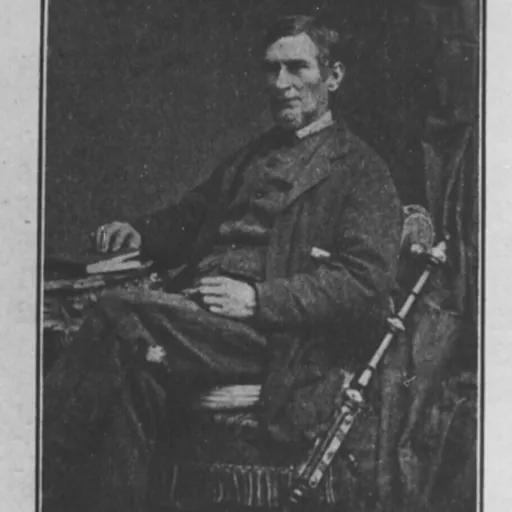
About Augustus Jones
Lived 1757 – 1836 (aged 78–79). Augustus Jones was an American magistrate and surveying.
Augustus Jones ( – November 16, 1836) was a North American-born Upper Canadian farmer, land speculator, magistrate, militia captain and surveyor. Jones trained as a surveyor in New York City, and fled as a United Empire Loyalist to Upper Canada. In Upper Canada, he worked as a crown surveyor in the Nassau District, where he quickly rose to the position of Deputy Surveyor General, the highest position in a district of Upper Canada. He occupied that position from 1789 informally, and 1791 formally, until his retirement in 1799. During that time he laid down many of the township boundaries in the Niagara Peninsula and on the north shore of Lake Ontario. He led various teams that cut many of the first sideroads and concession roads into these areas, facilitating their settlement by European and American immigrants. Jones also surveyed the routes for Dundas Street and Yonge Street, and supervised their construction. After his retirement, Jones farmed first in Saltfleet Township, later moving to Brantford and finally an estate outside Paris named Cold Springs, where he died in 1836.
Youth Augustus Jones was born to Ebenezer Jones, a Welsh immigrant, around 1757, likely in Dutchess County of the Province of New York. In his youth, he trained as a land surveyor in New York City. Jones worked for some years across New York, and his name appears in paperwork for land transfers in Newburgh, New York, in 1783 and 1784.
Flight from the United States Jones and his family remained loyal to the British Crown, and sometime in the 1780s, Jones; his father, Ebenezer; his brother, Stephen, and Stephen's family; and his sisters, Mary and Susannah, fled the United States. Jones proceeded ahead and obtained of land in Saltfleet Township, part of which would later become the site of the Battle of Stoney Creek.
Crown surveyor Jones met Major Archibald Campbell, the commanding officer of Fort Niagara on June 9, 1787. He presented the Major with a letter of recommendation from Cadwallader Colden Junior, which attested to Jones' good character and surveying capability. Two days later, Jones was hired as a land surveyor for the Crown.
After a short while, Jones was given command of his own surveying team. His first assignment was the surveying of Stamford Township, a task they began on November 5, 1787, and completed on January 8, 1788. That January, Jones was appointed to the position of assistant to Philip Frey, the deputy surveyor of the Nassau District. From January 15 to March 12, Jones surveyed Barton Township. From April 1 to 24, Jones surveyed Clinton Township. From May 1 to July 28, Jones led the survey of Bertie Township. From July 24 to August 24, Jones's team surveyed Saltfleet Township. From August 24 to October 25, the team surveyed Thorold Township. In Thorold, Jones was receiving a pay of four shillings a day, and his two primary assistants, Joseph Jones and Benjamin Stanton, received the same. All worked the full 54 days of the survey. Local men were hired as woodcutters and chainbearers for shorter periods, and typically earned two shillings a day.
On October 25, 1788, Jones's team began their survey of Grimsby Township; it was completed November 13, 1788. Saltfleet Township was surveyed from November 14, 1788, to December 25, 1788, and Binbrook Township was surveyed from December 24, 1788, until February 12, 1789. All of these townships were surveyed using the Front and Rear system, except Binbrook, which was surveyed with the Single Front system. During this time, Frey had assigned two other surveyors to lead surveys in the Nassau district. Daniel Hazen and Jesse Pawling both led teams, but neither group was as busy as Jones' group. Hazen's group surveyed only four townships, and incompletely, and Pawling's three, also incompletely. Glasgow Township, York Township and Etobicoke Township. Sideroads were then run north to the first concession road. Clarke township had previously been unnamed, Jones was the one to name it. The survey of the west end of the Nassau district finalised the boundary of the Toronto Purchase, which had been agreed upon in principle, but could not be completed because the land areas involved were not well known. On June 13, 1792, Jones submitted a town plan for Newark, Upper Canada to the Land Board.
Around this time, Jones began to acquire significant tracts of land across southern Ontario. He obtained large sections of land in Saltfleet Township and Barton Township with various petitions and grants, and small lots in Newark and York.
For a 1793, project, Simcoe employed the Queen's Rangers led by Captain Samuel Smith; this survey would be for the construction of a road from Hamilton to Woodstock; it would eventually become Dundas Street. The same year, he surveyed Flamborough Township, Beverley Township, Ancaster Township and York Township. Jones spent 1794 surveying Flamborough, Glanford, Binbrook, Delaware, Oxford, Dorchester, Burford, Grimsby and Windham. On the 29th of that December, Jones was given the assistance of thirty of the Queen's Rangers for the road's construction. The work began January 4, 1796, on this road, which would become Yonge Street. Jones worked as the effective master builder in addition to his title as surveyor. The road reached Holland Landing on February 16, 1796, and Jones returned to York on February 20 to inform the Lieutenant Governor that the road was completed. This first incarnation of Yonge Street measured some 34 miles and 53 chains. For the rest of 1796, Jones spent his time surveying Newark, Flamborough, Grimsby, Saltfleet, Beverley, York and Coot's Paradise.
Jones spent 1797 surveying Pickering, Glanford, Oxford and Blenheim. That year, he also surveyed the Humber Mill Reserve, Yarmouth, Gore, Newark and Stamford.
Farmer, magistrate and militia captain
Jones retired from his surveying work in 1800. Various reasons have been suggested for this step. One news item from 1995 offered this explanation: These financial losses, coupled with prejudice from his white neighbours towards Jones due to his Indian wife and children and their knowledge he had previously been married to two Indian women simultaneously led to the move. Jones made one last survey in 1825, resurveying the line of Dundas Street between Ancaster Township and West Flamborough Township. In Brantford he supported his family both by farming, and by selling of bits of land he had accumulated in his youth. After several years in Brantford, he moved to his estate Cold Springs on Dundas Street east of Paris, Ontario, where he farmed until his death.
Family life Peter Jones, Augustus Jones' younger son by Tuhbenahneequay. This photograph was taken August 4, 1845, by Hill & Adamson in Edinburgh, Scotland. It is the oldest surviving photograph of a North American Indian. On April 27, 1798, Jones married Sarah Tekarihogen (Tekerehogen), the daughter of Mohawk chief Tekarihogen. The couple would have a total of eight children. Their children were named Catherine, Rachel, Mary, Henry, Joseph, Sally, Lucretia and Augustus Junior (born 1818).
While married to Sarah Tekarihogen, Jones maintained a relationship with Tuhbenahneequay (Sarah Henry), the daughter of Mississauga chief Wahbanosay. Jones had previously hired Wahbanosay as a guide during some of his surveying expeditions in the area, including the surveying of Yonge Street. Their relationship had begun in the mid-1790s, and Jones had previously married Tuhbenahneequay in a Mississauga ceremony. Their first son, John (anglicised as Theyandanegea, written in Ojibwa as Tyenteneged, after Joseph Brant)
Although Jones took no part in the raising of his children by Tuhbenahneequay, he did take an active interest in their welfare. In 1805, he secured a pair of two-square-mile plots of land near the mouth of the Credit River for his two sons from the local Mississauga Indians, but the government of Upper Canada would not recognise the title. In 1816, Jones feared that the Mississauga band his sons John and Peter lived with would fall apart, in the aftermath of the War of 1812, the famine of 1816's harvest and the influx of settlers to the area in recent years. Jones travelled to find the boys, and brought them to his farm in Stoney Creek. He arranged for the boys to be schooled in Stoney Creek, as neither spoke much English. After nine months, Jones felt that Peter's command of English was sufficient, and took him out of school to teach him the farming craft. The next year, Jones and his family relocated to land near Paris, Ontario
Jones died on November 16, 1836, near Paris, Ontario. He was buried at Cold Springs, where his farm was located. After the death of his son Peter in 1856, Jones' remains were moved to Greenwood Cemetery in Brantford, Ontario, and interred beside Peter's. His grave was unmarked.
Honours On September 10, 2005, the city of Hamilton, Ontario, unveiled a statue of Jones in Stoney Creek Town Square.
A 1995 news article summarized the value of the major surveys completed by Augustus Jones as follows. "The work he did 200 years ago determined the eventual geographic and political boundaries of Centre Wellington and much of southern Ontario."
Don’t just read it —
keep it.
Full-length biographies made to live with: read them, listen on the way to work, watch them tonight.
- E-book
- Audio
- Video
Instant download · yours to keep · every purchase keeps this site free
Important facts
Family & relationships
People in Augustus Jones's life
Named in this biography and alive at the same time





Related people
Same field, nearest in time


Contemporaries
People whose lives overlapped Augustus Jones's



Frequently asked questions
Who was Augustus Jones?
Upper Canadian Surveyor
When was Augustus Jones born?
Augustus Jones was born in 1757 in Hudson Valley.
When did Augustus Jones die?
Augustus Jones died on 16 November 1836 in Paris.
What was Augustus Jones's occupation?
Augustus Jones was a magistrate and surveying.
What nationality was Augustus Jones?
Augustus Jones was American.
Sources & further reading
Cite this page
APA: Biography.guide. (2026). Augustus Jones. https://biography.guide/augustus-jones/
MLA: "Augustus Jones." Biography.guide, https://biography.guide/augustus-jones/.
Chicago: "Augustus Jones." Biography.guide. https://biography.guide/augustus-jones/.
Data last updated: 2026-09-23 · Spot an error? Report a correction.
Portrait: Wikimedia Commons · author & licence
Page generated 2026-09-27 05:05 UTC