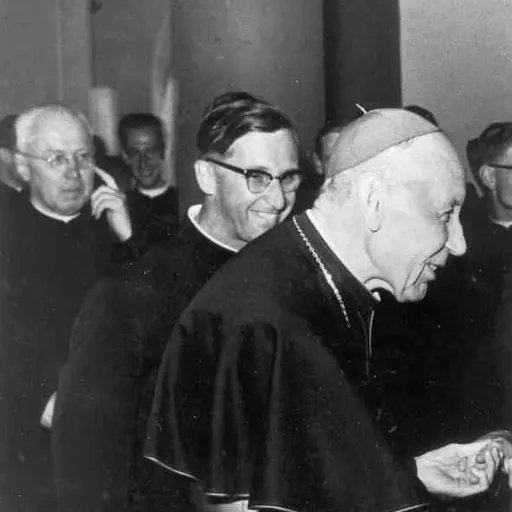
Augustin Bea
German Jesuit priest and scholar and cardinal
About Augustin Bea
Lived 1881 – 1968 (aged 87). Augustin Bea was a German theologian, university teacher, catholic priest and catholic bishop.
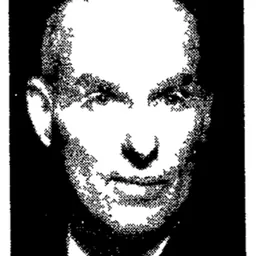
Augustin Bea (28 May 1881 – 16 November 1968) was a German Jesuit priest, cardinal, and scholar at the Pontifical Gregorian University, specialising in biblical studies and biblical archaeology. He also served as the personal confessor of Pope Pius XII.
He was made a cardinal in 1959 by Pope John XXIII and served as the first president of the Secretariat for Promoting Christian Unity from 1960 until his death. Bea was a leading biblical scholar and ecumenist, who greatly influenced Christian-Jewish relations during the Second Vatican Council in Nostra aetate. Bea published several books, mostly in Latin, and 430 articles.
Biography
Early life and education Bea was born in Riedböhringen, today a part of Blumberg, Baden-Württemberg; his father was a carpenter. He studied at the universities of Freiburg, Innsbruck, Berlin, and at Valkenburg, the Jesuit house of studies in the Netherlands. On 18 April 1902, he joined the Society of Jesus, as he "was much inclined to the scholarly life". Bea was ordained a priest on 25 August 1912, and finished his studies in 1914.
Priestly ministry Bea served as superior of the Jesuit residence in Aachen until 1917, at which time he began teaching Scripture at Valkenburg. From 1921 to 1924, Bea was the provincial superior of Germany. Superior General Wlodimir Ledóchowski then sent him to Rome, where he worked as the superior of the Biennial House of Formation (1924–1928), professor at the Pontifical Biblical Institute (1924–1949), and rector of the Institute of Superior Ecclesiastical Studies (1924–1930). In 1930, Bea was named rector of the Pontifical Biblical Institute, a post in which he remained for nineteen years.
Consistory and episcopal ministry When Pius XII proposed appointing Bea to the College of Cardinals in 1946, Superior General Jean-Baptiste Janssens spoke out against it, as many felt the Holy See was showing preferential treatment to the Jesuits. Raised to the rank of cardinal before his episcopal consecration, Bea was created Cardinal-Deacon of S. Saba by Pope John XXIII in the consistory of 14 December 1959. On 6 June 1960, he was appointed the first president of the newly formed Secretariat for Promoting Christian Unity, a Curial organisation charged with ecumenical affairs. It was not until two years later that, on 5 April 1962, Cardinal Bea was appointed a bishop: the Titular Archbishop of Germania in Numidia. He received his consecration on the following 19 April from John XXIII himself, with Cardinals Giuseppe Pizzardo and Benedetto Aloisi Masella serving as co-consecrators, in the Lateran Basilica. He resigned his post as titular archbishop in 1963, one year after the Second Vatican Council was convened.
Cardinal Bea was one of the electors in the 1963 papal conclave which elected Pope Paul VI, and was confirmed as the president of the Secretariat for Promoting Christian Unity (renamed the Pontifical Council for Promoting Christian Unity by Pope John Paul II on 28 June 1988) on 3 January 1966.
In 1963 he invited Protestant theologian Karl Barth to attend the Second Vatican Council as an observer, but Barth was unable to do so due to health reasons.
Cardinal Bea died from a bronchial infection in Rome, at the age of 87. He was buried in the apse of the parish church of Saint Genesius in his native Riedböhringen,
Bea was highly influential at the Second Vatican Council in the 1960s as a decisive force in the drafting of Nostra aetate, which repudiated anti-Semitism. In 1963, he held secret talks with Abraham Joshua Heschel, promoting Catholic–Jewish dialogue. John Borelli, a Vatican II historian, has observed that, "It took the will of John XXIII and the perseverance of Cardinal Bea to impose the declaration on the Council". During a session of the Central Preparatory Commission, he also rejected the proposition that the Council Fathers take an oath composed of the Nicene Creed and the anti-modernist oath. After Alfredo Ottaviani, the strongly conservative head of the Holy Office, presented his draft of the schema on the sources of Divine Revelation, Bea claimed that it "would close the door to intellectual Europe and the outstretched hands of friendship in the old and new world"; The Pope appointed Ottaviani and Bea to be the co-chairs of a commission set up to revise the draft in order to resolve the deadlock, leading ultimately to the presentation of revelation comprising both scripture and tradition which featured in the Dogmatic Constitution on Divine Revelation (Dei Verbum).
Bea was the author of The Church and the Jewish People (New York: Harper & Row, 1966) and marking the 50th anniversary of his death, Pope Francis called Cardinal Bea "an outstanding figure" who should not only be remembered for what he did, but also the way he did it. "He remains", the Pope said, "a model and a source of inspiration for ecumenical and interreligious dialogue, and in an eminent way for the "intra-familial" dialogue with Judaism".
Awards
1965 International Prize for the brotherhood of the Fellowship Commission (International Fellowship Award), Philadelphia, Pennsylvania, US 1966 Peace Prize of the German Book Trade, along with Willem Visser 't Hooft 1967 Human Relations Award for the Society for Family of Man (New York)
Published works Augustin Bea published 430 articles in the years 1918–1968. They dealt with archaeological issues, exegesis of Old Testament texts, Mariology, papal encyclicals, the unity of Christians, anti-Semitism, Vatican II, relations to Protestantism and the eastern Orthodox Churches, and ecumenicism.
Among his books: Hugo Rahner and Augustin Bea, Schöningh, Paderborn, 1947 , Buenos Aires, Revista Biblica, 1954 , Romae, 1933 , Romae, 1935 , Romae, 1939 , Romae 1946 , Romae, 1950 , Romae, 1953 , Herder Freiburg, 1959 (German translation of ), Herder Freiburg, 1966
Don’t just read it —
keep it.
Full-length biographies made to live with: read them, listen on the way to work, watch them tonight.
- E-book
- Audio
- Video
Instant download · yours to keep · every purchase keeps this site free
Important facts
People in Augustin Bea's life
Named in this biography and alive at the same time



Related people
Same field, nearest in time


Contemporaries
People whose lives overlapped Augustin Bea's





Frequently asked questions
Who was Augustin Bea?
German Jesuit priest and scholar and cardinal (1881-1968)
When was Augustin Bea born?
Augustin Bea was born on 28 May 1881 in Blumberg.
When did Augustin Bea die?
Augustin Bea died on 16 November 1968 in Rome.
What was Augustin Bea's occupation?
Augustin Bea was a theologian, university teacher, catholic priest and catholic bishop.
What nationality was Augustin Bea?
Augustin Bea was German.
Sources & further reading
Cite this page
APA: Biography.guide. (2026). Augustin Bea. https://biography.guide/augustin-bea/
MLA: "Augustin Bea." Biography.guide, https://biography.guide/augustin-bea/.
Chicago: "Augustin Bea." Biography.guide. https://biography.guide/augustin-bea/.
Data last updated: 2026-09-21 · Spot an error? Report a correction.
Portrait: Wikimedia Commons · author & licence
Page generated 2026-09-27 04:59 UTC