
Auguste Lacome
Basque settler in America
About Auguste Lacome
Lived 1812 – 1888 (aged 75–76). Auguste Lacome was a mountain man.
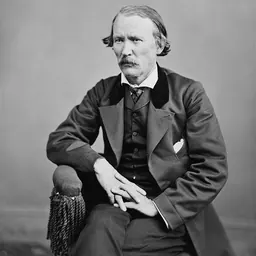
Auguste Sylvestre LaCome (October 25, 1821 – November 11, 1888) was a French settler and trader in the New Mexico Territory and brother of Jean Baptiste (Juan Bautista) LaCome. He led the search for the survivors of the White massacre.
Biography
Early life Auguste LaCome was born in the township of Ordizan near the French/Spanish border. His maternal grandfather, Alexis Doleac, left the priesthood to join the French Revolution in the name of liberty and equality. LaCome's father worked as a medical officer. His parents had three other sons besides Auguste and Jean Baptiste. One of those brothers, Joseph LaCome, also left France to travel to South America. None of their three daughters survived to adulthood.
US census records list Auguste LaCome's birthplace as both France and Spain, but he and his brother are referred to as "Frenchmen" in contemporary sources. He was issued a passport on August 6, 1842, and left from the port of Bordeaux aboard the Talma on September 9, 1842. He landed at New Orleans before settling in the New Mexico Territory. LaCome's physical appearance is described as being 1.73 meters tall (5'10") with chestnut hair and eyebrows, oval face, and pointed chin.
Family Restoration of Maria Rosa Arellano's San Luis, Colorado, gravestone. Inscription reads, "In memory of Maria Rosa Arellano, wife of Agustin LaCome, who passed away September 22 of 1873 at the age of 39 years". Auguste married Maria Rosa Arellano April 26, 1855, at Nuestra Señora de Los Dolores in Arroyo Hondo. Maria Rosa was born in 1833 in the Mexican territory of Santa Fe de Nuevo México before the Mexican Cession of the Mexican–American War. Her grandmother was known as "Josefa la Apache". She died while the LaCome family lived in San Luis, Colorado.
Children of Auguste and Maria Rosa Juan Maria LaCome, second from right and wife, Rumalita LaForet, at far right. Juan Maria and Rumalita's young son, José Augustin, is also pictured. José Eulogia (March 16, 1856 – died May 23, 1918) Gabriel Augustin (February 2, 1858 – ??) Pedro Antonio (adopted Navajo boy baptized at 12 years old in 1863) Further, the band had resolved to kill the party with the exception of one of the peons, who was to be allowed to live to inform the governor of their actions. An arrow was shot at LaCome but the interpreter jarred the Ute who held the bow and it missed its mark. After much negotiation the Utes consigned to only give a severe whipping to the interpreter and a peon. LaCome's rifle was returned to him, being too heavy for their use, along with four of his worn out mules, two oxen and two cows.
At the same time as this second mission, an incident at the mercantile at Rio Colorado had a band of Utes arriving with local Mexicans as hostages to intimidate illegal trade. LaCome returned to Rio Colorado after his encounter with the Muache band and, based on these incidents, presented a petition on behalf of citizens of Taos County to Calhoun for a campaign against the Apache. Kit Carson was also a signer of the petition. These rising conflicts foreshadowed the Jicarilla War.
Other documented trading In 1852, LaCome took trade items, including knives, tobacco, coffee, lead, sugar, and other goods, loaded on mules to trade with the Navajo at Cañon de Chelly. He returned a month later.
Trading license records specify that he traded with the Navajo at the Canyon de Chelly and that he traded with other Pueblos in addition to the Zuni. They also indicate he lived in San Luis, Colorado, and Rio Colorado, New Mexico, and traded as far as Wyoming and Nebraska.
The Spiegelberg Brothers are listed on several of his licenses as providing the surety bonds required by the territorial government for trade with the Native Americans. Abraham Staab, a prominent Jewish donor for the Cathedral in Santa Fe, is also listed.
A letter in French to Manuel Álvarez, a fellow trader and lieutenant-governor of New Mexico, notes their friendship and business dealings.
The 1860 census of Taos/Arroyo Hondo lists his occupation as a merchant with real estate valued at $2,000 and personal property at $8,000 (approximately $55,500 and $225,000 respectively in 2013 dollars).
A Pueblo Chieftain article dated June 8, 1872, lists LaCome's mercantile as one of three stores in San Luis in addition to a blacksmith, butcher, beer saloon, carpenter, and two hotels.
Hawken rifle
LaCome's .58 caliber percussion-lock prairie rifle is displayed in the Palace of the Governors museum in Santa Fe, where he is listed as a trader with the Zuni and Navajo. It is a Hawken style with a snail breech and double-set trigger in a scroll guard. The .58 caliber untapered barrel is 36" x 1-1/8", and the rifle is approximately 53" in overall length with a 13-5/8" length of pull.
The rifle was originally a fullstock, but was either damaged and repaired or intentionally cut down to a halfstock length. A custom pewter nose cap on the stock and an oak underrib were added in the modification. The front sight is a copper base with bone blade. The cheekpiece is an earlier square style typically found on flintlocks, rather than the beavertail typical of later percussion locks.
Senate run In 1876 Colorado held its first state elections. At age 55, LaCome ran against William H. Meyer for State Senate in Costilla County, 18th District. Meyer would later become the lieutenant governor of Colorado. Votes cast for "Locome" and "Lacompte" were included in the count for LaCome. Meyer carried the election 349–204.
Death and legacy
LaCome died on November 11, 1888, and was buried beneath the floor of Nuestra Señora de los Dolores church in Arroyo Hondo.
LaCome's son, José Eulogio, inherited the mercantile and went on to serve as a sheriff and New Mexico state legislator, as well as owning a saloon and hotel and silver and gold mines. Sylvestre Augustin built a house in Arroyo Hondo that still stands on LaCome Road.
Don’t just read it —
keep it.
Full-length biographies made to live with: read them, listen on the way to work, watch them tonight.
- E-book
- Audio
- Video
Instant download · yours to keep · every purchase keeps this site free
Important facts
People in Auguste Lacome's life
Named in this biography and alive at the same time

Related people
Same field, nearest in time



Contemporaries
People whose lives overlapped Auguste Lacome's




Frequently asked questions
Who was Auguste Lacome?
Basque settler in America
When was Auguste Lacome born?
Auguste Lacome was born in 1812 in Ordizan.
When did Auguste Lacome die?
Auguste Lacome died on 11 November 1888 in Arroyo Hondo, Taos County, New Mexico.
What was Auguste Lacome's occupation?
Auguste Lacome was a mountain man.
Sources & further reading
Cite this page
APA: Biography.guide. (2026). Auguste Lacome. https://biography.guide/auguste-lacome/
MLA: "Auguste Lacome." Biography.guide, https://biography.guide/auguste-lacome/.
Chicago: "Auguste Lacome." Biography.guide. https://biography.guide/auguste-lacome/.
Data last updated: 2026-09-22 · Spot an error? Report a correction.
Page generated 2026-09-27 05:31 UTC