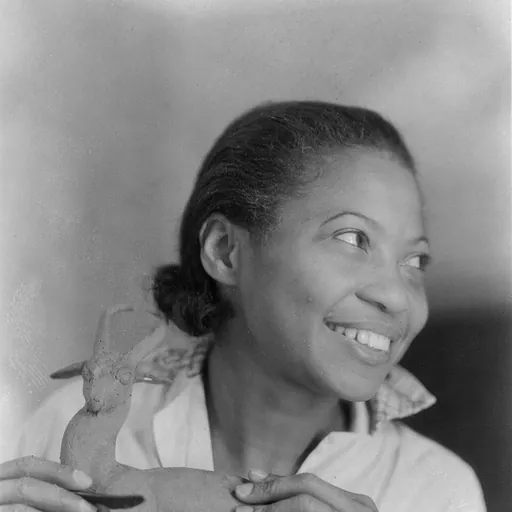
About Augusta Savage
Lived 1892 – 1962 (aged 70). Augusta Savage was an American sculptor, human rights defender, artist and educator.
Augusta Savage (born Augusta Christine Fells; February 29, 1892 – March 27, 1962) was an American sculptor associated with the Harlem Renaissance.
Early life Augusta Christine Fells was born in Jacksonville, Florida, on February 29, 1892, to Edward Fells and Cornelia Murphy. Her father was a poor Methodist minister who strongly opposed his daughter's early interest in art. "My father kicked me four or five times a week," Savage once recalled, "and almost whipped all the art out of me." This was because he believed her sculpture to be a sinful practice, due to his interpretation of the "graven images" portion of the Bible. She persevered, and the principal of her new high school in West Palm Beach, where her family relocated in 1915, encouraged her talent and allowed her to teach a clay modeling class. This began a lifelong commitment to teaching, as well as to creating art.
Personal life In 1907, at the age of 15, Augusta Fells married John T. Moore; the two had a daughter, Irene Connie Moore, who was born the following year. John died shortly thereafter. she retained the name Savage throughout her life, even after the two divorced in the early 1920s. Her talent and ability impressed the Cooper Union Advisory Council and she was awarded additional funds for room and board after losing the financial support of her job as an apartment caretaker.
After completing studies at Cooper Union, Savage worked in Manhattan steam laundries to support herself and her family. Her father had been paralyzed by a stroke, and the family's home destroyed by a hurricane. Her family from Florida moved into her small West 137th Street apartment. During this time, she obtained her first commission from the New York Public Library on West 135th Street, a bust of W. E. B. Du Bois.
In the spring of 1923, Savage applied for a summer art program at the Fontainebleau School of Fine Arts in France. Savage was deeply upset and questioned the committee, beginning the first of many public fights for equal rights in her life by writing a letter to the New York World. Poston died of pneumonia aboard a ship while returning from Liberia as part of a Universal Negro Improvement Association and African Communities League delegation in 1924. In 1925, Savage won a scholarship with the help of W.E.B DuBois to the Royal Academy of Fine Arts in Rome. This scholarship only covered tuition, and after being unable to raise money for travel and living expenses, she was unable to attend.
Savage won the Otto Kahn Prize in a 1928 exhibition at the William E. Harmon Foundation with her submission Head of a Negro.
In 1929, with the help of pooled resources from the Urban League, Rosenwald Foundation, a Carnegie Foundation grant, and donations from friends and former teachers, Savage was able to travel to France, at age 37. Savage settled into an apartment in Montparnasse and worked in the studio of [Félix] Benneteau[-Desgrois], a professor at the school. In Paris, she also studied with the sculptor Charles Despiau. She exhibited, and twice won awards, at the Paris Salon and at one Exposition. She toured France, Belgium, and Germany, researching sculpture in cathedrals and museums.
Later career and teaching Savage returned to the United States in 1931, energized from her studies and achievements. The Great Depression had almost stopped art sales. She pushed on, and in 1934 became the first African-American artist to be elected to the National Association of Women Painters and Sculptors. She launched the Savage Studio of Arts and Crafts, located in a basement on West 143rd Street in Harlem, with the help of a grant from the Carnegie Foundation.
Savage was one of four women and only two African Americans to receive a professional commission from the Board of Design to be included in the 1939 New York World's Fair. and was one of the most popular and most photographed work at the fair; small metal souvenir copies were sold, and many postcards of the piece were purchased. Savage did not have funds to have the piece cast in bronze or to move and store it, and so like other temporary installations, the sculpture was destroyed at the close of the fair. While in Saugerties, she established close ties with her neighbors and welcomed family and friends from New York City to her rural home. Savage cultivated a garden and sold pigeons, chickens, and eggs. The K-B Products Corporation, the world's largest growers of mushrooms at that time, employed Savage as a laboratory assistant in the company's cancer research facility. She acquired a car and learned to drive to enable her commute. Herman K. Knaust, director of the laboratory, encouraged Savage to pursue her artistic career and provided her with art supplies. Though her art production slowed down, Savage taught art to children in summer camps and sculpted friends and tourists, and explored writing children's stories.
Much of her work is in clay or plaster, as she could not often afford bronze. One of her most famous busts is titled Gamin which is on permanent display at the Smithsonian American Art Museum in Washington, D.C.; a life-sized version is in the collection of the Cleveland Museum of Art. At the time of its creation, Gamin, which is modeled after a Harlem youth, was voted most popular in an exhibition of over 200 works by black artists. Her style can be described as realistic, expressive, and sensitive. Though her art and influence within the art community are documented, the location of much of her work is unknown.
Savage moved in with her daughter, Irene, in New York City when her health started to decline, she later died of cancer on March 26, 1962. Gould claimed to be working on the longest book ever written, The Oral History of Our Time. He became obsessed with Savage, writing to her constantly, and proposing marriage. This obsession, which seems to have been violent, and may have involved rape, lasted for more than two decades. During those years, Gould was arrested several times for attacking women. He was in and out of psychiatric hospitals, where he was eventually diagnosed as psychopathic. Gould died in 1957, in a psychiatric hospital, likely after having been lobotomized in 1949. After the article was published, the writer Millen Brand, a friend of Savage's, wrote to Mitchell to tell him that he was wrong, that the Oral History did exist, reporting that "Joe [Gould] showed me long sections of the Oral History that were actually oral history ... the longest stretch of it, running through several composition books and much the longest thing probably that he ever wrote, was his account of Augusta Savage." Brand told Mitchell that Savage had been terrified of Gould but, as a Black woman, was unable to get help from the police. Mitchell never reported any of this, but New Yorker writer Jill Lepore, drawing from evidence in the Millen Brand Papers at Columbia and the Joseph Mitchell papers, then newly deposited at the New York Public Library, told the story in a 2016 book called Joe Gould's Teeth in which she speculated that Savage left New York in 1945 to escape Gould. Sculptural interpretation of Negro Music Gwendolyn Knight, 1934–35
Individual exhibitions Grande Chaumière, Paris, 1929 Salon d'Automne, Paris, 1930 Argent Galleries, New York and Art Anderson Gallery, New York, 1932 Argent Galleries, New York and New York World's Fair, 1939 New York Public Library, 1988
Legacy Augusta Fells Savage Institute of Visual Arts in Baltimore is named after her. She is the namesake of the Augusta Savage Gallery at the University of Massachusetts Amherst. Namesake of the Augusta Savage Friendship Park, Green Cove Springs FL Namesake of the Augusta Savage Arts and Cultural Center, Green Cove Springs FL
Don’t just read it —
keep it.
Full-length biographies made to live with: read them, listen on the way to work, watch them tonight.
- E-book
- Audio
- Video
Instant download · yours to keep · every purchase keeps this site free
Important facts
Family & relationships
People in Augusta Savage's life
Named in this biography and alive at the same time






Related people
Same field, nearest in time



Contemporaries
People whose lives overlapped Augusta Savage's

Frequently asked questions
Who was Augusta Savage?
American sculptor (1892–1962)
When was Augusta Savage born?
Augusta Savage was born on 29 February 1892 in Green Cove Springs.
When did Augusta Savage die?
Augusta Savage died on 26 March 1962 in New York City.
What was Augusta Savage's occupation?
Augusta Savage was a sculptor, human rights defender, artist and educator.
What nationality was Augusta Savage?
Augusta Savage was American.
Sources & further reading
Cite this page
APA: Biography.guide. (2026). Augusta Savage. https://biography.guide/augusta-savage/
MLA: "Augusta Savage." Biography.guide, https://biography.guide/augusta-savage/.
Chicago: "Augusta Savage." Biography.guide. https://biography.guide/augusta-savage/.
Data last updated: 2026-09-22 · Spot an error? Report a correction.
Portrait: Wikimedia Commons · author & licence
Page generated 2026-09-27 05:02 UTC