
About Aubrey Faulkner
Lived 1881 – 1930 (aged 48). Aubrey Faulkner was a cricketer.
George Aubrey Faulkner (17 December 1881 – 10 September 1930) was a South African cricketer who played 25 Test matches for South Africa and fought in both the Second Boer War and World War I. In cricket, he was an all-rounder who was among the best batsmen in the world at his peak and was one of the first leg spin bowlers to use the googly.
Faulkner played Test cricket for South Africa from 1906 to 1912. His greatest achievements as a Test cricketer included taking six wickets in eleven overs against England and the first-ever double century by a South African. He was the best all-rounder in the world during his career. Following his Test career, he played club cricket in Nottingham.
Faulkner was awarded the Distinguished Service Order and Order of the Nile for his bravery in World War I. During the war, he contracted malaria multiple times, which physically deteriorated his body. Unable to play cricket at the same level as before the war, he turned instead to coaching, starting a cricket school, and training several future Test cricketers. Faulkner likely suffered from undiagnosed bipolar disorder, and he committed suicide in September 1930. In June 2021, he was inducted into the ICC Cricket Hall of Fame as one of the special inductees to mark the inaugural edition of the ICC World Test Championship final.
Early life
Faulkner was born in Port Elizabeth, Cape Colony on 17 December 1881. His father was a wealthy man and Faulkner was able to attend the prestigious Wynberg Boys' High School, but he endured violence in his childhood as his father was an alcoholic and a wife-beater (Faulkner himself became a lifelong teetotaller). On one occasion, he returned home from school to find his father had assaulted his mother, and he reacted by beating up his father. Faulkner left home at the age of nineteen and moved to Johannesburg to join the Imperial Light Horse and fight in the Anglo-Boer War. He was promptly selected for his Test debut in the first Test of the series against England at Johannesburg, where he was part of a four-man googly attack along with Schwarz, Bert Vogler and Gordon White. and he retained his place throughout the whole series, being a significant contributor to South Africa's 4–1 series victory and at times being more difficult to play than any of the other South African bowlers.
Faulkner was selected for the South African tour of the United Kingdom in 1907. His mastery of googly bowling, along with that of Schwarz, Vogler, and White, had a significant effect on the acceptance of wrist spin as an effective bowling weapon, the highlight of the tour for Faulkner being his spell at the Leeds Test match. England was batting first and had survived to lunch with only one wicket lost. Faulkner came on to bowl after lunch, and in the span of eleven overs, took six wickets for just 17 runs. During this tour, the four spinners took a combined total of 228 first-class wickets, with some Englishmen complaining that Faulkner's googly was unfair because it was so hard to detect. When he came in to bat in the second innings, South Africa were less than 30 runs ahead. Still, Faulkner scored his maiden Test century with 123 runs out of 216 of the runs scored over two hours and fifty minutes. England was chasing 244 runs for victory and still had two wickets in hand with 46 runs to go before Faulkner took the match's final two wickets to give South Africa a 19-run win. Faulkner was chaired off of the ground by his teammates for his efforts. South Africa went on to win the series, and Faulkner would be their top run-scorer in 5 of the 10 innings. He scored 545 runs at 60.55 and took 29 wickets at 21.89, the highest run-scorer from either team and the second-highest wicket-taker. These would be the last Test matches that Faulkner ever played in South Africa. The conditions in Australia were alien to Faulkner, so he shut out most of the socializing of the tour and worked on his batting in the nets. Even during the Test matches, he was practicing his batting in the nets until he had to come in to bat instead of watching the match. In the second Test match at the Melbourne Cricket Ground, Australia were bowled out on the first day for 348 and Faulkner came out to bat early on the second day. He passed 150, the first South African to do so in 25 years of playing Test cricket, then scored the first-ever South African double-century, batting well into the match's third day. His innings lasted more than five hours, and he hit twenty-six fours. He played so strongly off of the back foot that when his bat hit the ball, it sounded like a pistol shot. It took 40 years for another South African to score a Test double century. South Africa's 150-run first innings lead was blown away by a 159 scored by Victor Trumper faster than a run every ball. Faulkner went overly defensive in the second innings and was dismissed for 8 runs, and South Africa was bowled out for 80 to lose the match by 89 runs. Over the five-match series, Faulkner scored 723 runs, which was more than the second and third-best South African batsmen combined.
Move to England
Faulkner moved to England in 1912 intending to play county cricket for either Surrey or Middlesex, but businessman Julien Cahn offered him more money to play club cricket in Nottingham. In just a season of 1912, he scored 2,868 runs with an average of 84.35, including multiple double-centuries, and took 218 wickets, including ten in a match on two occasions.
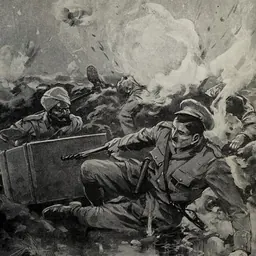
Following the outbreak of World War I, Faulkner enlisted in the British Army, joining the Royal Field Artillery and served on the Western Front, Macedonia and Palestine, taking part in the capture of Jerusalem. Early in his career he was primarily seen as a bowler because of his great use of the googly, but later he developed into a great batsman. Because Faulkner's googly was fast and hard to detect, it was almost un-hittable and often resulted in taking a wicket.
In Faulkner's time, most batsmen stood side-on as the bowler approached, but Faulkner stood open and flexed his bottom hand around the grip of his bat. He had eccentric footwork in his defense but had good technique. His strike of the ball was aggressive and powerful. Faulkner was also a strong fielder. He typically fielded in the slips, but he was also a capable outfielder.
Don’t just read it —
keep it.
Full-length biographies made to live with: read them, listen on the way to work, watch them tonight.
- E-book
- Audio
- Video
Instant download · yours to keep · every purchase keeps this site free
Important facts
People in Aubrey Faulkner's life
Named in this biography and alive at the same time
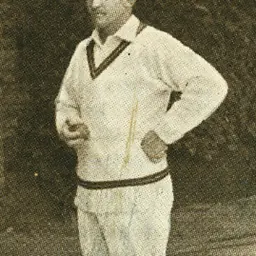

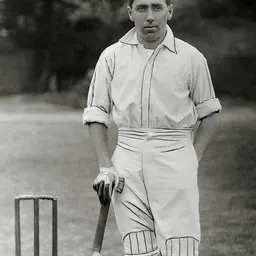
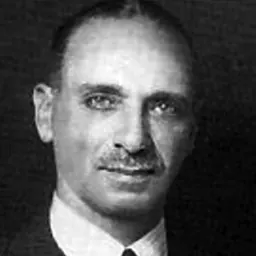
Related people
Same field, nearest in time

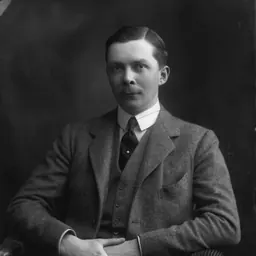



Contemporaries
People whose lives overlapped Aubrey Faulkner's




Frequently asked questions
Who was Aubrey Faulkner?
South African cricketer (1881-1930)
When was Aubrey Faulkner born?
Aubrey Faulkner was born on 17 December 1881 in Gqeberha.
When did Aubrey Faulkner die?
Aubrey Faulkner died on 10 September 1930 in Fulham.
What was Aubrey Faulkner's occupation?
Aubrey Faulkner was a cricketer.
What nationality was Aubrey Faulkner?
Aubrey Faulkner's recorded nationality: Union of South Africa.
Sources & further reading
Cite this page
APA: Biography.guide. (2026). Aubrey Faulkner. https://biography.guide/aubrey-faulkner/
MLA: "Aubrey Faulkner." Biography.guide, https://biography.guide/aubrey-faulkner/.
Chicago: "Aubrey Faulkner." Biography.guide. https://biography.guide/aubrey-faulkner/.
Data last updated: 2026-09-20 · Spot an error? Report a correction.
Page generated 2026-09-27 05:21 UTC