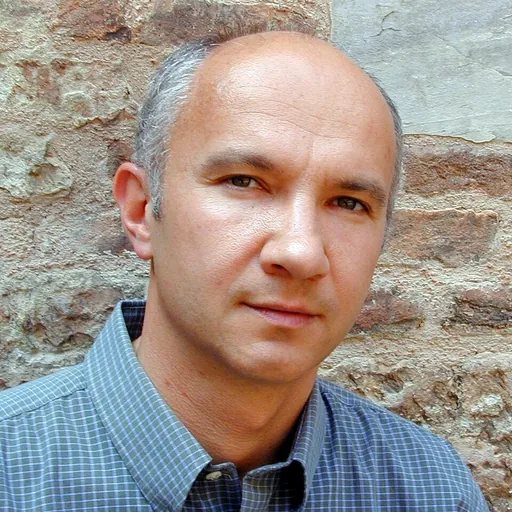
About Artur Ekert
Born 1961. Artur Ekert is a Polish and British physicist, university teacher and quantum physicist, known for Quantum cryptography.
Artur Konrad Ekert (born 19 September 1961) is a professor of quantum physics at the Mathematical Institute, University of Oxford, professorial fellow in quantum physics and cryptography at Merton College, Oxford, Lee Kong Chian Centennial Professor at the National University of Singapore and the founding director of the Centre for Quantum Technologies (CQT). His research interests extend over most aspects of information processing in quantum-mechanical systems, with a focus on quantum communication and quantum computation. He is best known as one of the pioneers of quantum cryptography.
Early life Ekert was born in Wrocław, and studied physics at the Jagiellonian University in Kraków and at the University of Oxford. Between 1987 and 1991 he was a graduate student at Wolfson College, Oxford. In his doctoral thesis and a professorial fellow of King's College, Cambridge. Since 2006 he is professor of quantum physics at the Mathematical Institute, University of Oxford. Also in 2006 was appointed a Lee Kong Chian Centennial Professor at the National University of Singapore In 2020 he joined the Okinawa Institute of Science and Technology as adjunct professor.
He has worked with and advised several companies and government agencies, served on various professional advisory boards, and is the Vice Chairman of The Noel Croucher Foundation.
Research Ekert's research extends over most aspects of information processing in quantum-mechanical systems, with a focus on quantum cryptography and quantum computation. Building on the idea of quantum non-locality and Bell's inequalities he introduced entanglement-based quantum key distribution. His 1991 paper generated a spate of new research that established a vigorously active new area of physics and cryptography. It is one of the most cited papers in the field and was chosen by the editors of the Physical Review Letters as one of their "milestone letters", i.e. papers that made important contributions to physics, announced significant discoveries, or started new areas of research. His subsequent work with John Rarity and Paul Tapster, from the Defence Research Agency (DRA) in Malvern, resulted in the proof-of-principle experimental quantum key distribution, introducing parametric down-conversion, phase encoding and quantum interferometry into the repertoire of cryptography. He and collaborators were the first to develop the concept of a security proof based on entanglement purification.
Ekert and colleagues have made a number of contributions to both theoretical aspects of quantum computation and proposals for its experimental realisations. These include proving that almost any quantum logic gate operating on two quantum bits is universal, proposing one of the first realistic implementations of quantum computation, e.g. using the induced dipole-dipole coupling in an optically driven array of quantum dots, introducing more stable geometric quantum logic gates, and proposing "noiseless encoding", which became later known as decoherence free subspaces.
His other notable contributions include work on quantum state swapping, optimal quantum state estimation and quantum state transfer. With some of the same collaborators, he has written on connections between the notion of mathematical proofs and the laws of physics. He has also contributed semi-popular writing on the history of science.
Honours and awards For his discovery of quantum cryptography he was awarded the 1995 Maxwell Medal and Prize by the Institute of Physics, the 2007 Hughes Medal by the Royal Society, the 2019 Micius Quantum Prize and the 2024 Royal Society Milner Award. He is also a co-recipient of the 2004 European Union Descartes Prize. In 2016 he was elected a Fellow of the Royal Society. He is a fellow of the Singapore National Academy of Science and a recipient of the 2017 Singapore Public Administration Medal (Silver) Pingat Pentadbiran Awam. He is a foreign member of the Polish Academy of Arts and Sciences. In 2025 he was awarded the Commander's Cross of the Order of Polonia Restituta.
Don’t just read it —
keep it.
Full-length biographies made to live with: read them, listen on the way to work, watch them tonight.
- E-book
- Audio
- Video
Instant download · yours to keep · every purchase keeps this site free
Important facts
People in Artur Ekert's life
Named in this biography and alive at the same time




Related people
Same field, nearest in time




Contemporaries
People whose lives overlapped Artur Ekert's


Frequently asked questions
Who is Artur Ekert?
British physicist
When was Artur Ekert born?
Artur Ekert was born on 19 September 1961 in Wrocław.
What is Artur Ekert's occupation?
Artur Ekert is a physicist, university teacher and quantum physicist.
What is Artur Ekert known for?
Artur Ekert is known for Quantum cryptography.
What nationality is Artur Ekert?
Artur Ekert is Polish and British.
Sources & further reading
Cite this page
APA: Biography.guide. (2026). Artur Ekert. https://biography.guide/artur-ekert/
MLA: "Artur Ekert." Biography.guide, https://biography.guide/artur-ekert/.
Chicago: "Artur Ekert." Biography.guide. https://biography.guide/artur-ekert/.
Data last updated: 2026-09-23 · Spot an error? Report a correction.
Portrait: Wikimedia Commons · author & licence
Page generated 2026-09-27 05:07 UTC