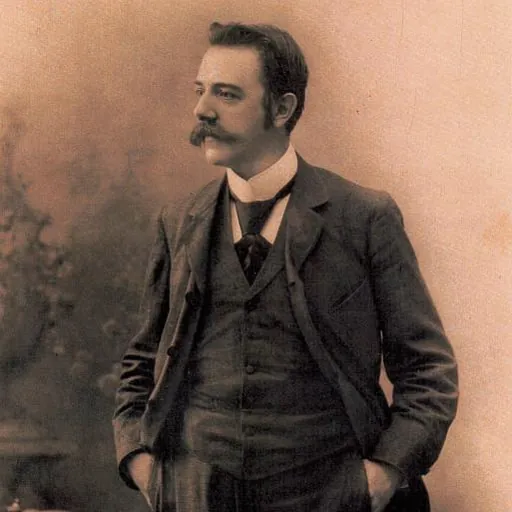
About Arthur van Gehuchten
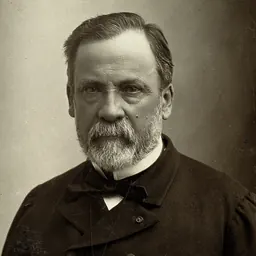
Lived 1861 – 1914 (aged 53). Arthur van Gehuchten was a Belgian neuropathologist, university teacher and physician.
Arthur van (or Van) Gehuchten (20 April 1861 – 9 December 1914) was a Belgian anatomist, born in Antwerp. He was professor in the faculty of medicine at the University of Leuven until the start of World War I in 1914. He moved to England and taught biology at Cambridge University until his death. Van Gehuchten is especially known for his contributions to the theory of neurons. In anatomy, the van Gehuchten method is the fixing of a histologic tissue in a mixture of glacial acetic acid 10 parts, chloroform 30 parts, and alcohol 60 parts.
Writings L'Anatomie du système nerveux de l'homme (1893) Contribution à l'étude du faisceau pyramidal (1896) Structure du télencéphale: centres de projection et centres d'association. Polleunis & Ceuterick, 1897 Cours d'anatomie humain systématique (I-III, 1906–09) Les centres nerveaux cérébro-spinaux (1908) Het zenuwgestel. Nederl. Boekh, 1908 La radicotomie postérieure dans les affections nerveuses spasmodiques (1911) Coup de couteau dans la moelle lombaire. Essai de physiologie pathologique. Le Névraxe 9, ss. 208–232 (1907) Le mouvement pendulaire ou réflexe pendulaire de la jambe. Contribution à l'étude des réflexes tendineux. Le Névraxe 10, ss. 263–266 (1908) Over myopatische ziekten. Voordracht met kinematographische lichtbeelden. Handelingen van het XIVe Vlaams Natuur-en Geneeskundig Congres 1–8 (1910) La radicotomie postérieure dans les affections nerveuses spasmodiques (modification de l'opération de Foerster). Bulletin de l'Académie royale de Médecine de Belgique ss. 1–43 (1910) Het doorsnijden der achterste ruggemergwortels als behandeling van zekere vormen van spastische paraplegie, (met kinematographische lichbeelden). Handelingen van het XVIe Vlaamsch Natuur- en Geneeskundig Congres 422–43 (1913)
Neurone Van Gehuchten adopted Waldeyer's coinage for the nerve cell, but spelt this in French as 'le neurone' rather than 'le neuron'. It is believed that the reason for adding the 'e' at the end of the word relates to the interplay between linguistics and phonetics: the final 'n' in 'neuron' would have been 'sounded' in the classical Greek, and also in Waldeyer's German coinage, and, to do the same in French, there needed to be an 'e' placed at the end of the word. Without this, 'neuron' would have rhymed with 'maison' and the link with the original Greek would have been lost.
Don’t just read it —
keep it.
Full-length biographies made to live with: read them, listen on the way to work, watch them tonight.
- E-book
- Audio
- Video
Instant download · yours to keep · every purchase keeps this site free
Important facts
Related people
Same field, nearest in time




Contemporaries
People whose lives overlapped Arthur van Gehuchten's


Frequently asked questions
Who was Arthur van Gehuchten?
Belgian anatomist
When was Arthur van Gehuchten born?
Arthur van Gehuchten was born on 20 April 1861 in Antwerp.
When did Arthur van Gehuchten die?
Arthur van Gehuchten died on 9 December 1914 in Cambridge.
What was Arthur van Gehuchten's occupation?
Arthur van Gehuchten was a neuropathologist, university teacher and physician.
What nationality was Arthur van Gehuchten?
Arthur van Gehuchten was Belgian.
Sources & further reading
· Wikipedia: Arthur van Gehuchten
· DBpedia: Arthur van Gehuchten
Cite this page
APA: Biography.guide. (2026). Arthur van Gehuchten. https://biography.guide/arthur-van-gehuchten/
MLA: "Arthur van Gehuchten." Biography.guide, https://biography.guide/arthur-van-gehuchten/.
Chicago: "Arthur van Gehuchten." Biography.guide. https://biography.guide/arthur-van-gehuchten/.
Data last updated: 2026-09-23 · Spot an error? Report a correction.
Portrait: Wikimedia Commons · author & licence
Page generated 2026-09-27 05:05 UTC