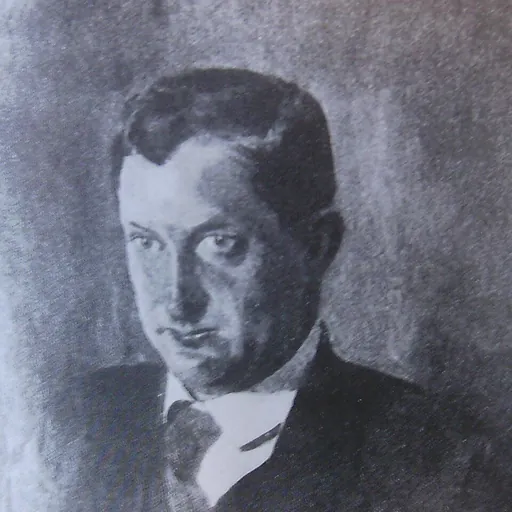
About Arthur Kutscher
Lived 1878 – 1960 (aged 82). Arthur Kutscher was a German linguist, historian, university teacher, theatrologist, literary scholar and writer.
Artur Heinrich Theodor Christoph Kutscher (sometimes wrongly written Arthur; 17 July 1878 in Hannover – 29 August 1960 in Munich) was a German historian of literature and researcher in drama.
Life Artur Kutscher settled in Munich after studying philosophy, literature, art history and Germanistik at the Ludwig-Maximilians-Universität München, Kiel University, and the Humboldt University of Berlin (doctorate in 1904). In 1907, he completed his habilitation in literary studies at the Humboldt University of Berlin, became a private lecturer in the same year and an außerordentlicher or extraordinary professor (not holding a chair) at the Ludwig-Maximilians-Universität München in 1915.
Together with Max Herrmann, he can be seen as a founding father of theatre studies in Germany. He was a professor at the Ludwig-Maximilians-Universität München, where he taught a famous seminar in theatre history. Kutscher was a friend of the iconoclastic dramatist and cabaret-star Frank Wedekind. Brecht's first full-length play, Baal (written 1918), was written in response to an argument in one of Kutscher's drama seminars. While Kutscher was responsible for inspiring an admiration for Wedekind in the young Brecht, he was "bitterly critical" of Brecht's own early dramatic writings.
During the First World War, he served as an officer (1st Lieutenant in the Landwehr) on the Western Front and led the 8th company of the Reserve Infantry Regiment No. 92. He earned the Iron Cross, but also the Order of Military Merit, 4th Class with Swords.
In 1933, he joined the National Socialist Teachers League. In 1938, he also became a member of the NSV and the NS-Reichskriegerbund. After becoming a professor in 1940, he applied for admission to the NSDAP on 12 December 1941 and was accepted on 1 January 1942 (membership number 8,802,675).
He retired in 1951. In 1958, two years before his death, he was awarded the Great Cross of Merit (Großes Verdienstkreuz) of the Order of Merit of the Federal Republic of Germany. Works (excerpt)
Friedrich Hebbel als Kritiker des Dramas. Seine Kritik und ihre Bedeutung, Berlin 1907 Die Kunst und unser Leben, 1909 Kriegstagebuch, 2 volumes, 1915 Das richtige Soldatenlied. Verse und Singweisen im Felde gesammelt, G. Grothe, Berlin 1917 Frank Wedekind, sein Leben und seine Werke. With plates, including portraits (Frank Wedekind, his Life and his Work), 1922 Record on Amazon.co.uk Grundriss der Theaterwissenschaft (Compendium of Dramatics), 2 Vols., 1932-1937 Stilkunde des deutschen Dichtung (Stylistics of German Fiction), 1949 Der Theaterprofessor (The Theatre Professor), 1960 (autobiography)
Don’t just read it —
keep it.
Full-length biographies made to live with: read them, listen on the way to work, watch them tonight.
- E-book
- Audio
- Video
Instant download · yours to keep · every purchase keeps this site free
Important facts
People in Arthur Kutscher's life
Named in this biography and alive at the same time
Related people
Same field, nearest in time

Contemporaries
People whose lives overlapped Arthur Kutscher's






Frequently asked questions
Who was Arthur Kutscher?
German academic (1878-1960)
When was Arthur Kutscher born?
Arthur Kutscher was born on 17 July 1878 in Hanover.
When did Arthur Kutscher die?
Arthur Kutscher died on 29 August 1960 in Munich.
What was Arthur Kutscher's occupation?
Arthur Kutscher was a linguist, historian, university teacher, theatrologist, literary scholar and writer.
What nationality was Arthur Kutscher?
Arthur Kutscher was German.
Sources & further reading
Cite this page
APA: Biography.guide. (2026). Arthur Kutscher. https://biography.guide/arthur-kutscher/
MLA: "Arthur Kutscher." Biography.guide, https://biography.guide/arthur-kutscher/.
Chicago: "Arthur Kutscher." Biography.guide. https://biography.guide/arthur-kutscher/.
Data last updated: 2026-09-23 · Spot an error? Report a correction.
Portrait: Wikimedia Commons · author & licence
Page generated 2026-09-27 05:05 UTC