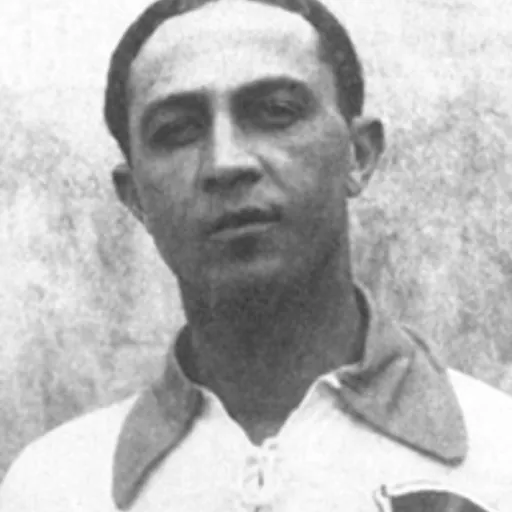
About Arthur Friedenreich
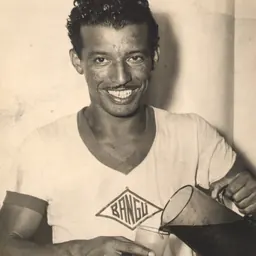
Lived 1892 – 1969 (aged 77). Arthur Friedenreich was a Brazilian association football player.
Arthur Friedenreich (18 July 1892 – 6 September 1969) was a Brazilian professional footballer who played as a forward. He was nicknamed The Tiger or Golden Foot. He played for the Brazil national team and was a record nine times top scorer of the state championship of São Paulo. He is occasionally cited as one of the all-time top scorers in football history, although this is highly disputed. At some point, Friedenreich married his wife, Jonas, and they had a son named Oscar, after Friedenreich’s father. Both outlived him, being left in financial hardship. Notably, on 16 September 1928, he scored a 7-goal haul in a 9–0 trashing of União Lapa, breaking the record for the most goals in a single Campeonato Paulista match at the time. On 27 December 1931, he scored a four-goal haul to help São Paulo to a 4–2 win over São Bento in the 1931 Campeonato Paulista, becoming, at the age of 39 years and 162 days, the oldest player ever to score a poker-trick, a record that has since been broken by Josef Bican in 1955, aged 41. Like so many other natives of São Paulo, he enlisted in the São Paulo Army to fight in the Paulista War in 1932, where he rose from sergeant to lieutenant, commanding a division with several athletes.
Later career On 12 March 1933, the 40-year-old Friedenreich started for SPF in the first professional football match in São Paulo, where Friedenreich scored the opening goal in a 4–1 win over his former club Santos. As he grew older, he began to play less and less, only when São Paulo required his assistance, so he began refereeing matches, doing so with a shirt that the Paulista club had offered him, which was a white uniform with a "P" embroidered on the chest, right above the years "1918-1928", a reference to the time he spent at the club. Likewise, on 5 November 1933, he visited Belo Horizonte to referee a friendly match between Atlético Mineiro and Retiro-MG (Nova Lima); his performance was praised by the local press, with the Estado de Minas stating that "Fried stopped calling penalties", while the Correio Mineiro described him as a "correct referee characterized by the strictest discipline".
On 5 July 1934, the Brazilian Football Federation (CBF) helped sponsor and organize the commemorative program of Friedenreich's sporting jubilee (25-year career) in Brasília, which consisted, among other things, of two matches between São Paulo and Rio de Janeiro. In that same year, he returned to Flamengo, for whom he had already played in 1917, and where he retired after refusing a contract renewal. All of those 357 goals were scored at Campeonato Paulista, where he still is the second-highest goalscorer, only behind Pelé, who surpassed by more over a century of goals (466).
International career Brazil Friedenreich made his debut for the Brazilian national team in their first-ever official match in 1914, beating Exeter City 2–0. In the opening match of the former tournament, he netted a hat-trick to help his side to a 6–0 win over Chile, becoming the first-ever footballer to score a hat-trick in a major international tournament. A few days later, on 29 May, he started in the decisive match of the tournament against Uruguay, scoring the match-winning goal that allowed Brazil to win its first international title in the 122nd minute, the latest goal in Copa América history, a record that will likely stand forever due to the current rules.
Friedenreich was a member of the Brazil team that competed in the 1925 South American Championship, scoring once against in a 5–2 win over Paraguay on 6 December, and another one in a 2–2 draw against the eventual champions Argentina on Christmas Day. In doing so at the age of 33 years and 160 days, he became the oldest-ever goalscorer in the then short history of Copa America. Friedenreich was not picked by Brazil for the 1930 FIFA World Cup because of a clash between the Rio and São Paulo state football federations that saw only players from Rio travelling to the competition. The following year, in August 1914, Friedenreich started for both a Ypiranga/AA São Bento XI and a APEA League XI in two matches against Italian club Pro Vercelli, scoring in both. During a Paulistano tour of Europe in 1925, Friedenreich scored 12 goals to help his side win 9 out of 10 matches, notably scoring a hat-trick in a 7–2 trashing of France on 15 March, after which he began being called Le roi du football ("The King of Football"). He is widely regarded as the greatest Brazilian football player of the amateur era, as well as the biggest name in Brazilian football until the emergence of Leônidas da Silva.
After football Despite his status as one of Brazil’s most renowned early footballers, Friedenreich did not transition into coaching or other roles within the football world after retiring. In 1999, IFFHS named him the fifth greatest Brazilian Player of the 20th Century, only behind Zizinho, Zico, Garrincha, and Pelé.
Discrimination and race in Brazilian football Friedenreich was subject to the racial prejudices of his era. however, Andrade kept the papers for one last revision, so when he died a few days later, De Vaney attempted to recover them, but the papers were never found again because Andrade's family, uninterested in football, thought they were useless and threw them in the trash. This tally is 48 goals higher than Pelé's Guinness World Record of 1,281 goals, which caused him to be occasionally cited as one of the all-time top scorers in football history. The media also said for years that he had never missed a single penalty in over 500 attempts, which is certain to be untrue, given that some records indicate that he wasted at least 12 penalties. 1,239 goals in 1,329 matches – according to research by his former teammate Mario de Andrade and journalist 557 goals in 562 matches – according to RSSSF 554 goals in 561 matches – according to journalist Alexandre da Costa in the book O Tigre do futebol: uma viagem nos tempos de Artur Friedenreich 357 goals in 323 matches – according to IFFHS
Goals for São Paulo state team Scores and results list São Paulo's goal tally first, score column indicates score after each Friedenreich goal. + List of international goals scored by Arthur Friedenreich
Copa dos Campeões Estaduais: 1920
São Paulo Campeonato Paulista: 1931 1923
Brazil Copa América:
Individual South American Championship player of the tournament: 1919 Copa América top scorer: 1919 1912, 1914, 1917, 1918, 1919, 1921, 1927, 1928, 1929
Don’t just read it —
keep it.
Full-length biographies made to live with: read them, listen on the way to work, watch them tonight.
- E-book
- Audio
- Video
Instant download · yours to keep · every purchase keeps this site free
Important facts
People in Arthur Friedenreich's life
Named in this biography and alive at the same time


Related people
Same field, nearest in time



Contemporaries
People whose lives overlapped Arthur Friedenreich's


Frequently asked questions
Who was Arthur Friedenreich?
Brazilian footballer (1892–1969)
When was Arthur Friedenreich born?
Arthur Friedenreich was born on 18 July 1892 in São Paulo.
When did Arthur Friedenreich die?
Arthur Friedenreich died on 6 September 1969 in São Paulo.
What was Arthur Friedenreich's occupation?
Arthur Friedenreich was an association football player.
What nationality was Arthur Friedenreich?
Arthur Friedenreich was Brazilian.
Sources & further reading
· Wikipedia: Arthur Friedenreich
· DBpedia: Arthur Friedenreich
Cite this page
APA: Biography.guide. (2026). Arthur Friedenreich. https://biography.guide/arthur-friedenreich/
MLA: "Arthur Friedenreich." Biography.guide, https://biography.guide/arthur-friedenreich/.
Chicago: "Arthur Friedenreich." Biography.guide. https://biography.guide/arthur-friedenreich/.
Data last updated: 2026-09-23 · Spot an error? Report a correction.
Portrait: Wikimedia Commons · author & licence
Page generated 2026-09-27 05:05 UTC