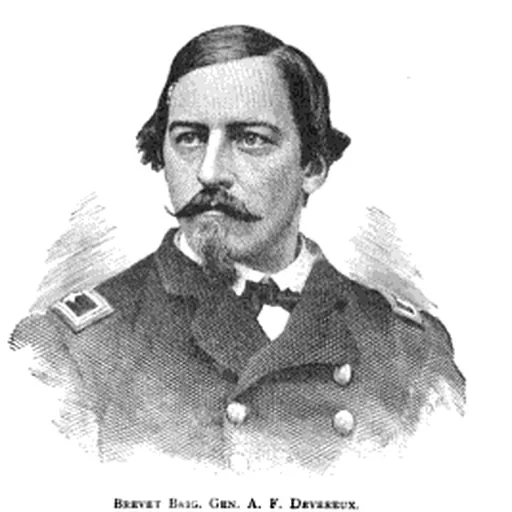
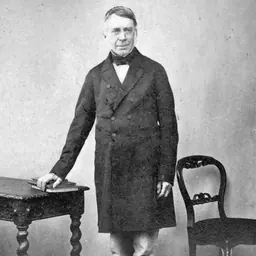
Arthur F. Devereux
Brigadier general in the United States Army during the American Civil War
About Arthur F. Devereux
Lived 1838 – 1906 (aged 67). Arthur F. Devereux was an American.
Arthur Forrester Devereux (April 27, 1838 – February 13, 1906) was a captain in the Massachusetts Volunteer Militia prior to the Civil War and a colonel in the Union Army during the Civil War. He is notable for his expertise and proficiency in the instruction of military drill. During the Battle of Gettysburg, the 19th Massachusetts Infantry, under his command, played an important role in filling a breach in the Union lines during Pickett's Charge. After his active service had concluded, Devereux was awarded the honorary rank of brevet brigadier general, United States Volunteers, by appointment of President Andrew Johnson on February 21, 1866, to rank from March 13, 1865, and confirmation by the U.S. Senate on April 10, 1866.
Early career Born in Salem, Massachusetts, Devereux attended Harvard College and the United States Military Academy at West Point. His father was George H. Devereux who had served as adjutant general of Massachusetts from 1848 – 1851. His father's interest in military matters likely influenced Arthur Devereux's career. Devereux did not graduate from West Point, however, and instead moved to Chicago, Illinois, to pursue a career in business in 1854, when he was 15 or 16 years old.
Salem Light Infantry company Returning to Massachusetts in 1855, Devereux was eventually elected captain of the Salem Light Infantry company in 1859. The Salem Light Infantry company was a Massachusetts militia unit with a long history, having been established in 1805. Inspired by Ellsworth's Chicago Cadets, Devereux enhanced the Salem company's prestige by transforming it into a Zouave unit and training its members in precision drill. At the time, the Constitution was serving as a training ship at the United States Naval Academy in Annapolis. As one of the original six frigates of the U.S. Navy, the warship was an important national symbol. The Navy soon towed the Constitution, with Devereux's Salem company on board, to New York City where she would be less vulnerable to those seeking to destroy the Union in order to preserve slavery. Returning to Maryland, Devereux and his company rejoined the 8th Massachusetts, aiding in repairing railroads and serving guard duty outside of Baltimore. The 8th Massachusetts was mustered out of service on August 1, 1861.
After their first winter of service on picket duty in the vicinity of Washington, D.C., the 19th Massachusetts was attached to the 3rd Brigade, 2nd Division, of the II Corps in the Army of the Potomac. Devereux was placed on sick leave just before the Seven Days Battles and therefore missed the unit's first severe action. The unit was involved in the Second Battle of Bull Run on August 30, 1862. During the Battle of Antietam on September 17, 1862, the 19th Massachusetts, as part of Maj. Gen. John Sedgwick's division, took part in an infamous charge on Confederate lines in the West Woods. The division was virtually surrounded by Confederates and suffered heavy casualties. Devereux was wounded during this action. Hinks suffered a severe wound at Antietam which required his extended absence from the army. In his place, Devereux took command of the 19th Massachusetts. Devereux's promotion to colonel was effective November 29, 1862. The 19th Massachusetts was in line with the 42nd New York. The two units were the second line of defense in their brigade.
As the Confederate charge struck the Union position, a gap in the Union line opened in front of the 19th Massachusetts between their brigade and the adjacent brigade commanded by Alexander S. Webb. Seeing the break, Devereux turned to the colonel of the 42nd New York and, gesturing to the gap said, "Mallon, we must move!"
Devereux was forced to resign his command on February 27, 1864, according to historian James Bowen, due to, "imperative family considerations." Devereaux was nominated by President Andrew Johnson on February 21, 1866, for the award of the honorary grade of brevet brigadier general, U.S. Volunteers, to rank from March 13, 1865, for gallant services during the war and the U.S. Senate confirmed the award on April 10, 1866.
Family and post-war life About the time of his resignation in 1864, Devereux married Clara Anna Rich of Haverhill, Massachusetts. They had three sons and four daughters.
Arthur Devereux went back to a business career after the war, first in Boston, then in New York and eventually settling with his wife and children in Cincinnati, Ohio. In Ohio, Devereux became a representative in the Ohio legislature (known as the Ohio General Assembly).
Don’t just read it —
keep it.
Full-length biographies made to live with: read them, listen on the way to work, watch them tonight.
- E-book
- Audio
- Video
Instant download · yours to keep · every purchase keeps this site free
Important facts
People in Arthur F. Devereux's life
Named in this biography and alive at the same time



Contemporaries
People whose lives overlapped Arthur F. Devereux's

Frequently asked questions
Who was Arthur F. Devereux?
Brigadier general in the United States Army during the American Civil War
When was Arthur F. Devereux born?
Arthur F. Devereux was born on 27 April 1838 in Salem.
When did Arthur F. Devereux die?
Arthur F. Devereux died on 13 February 1906 in Cincinnati.
What nationality was Arthur F. Devereux?
Arthur F. Devereux was American.
Sources & further reading
· Wikipedia: Arthur F. Devereux
Cite this page
APA: Biography.guide. (2026). Arthur F. Devereux. https://biography.guide/arthur-f-devereux/
MLA: "Arthur F. Devereux." Biography.guide, https://biography.guide/arthur-f-devereux/.
Chicago: "Arthur F. Devereux." Biography.guide. https://biography.guide/arthur-f-devereux/.
Data last updated: 2026-09-22 · Spot an error? Report a correction.
Portrait: Wikimedia Commons · author & licence
Page generated 2026-09-27 05:03 UTC