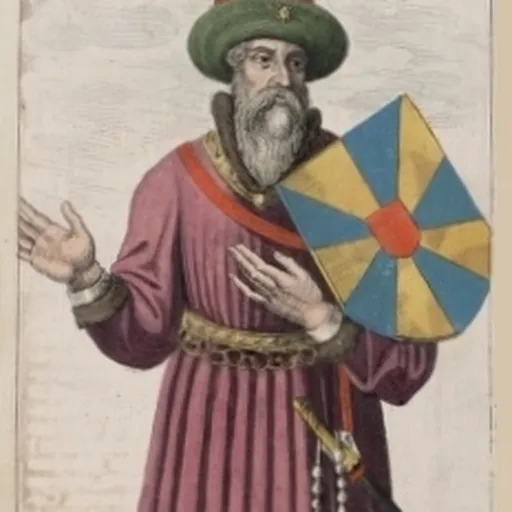
About Arnulf I, Count of Flanders
Lived 889 – 965 (aged 75–76). Arnulf I, Count of Flanders was a politician.
Arnulf I (/899 – 27 March 964), called "the Great", was the first Count of Flanders.
Life Arnulf was the son of margrave Baldwin II of Flanders and Ælfthryth of Wessex, daughter of Alfred the Great. Through his mother he was a descendant of the Anglo-Saxon kings of England, and through his paternal grandmother Judith of Flanders, a descendant of Charlemagne. Presumably Arnulf was named either after Saint Arnulf of Metz, a progenitor of the Carolingian dynasty, or King Arnulf of Carinthia, whom his father supported.
At the death of their father in 918, Arnulf became Count of Flanders and inherited the historical territories of the County of Flanders, while his brother Adeloft or Adelolf received the territories conquered by his father and became Count of Boulogne and Counf of Tournois. However, in 933 Adeloft died, and Arnulf took the countship of Boulogne for himself. Arnulf titled himself count by the Grace of God.
Arnulf I greatly expanded Flemish rule to the south, taking all or part of Artois, Ponthieu, Amiens, and Ostrevent. He exploited the conflicts between Charles the Simple and Robert I of France, and later those between Louis IV and his barons. Arnulf also made Bruges the center of his administration, contributing to the rise of the town as a major trading hub.
In his southern expansion Arnulf inevitably had conflict with the Normans, who were trying to secure their northern frontier. This led to the 942 murder of the Duke of Normandy, William Longsword, at the hands of Arnulf's men. The Viking threat was receding during the later years of Arnulf's life, and he turned his attentions to the reform of the Flemish government.
Religious reforms Arnulf earned his epithet "The Great" with his religious reforms. He was a strong supporter of the Cluniac Reforms. His motivation was not religious: abbeys owned larges estates, were an economical power, made their lay abbots very rich, and their region prosperous. But in the first half of the tenth century their economical power declined because of looser interpretation of the Rule of Saint Benedict and bad management. In 940 Arnulf appointed Gérard of Brogne as abbot of Saint Peter's Abbey in Ghent, where he enforced monastic discipline by reintroducing the Benedictine rule, and by replacing the canons by monks. Between 940 and 953 Gérard reformed all major abbeys in the county of Flanders: Saint Bavo's Abbey in Ghent, Abbey of Saint Bertin in Saint-Omer, Abbey of Saint-Vaast in Atrecht and Saint-Amand Abbey. While the Cluniac reforms insisted on abbeys being completely independend from secular power, and the abbots being appointed by the head of their congregation, Gérard granted these abbeys much autonomy and allowed Arnulfs to interference in their management. These reforms not only re-established these abbeys as economical powers but also stimulated their cultural influence: the first annals of the county of Flanders, the Gesta Abbatum Sithiensium was written by Folcuin in the abbey of Saint-Bertain. When Dunstan, abbot of Glastonbury, fled into exile, Arnulf received him with honour and lodged him in the Abbey of Mont Blandin, near Ghent.
Family The name of Arnulf's first wife is unknown but he had at least one daughter by her:
Name unknown; married Isaac of Cambrai. Their son Arnulf succeeded his father as Count of Cambrai. King Lothair respected the agreement and sent his mother Gerberga of Saxony and his 12-year old brother Charles, Duke of Lower Lorraine to Flanders to guard Arnulf II.
Don’t just read it —
keep it.
Full-length biographies made to live with: read them, listen on the way to work, watch them tonight.
- E-book
- Audio
- Video
Instant download · yours to keep · every purchase keeps this site free
Important facts
People in Arnulf I, Count of Flanders's life
Named in this biography and alive at the same time



Related people
Same field, nearest in time


Contemporaries
People whose lives overlapped Arnulf I, Count of Flanders's


Frequently asked questions
Who was Arnulf I, Count of Flanders?
First Count of Flanders from 918 to 964
When was Arnulf I, Count of Flanders born?
Arnulf I, Count of Flanders was born in 889.
When did Arnulf I, Count of Flanders die?
Arnulf I, Count of Flanders died on 27 March 965.
What was Arnulf I, Count of Flanders's occupation?
Arnulf I, Count of Flanders was a politician.
Sources & further reading
· Wikipedia: Arnulf I, Count of Flanders
· DBpedia: Arnulf I of Flanders
Cite this page
APA: Biography.guide. (2026). Arnulf I, Count of Flanders. https://biography.guide/arnulf-i-count-of-flanders/
MLA: "Arnulf I, Count of Flanders." Biography.guide, https://biography.guide/arnulf-i-count-of-flanders/.
Chicago: "Arnulf I, Count of Flanders." Biography.guide. https://biography.guide/arnulf-i-count-of-flanders/.
Data last updated: 2026-09-20 · Spot an error? Report a correction.
Portrait: Wikimedia Commons · author & licence
Page generated 2026-09-27 04:58 UTC