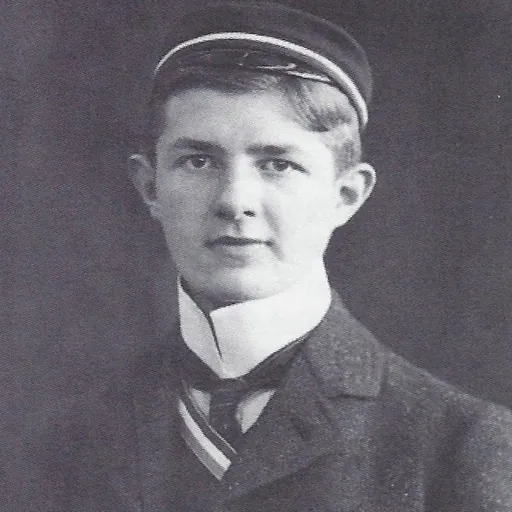
About Arnold Eucken
Lived 1884 – 1950 (aged 65). Arnold Eucken was a German physicist, chemist, university teacher and physical chemist.
Arnold Thomas Eucken (; 3 July 1884 – 16 June 1950) was a German chemist and physicist. He is known for his contribution to thermodynamics and molecular physics, in particular, for the discovery of Eucken's law of thermal conductivity, the measurement of the heat capacity of hydrogen at low temperatures, and the development of the Eucken–Polanyi potential theory of adsorption.
Life Arnold Thomas Eucken was born in Jena, son of the philosopher and later Nobel Prize in Literature laureate Rudolf Christoph Eucken, in Jena. A maternal great grandfather was the physicist Thomas Johann Seebeck. His brother Walter became an economist.
Arnold Eucken went to the humanist high school in Jena and studied Physics and Mathematics at the Kiel University, University of Jena and University of Berlin. In 1905 he began to work in Berlin under Walther Nernst on the energy states of hydrogen and received a doctorate in 1906.
He habilitated in 1911 and after the Italo-Turkish War he joined back in 1915 Eucken at the Technische Hochschule Breslau, and from 1930 at the University of Göttingen as a successor of Gustav Tammann. After "the seizure of power" of the National Socialists, Eucken became a member of the Nazi Party in 1933. A major contribution was a "Textbook of Chemical Physics" first published in 1930.
One of his last PhD students, Manfred Eigen won the Nobel Prize in Chemistry in 1967.
Work In 1908, while working with Nernst, Eucken developed a vacuum calorimeter to study heat capacity hydrogen molecules. His measurements published in 1912, confirmed that the heat capacity of hydrogen drops by a factor of a gas constant at low temperatures (about 40 K). Diatomic gas starts to behave as a monotoatomic gas because of the suppression of rotational modes at low temperatures. This confirmed Nernst's theory that the heat capacity of diatomic molecules would behave according to quantum mechanics.
Eucken's 1911 work on thermal conduction, demonstrated that in dielectric systems, the thermal conductivity of the crystal in inversely proportional to the temperature of the crystal. This relation is sometimes known as Eucken's law.
Eucken was also coined the term adsorption potential and was the first to publish a theory of potential theory of adsorption in 1914.
Don’t just read it —
keep it.
Full-length biographies made to live with: read them, listen on the way to work, watch them tonight.
- E-book
- Audio
- Video
Instant download · yours to keep · every purchase keeps this site free
Important facts
People in Arnold Eucken's life
Named in this biography and alive at the same time


Related people
Same field, nearest in time


Contemporaries
People whose lives overlapped Arnold Eucken's

Frequently asked questions
Who was Arnold Eucken?
German scientist (1884-1950)
When was Arnold Eucken born?
Arnold Eucken was born on 3 July 1884 in Jena.
When did Arnold Eucken die?
Arnold Eucken died on 16 June 1950 in Seebruck, Seeon-Seebruck.
What was Arnold Eucken's occupation?
Arnold Eucken was a physicist, chemist, university teacher and physical chemist.
What nationality was Arnold Eucken?
Arnold Eucken was German.
Sources & further reading
Cite this page
APA: Biography.guide. (2026). Arnold Eucken. https://biography.guide/arnold-eucken/
MLA: "Arnold Eucken." Biography.guide, https://biography.guide/arnold-eucken/.
Chicago: "Arnold Eucken." Biography.guide. https://biography.guide/arnold-eucken/.
Data last updated: 2026-09-22 · Spot an error? Report a correction.
Portrait: Wikimedia Commons · author & licence
Page generated 2026-09-27 05:04 UTC