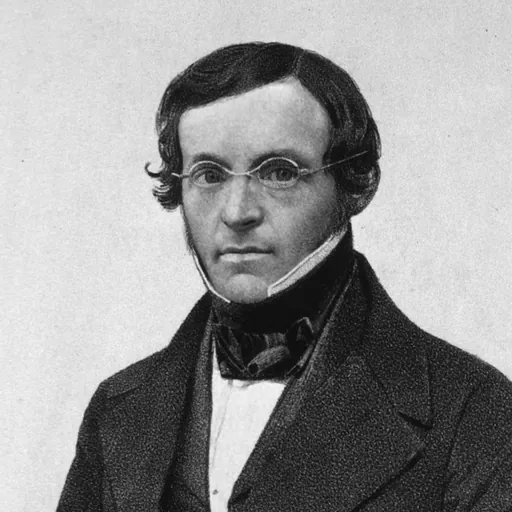
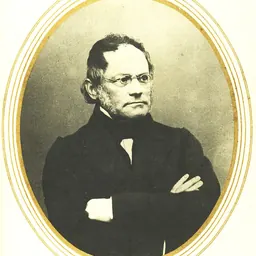
Arnold Adolph Berthold
German physiologist and zoologist
About Arnold Adolph Berthold
Lived 1803 – 1861 (aged 57). Arnold Adolph Berthold was a German zoologist, entomologist, university teacher, physician, anatomist and physiologist.
Arnold Adolph Berthold (also Arnold Adolf Berthold) (26 February 1803, in Soest – 3 January 1861, in Göttingen) was a German scientist, most notably a physiologist and zoologist. He is best known in modern science for his pioneering experiments in the field of endocrinology. He published works on herpetology, ornithology, entomology and chemistry.
Early life and education Berthold was the second-youngest of six children. His father was a carpenter and his family was not wealthy. He went to the local gymnasium (equivalent to a grammar school) where he studied the classics but was most interested in natural history. He followed his older brother's example to study medicine at University of Göttingen in August 1819. His thesis was under the direction of Johann Friedrich Blumenbach (1752–1840) and he qualified on 10 September 1823.
Career He remained at Göttingen for a year before doing a tour of other universities and clinics, which included meeting Johann Lukas Schönlein. In 1825, Berthold decided to practise medicine in Berlin and began experimenting on the effects of coal gas and mercury on the body. Unsettled, he continued to tour Germany and Franc, attending the lectures of other contemporary luminaries Georges Cuvier, Étienne Geoffroy Saint-Hilaire and André Marie Constant Duméril. He forwent the idea of private medical practice and wrote a paper on the thyroid gland of the parrot. He returned to his alma mater as a privatdozent in medicine and began to teach physiology; he spent the rest of his career there. He was appointed as an extraordinary professor in 1835 and a full professor in 1836. In 1840, he was made zoological director of the museum.
He published on the topics of the duration of pregnancy, hair growth, myopia and hermaphroditism. In 1829, he published Lehrbuch der Physiologie des Menschen und der Thiere (Textbook on the physiology of humans and animals) which was reprinted a number of times. He collaborated with Robert Bunsen in 1834 to develop the usage of hydrated iron oxide as an antidote for arsenic poisoning. Berthold and assumed, essentially, the leadership of the teaching of anatomy and physiology over the ageing Blumenbach. In 1840, Blumenbach died and his role was taken over by Rudolf Wagner (Berthold wrote a 20-page section on the topic of sexual physiology in a dictionary on physiology that Wagner edited). Berthold taught and encouraged the young Carl Bergmann (anatomist), who became known for experiments on thermoregulation and who coined the terms poikilotherm and homeotherm.
On 8 February 1849, Berthold spoke at the Royal Scientific Society in Göttingen. He described how he'd taken six cock chickens and removed the testes from four of them. The two uncastrated birds continued to develop normally. The other birds remained without male characteristics. Crucially, however, Berthold reprised an experiment that he knew John Hunter had tried with unclear results before 1771 with hens. He transplanted testes back into the abdomens of two of the castrated birds but in a different location; the remasculated birds progressed to develop secondary sexual characteristics, indicating that the testes functioned effectively normally.
Upon autopsy, he found that the transplanted testes had grown a new vasculature but no other bodily connection: this finally demonstrated that whatever was controlling the secondary characteristics was transported from the testes via the bloodstream. The prevailing theory, that sexual characteristics were mediated via the nervous system, was thus disproved.
Don’t just read it —
keep it.
Full-length biographies made to live with: read them, listen on the way to work, watch them tonight.
- E-book
- Audio
- Video
Instant download · yours to keep · every purchase keeps this site free
Important facts
People in Arnold Adolph Berthold's life
Named in this biography and alive at the same time




Related people
Same field, nearest in time


Contemporaries
People whose lives overlapped Arnold Adolph Berthold's






Frequently asked questions
Who was Arnold Adolph Berthold?
German physiologist and zoologist (1803–1861)
When was Arnold Adolph Berthold born?
Arnold Adolph Berthold was born on 26 February 1803 in Soest.
When did Arnold Adolph Berthold die?
Arnold Adolph Berthold died on 3 February 1861 in Göttingen.
What was Arnold Adolph Berthold's occupation?
Arnold Adolph Berthold was a zoologist, entomologist, university teacher, physician, anatomist and physiologist.
What nationality was Arnold Adolph Berthold?
Arnold Adolph Berthold was German.
Sources & further reading
· Wikipedia: Arnold Adolph Berthold
· DBpedia: Arnold Adolph Berthold
Cite this page
APA: Biography.guide. (2026). Arnold Adolph Berthold. https://biography.guide/arnold-adolph-berthold/
MLA: "Arnold Adolph Berthold." Biography.guide, https://biography.guide/arnold-adolph-berthold/.
Chicago: "Arnold Adolph Berthold." Biography.guide. https://biography.guide/arnold-adolph-berthold/.
Data last updated: 2026-09-23 · Spot an error? Report a correction.
Portrait: Wikimedia Commons · author & licence
Page generated 2026-09-27 05:05 UTC