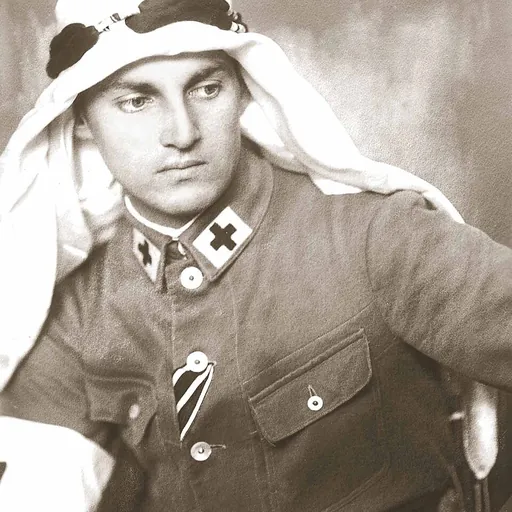
About Armin T. Wegner
Lived 1886 – 1978 (aged 91). Armin T. Wegner was a German photographer, writer, resistance fighter, physician, author and pacifist.
Armin Theophil Wegner (October 16, 1886 – May 17, 1978) was a German soldier and medic in World War I, a prolific author, and a human rights activist. Stationed in the Ottoman Empire during World War I, Wegner was a witness to the Armenian genocide and the photographs he took documenting the plight of the Armenians today "comprises the core of witness images of the Genocide."
In the years following World War I, Wegner also voiced his opposition, at great risk to his own life, to the antisemitic policies of the Nazi regime. In 1933, he authored an impassioned plea to Adolf Hitler on behalf of German Jews. He suggested that the persecution of the Jews was not just a question of "the fate of our Jewish brothers alone, [but also] the fate of Germany." Noting that he was writing the letter as a proud German who could himself trace his Prussian familial roots back to the time of the Crusades, Wegner asked Hitler what would become of Germany if it continued its persecution of Jews. Answering his own question, Wegner declared, "There is no Fatherland without justice!" Upon completing his doctoral studies in law, he joined the armed forces. He rose to the rank of second lieutenant in the German Sanitary Corps, which was attached to the Ottoman Sixth Army. Wegner was part of a German detachment led by Colmar Freiherr von der Goltz, which was stationed along the Baghdad Railway in Syria and Mesopotamia; here, Wegner witnessed the death marches of Armenians during the height of the Armenian genocide.
Disobeying orders intended to smother news of the massacres (as the Ottoman Empire and Germany were allies), he gathered information on the massacres, collected documents, annotations, notes, and letters and took hundreds of photographs in the Armenian deportation camps in Deir ez-Zor,
Weimar period In Germany after the war, Wegner married author Lola Landau, and became an activist espousing pacifism.
In 1921 Wegner testified at the trial of Soghomon Tehlirian, the Ottoman Armenian who had killed Talat Pasha in Berlin.
On August 16, 1933, Wegner was arrested and taken to the Gestapo prison in Berlin. He was charged with pacifistic activities and the distribution of “horror propaganda”. During his one-day imprisonment here, he was tortured. Next day he was transferred to concentration camp Oranienburg, north of Berlin. On September 7, Wegner and some of his fellow prisoners were transported to camp Börgermoor, one of the so-called Emslandlager in northwestern Germany close to the Dutch border. After about six weeks, Wegner was transferred to the Lichtenburg concentration camp. On December 23, 1933, he were released as a result of the Christmas amnesty, proclaimed by Nazi leader Hermann Göring. In March 1934, Wegner was imprisoned for a short time again, in Leer, East Friesland.
After his imprisonment Wegner left for a short time to England, but returned to Germany. His wife and daughter emigrated to Palestine in 1936. The same year Wegner himself emigrated to the village Positano on the Tyrrhenian Sea in the Italian province of Salerno.
In 1939, Wegner and his wife mutually agreed to divorce. He would later suggest, "Germany took everything from me... even my wife." In 1945 he married Irene Kowaliska.
According to Stefan Ihrig, Wegner was a "broken man" by the 1960s. Ihrig suggests that all of Wegner's efforts ultimately failed, in particular due to the fact that he did not manage to save a single Jew from the Nazis.
Legacy
Wegner was awarded the Highest Order of Merit by the Federal German Government in 1956. His native city of Wuppertal awarded him the prestigious Eduard-Von-der-Heydt prize in 1962.
He died at the age of 91 in Rome. Some of his ashes were later taken to Armenia to be honored at a posthumous state funeral near the Armenian Genocide Monument's perpetual flame.
A 2000 documentary film, Destination: Nowhere (The Witness) directed by Carlo Massa and produced by Dr. J. Michael Hagopian, depicted Wegner's personal account of the Armenian genocide through his own photographs. Prior to the release of the documentary he was honored at the Armenian Genocide Museum in Yerevan for championing the plight of Armenians throughout his life.
Recalled by some as "the only writer in Nazi Germany ever to raise his voice in public against the persecution of the Jews", by the time of Wegner's death in Rome he had been "virtually forgotten" by the German people. He had never felt at home again in Germany after fleeing in the 1930s, and had lived out the remainder of his days in Italy. The inscription on Wegner's gravestone echoes the dying words attributed to Pope Gregory VII in 1085. Amavi iustitiam odi iniquitatem / Propterea morior in exsilio I loved justice and hated iniquity / Therefore I die in exile.
Don’t just read it —
keep it.
Full-length biographies made to live with: read them, listen on the way to work, watch them tonight.
- E-book
- Audio
- Video
Instant download · yours to keep · every purchase keeps this site free
Important facts
People in Armin T. Wegner's life
Named in this biography and alive at the same time




Related people
Same field, nearest in time




Contemporaries
People whose lives overlapped Armin T. Wegner's


Frequently asked questions
Who was Armin T. Wegner?
German pacifist, writer and poet (1886–1978)
When was Armin T. Wegner born?
Armin T. Wegner was born on 16 October 1886 in Elberfeld.
When did Armin T. Wegner die?
Armin T. Wegner died on 17 May 1978 in Rome.
What was Armin T. Wegner's occupation?
Armin T. Wegner was a photographer, writer, resistance fighter, physician, author and pacifist.
What nationality was Armin T. Wegner?
Armin T. Wegner was German.
Sources & further reading
Cite this page
APA: Biography.guide. (2026). Armin T. Wegner. https://biography.guide/armin-t-wegner/
MLA: "Armin T. Wegner." Biography.guide, https://biography.guide/armin-t-wegner/.
Chicago: "Armin T. Wegner." Biography.guide. https://biography.guide/armin-t-wegner/.
Data last updated: 2026-09-22 · Spot an error? Report a correction.
Portrait: Wikimedia Commons · author & licence
Page generated 2026-09-27 05:01 UTC