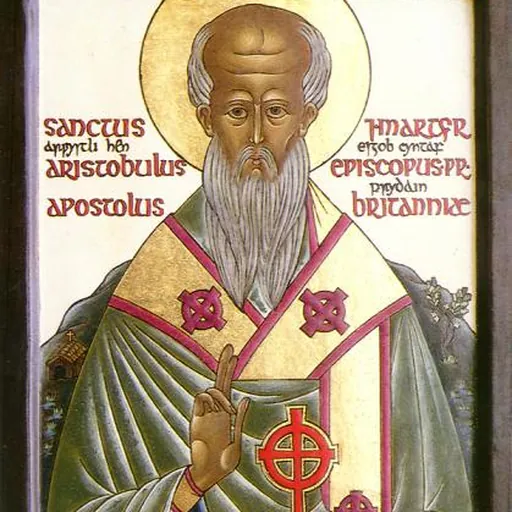
Aristobulus of Britannia
Ancient Roman saint, mentioned in Romans 16:10, served as missionary to Britain
About Aristobulus of Britannia
Lived 50 BC – 100. Aristobulus of Britannia was a Roman priest.
Aristobulus of Britannia is a Christian saint named by Hippolytus of Rome (170–235) and Dorotheus of Gaza (505–565) as one of the Seventy Disciples mentioned in and as the first bishop in Roman Britain. translit. Hagios Aristoboulos episkopos Brettanias, adelphos tou apostolou Barnaba, transcr. (Byzantine/Modern) Aghios Apostolos Aristovoulos, episkopos Vrettanias, adelfos tou apostolou Varnava ("The Holy Apostle Aristobulus, Bishop of Britain, brother of the Apostle Barnabas")
Welsh: Arwystli Hen Episcob Cyntaf Prydain ("Aristibule the Old, First Bishop of Britain")
Traditions Pseudo-Hippolytus lists "Aristobulus, bishop of Britain" among the seventy disciples.
Aristobulus may be mentioned in the New Testament in the Epistle to the Romans (: "...Salute them which are of Aristobulus' household") although this may mean members of the household of the late Aristobulus IV. According to Lionel Smithett Lewis, the writings of St Dorotheus, Bishop of Tyre AD 303, assert that Aristobulus, whom Paul saluted in the Epistle to the Romans, was the Bishop of Britain.
Greek, Latin, and Alexandrian traditions Greek, Latin, and Alexandrian tradition says Aristobulus was the brother of the Apostle Barnabas, of Jewish Cypriot origin. Like Barnabas, he accompanied Saint Paul on his journeys. along with Urban of Macedonia, Stachys, Ampliatus, Apelles of Heraklion and Narcissus of Athens (all of these names are mentioned together by St. Paul in , which cannot be casual). On his missionary journey to Britain, he stopped to preach to the Celtiberians of northern Hispania.
Aristobulus preached and died in Roman Britain. This is in accord with the date given by Gildas (c. 500–570 AD) that the "Light of Christ" shone in Britain in the last year of Emperor Tiberius. However, George Smith points out that this a misinterpretation of Gildas, and asserts that the Gospel was not preached in Britain before the reign of Claudius, whose full name was Tiberius Claudius Caesar Augustus Germanicus.
British tradition From these traditions, it seems that Aristobulus was the founder of British Christianity. There is no evidence for any connection with Glastonbury and John Scott shows in An Early History of Glastonbury that the legend purporting that Joseph of Arimathea founded the Glastonbury Abbey there is of 12th or 13th-century origin and has no basis in fact. Rather, the early writings frequently centre on Aristobulus. There is a tradition linking him to one of the medieval Welsh saints Arwstyl ap Cunedda. The title "Arwystli Hen" He married Salome, the daughter of Herod II and Herodias. They had three sons: Herod, Agrippa, and Aristobulus. Lionel Smithett Lewis maintains that this latter Aristobulus could have been the Aristobulus of Britannia, and referred to by Cressy. However, it is this man's father who was the husband of Salome, as mentioned by Alford (see previous section).
In 55, Nero appointed Aristobulus of Chalcis as King of Armenia Minor. He participated with his forces in the Roman–Parthian War of 58–63, where he received a small portion of Armenia in exchange, an area he continued to rule until 72 when Vespasian reduced the regional autonomy of some of the provinces.
It is probable that the "Philip" (mentioned above) are those mentioned in the New Testament are Philip the Tetrarch. The matter is disputed by scholars. There is no contemporary evidence for Philip the Tetrarch's use of the name "Herod Philip" as a dynastic title, as did occur with his brothers Herod Antipas and Herod Archelaus, yet he was of the same family and the scriptural reference may be emphasising this fact, as do later scriptural commentators. Today, Herod II is sometimes called "Herod Philip I" (because the gospels call the husband of Herodias "Philip"), and then Philip the Tetrarch is called "Herod Philip II", but this is an anachronistic convention. Kokkinos says, "The stubborn existence of many theologians in referring to Herod III as 'Herod Philip' is without any value...No illusory Herod Philip ever existed." Philip's half-brothers, Archelaus and Antipas, had adopted the name of Herod, "presumably" for a dynastic claim from Herod the Great.
Commemorations The earliest date given for his feast is 17 March in the Adonis Martyrology. However, the Martyrology of Rome and equivalent Synaxaria of Constantinople and Alexandria all give his feast as 15 March. His feast is kept on this day on the Eastern Orthodox liturgical calendar, except for in the Russian Orthodox Church and those who follow her tradition, such as the OCA, where it is kept on 16 March in the Russian tradition such OCA. He is also one of the saints commemorated on 4 January (feast of the Seventy Disciples) and on 31 October (feast of the assistants of Saint Andrew). In the Roman Catholic liturgical calendar, his feast is 15 March.
Don’t just read it —
keep it.
Full-length biographies made to live with: read them, listen on the way to work, watch them tonight.
- E-book
- Audio
- Video
Instant download · yours to keep · every purchase keeps this site free
Important facts
People in Aristobulus of Britannia's life
Named in this biography and alive at the same time




Related people
Same field, nearest in time


Contemporaries
People whose lives overlapped Aristobulus of Britannia's



Frequently asked questions
Who was Aristobulus of Britannia?
Ancient Roman saint, mentioned in Romans 16:10, served as missionary to Britain
When was Aristobulus of Britannia born?
Aristobulus of Britannia was born in 50 BC in Cyprus.
When did Aristobulus of Britannia die?
Aristobulus of Britannia died in 100 in Wales.
What was Aristobulus of Britannia's occupation?
Aristobulus of Britannia was a priest.
What nationality was Aristobulus of Britannia?
Aristobulus of Britannia was Roman.
Sources & further reading
· Wikipedia: Aristobulus of Britannia
· DBpedia: Aristobulus of Britannia
Cite this page
APA: Biography.guide. (2026). Aristobulus of Britannia. https://biography.guide/aristobulus-of-britannia/
MLA: "Aristobulus of Britannia." Biography.guide, https://biography.guide/aristobulus-of-britannia/.
Chicago: "Aristobulus of Britannia." Biography.guide. https://biography.guide/aristobulus-of-britannia/.
Data last updated: 2026-09-23 · Spot an error? Report a correction.
Portrait: Wikimedia Commons · author & licence
Page generated 2026-09-27 05:05 UTC