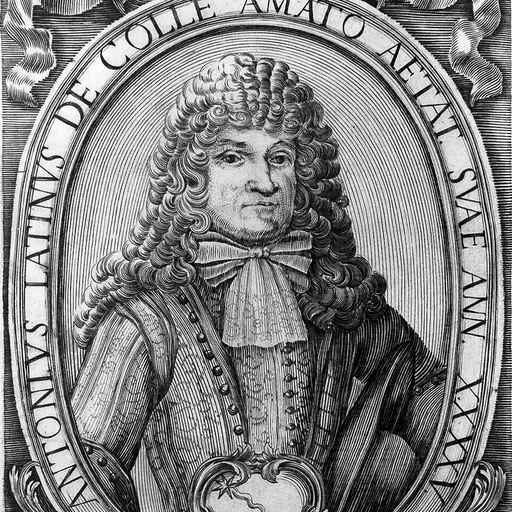
About Antonio Latini
Lived 1642 – 1696 (aged 53–54). Antonio Latini was a chef and autobiographer.
Antonio Latini (1642–1692) was a steward of Cardinal Antonio Barberini, cardinal-nephew of Pope Urban VIII in Rome and subsequently to Don Stefano Carillo Salcedo, first minister to the Spanish viceroy of Naples. He is also credited to be the one that made the first "official" ice cream.
Biography Latini was born in Collamato, now a frazione of the town of Fabriano, in the province of Ancona, but at the time in the Papal States. His cookbook, Lo scalco alla moderna "the Modern Steward", (Naples, vol. I 1692, vol. II 1694), contains in its first volume the (surprisingly late) earliest surviving recipes for tomato sauce, though he did not suggest serving it over pasta. One of his tomato recipes is for sauce alla spagnuola, "in the Spanish style". In his second volume Latini gives early recipes for sorbetti.
Latini had gone to Rome at the age of sixteen, and worked his way up in the familia or household of Cardinal Barberini. By turns assistant cook, waiter and wardrobe attendant, he learned the theatrical carving skills expected of a maître d'hôtel and swordsmanship as well. Mastering the arts of successively important stewardship positions, he was made a Roman conte, a "Knight of the Golden Spur" for his service. After working in Rome and at courts in Macerata, Mirandola and Faenza, Latini went to serve as scalco, or household steward, to Carillo Salcedo in 1682.
In Naples, Latini cast his net widely for the best products of the Kingdom of Naples for Don Stefano's table. In Lo scalco alla moderna a brief description of the Regno listed fruits and local specialties in melons and game, oil and olives, vegetables and salads of "rare quality", drawn from Latini's professional experience from 25 locales, none of them as far afield as Sicily, in fact mostly within a days journey of Naples: Poggio Reale, Chiaja, Posillipo hills, Pozzuoli, Procida, Ischia, Capri, Sorrento, Vico, Castell'a mare di Stabbia, Torre del Greco, Granatiello, Monte di Somma, Orta, Nola, Aversa, Cardito, Arienzo, Acerra, Giugliano, Capua, Gaeta, Venafro, Sora, Isola di Sora.
Latini's manuscript autobiography, not included in Lo scalco alla moderna, brings his personal career to light by sharing details of a kitchen career that had hitherto been unheard of when they were first described in print by French gastronomist Marie-Antoine Carême. A transcription that was made in 1690 was discovered in the city library of Fabriano and published by Furio Liccichenti.
Don’t just read it —
keep it.
Full-length biographies made to live with: read them, listen on the way to work, watch them tonight.
- E-book
- Audio
- Video
Instant download · yours to keep · every purchase keeps this site free
Important facts
People in Antonio Latini's life
Named in this biography and alive at the same time
Related people
Same field, nearest in time





Contemporaries
People whose lives overlapped Antonio Latini's






Frequently asked questions
Who was Antonio Latini?
Italian chef
When was Antonio Latini born?
Antonio Latini was born in 1642.
When did Antonio Latini die?
Antonio Latini died in 1696 in Naples.
What was Antonio Latini's occupation?
Antonio Latini was a chef and autobiographer.
Sources & further reading
Cite this page
APA: Biography.guide. (2026). Antonio Latini. https://biography.guide/antonio-latini/
MLA: "Antonio Latini." Biography.guide, https://biography.guide/antonio-latini/.
Chicago: "Antonio Latini." Biography.guide. https://biography.guide/antonio-latini/.
Data last updated: 2026-09-23 · Spot an error? Report a correction.
Portrait: Wikimedia Commons · author & licence
Page generated 2026-09-27 05:07 UTC