
Antonio Barberini
Italian cardinal (1607-1671), nephew of Pope Urban VIII
About Antonio Barberini
Lived 1607 – 1671 (aged 63). Antonio Barberini was a French catholic priest and catholic bishop.
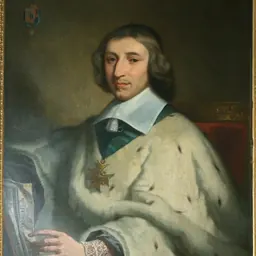
Antonio Barberini (5 August 1607 – 3 August 1671) was an Italian Catholic cardinal, Archbishop of Reims, military leader, patron of the arts and a prominent member of the House of Barberini. As one of the cardinal-nephews of Pope Urban VIII and a supporter of France, he played a significant role at a number of the papal conclaves of the 17th century. With his brothers Cardinal Francesco Barberini and Taddeo Barberini he helped to shape politics, religion, art and music of 17th century Italy. He is sometimes referred to as Antonio the Younger or Antonio Barberini iuniore to distinguish him from his uncle Antonio Marcello Barberini.
Early life Barberini was born on 5 August 1607 in Rome, the youngest of 6 children to Carlo Barberini and Costanza Magalotti (sister of Lorenzo Magalotti). Like his brothers, Antonio was educated at the Collegio Romano.
Pontificate of Urban VIII
Barberini's uncle, Maffeo Barberini was elected as pope on 6 August 1623 (the day after Antonio's 16th birthday) and took the papal throne as Pope Urban VIII. Almost immediately, he elevated his brother, Antonio's other uncle, Antonio Marcello Barberini to the position of cardinal. In the tradition of cardinal nephews, Urban also elevated Antonio's older brother Francesco Barberini to the rank of cardinal.
Urban's famous nepotism wasn't sufficiently quelled by the appointment of one cardinal-nephew. Less than a month after his 20th birthday and without having established an ecclesiastic career of his own, Antonio Barberini was appointed as a cardinal on 30 August 1627. His elevation was made in pectore and was published on 7 February 1628. Urban also purchased the comune of the town of Palestrina outside Rome, and Antonio's other brother, Taddeo Barberini, became the Prince of Palestrina.
In 1628, Antonio was appointed Prefect of the Apostolic Signatura. In 1630, he was made the papal legate in Urbino and in 1633, he became legate in Avignon where he developed close contacts with various French church power brokers. In 1636, against the wish of his uncle the Pope, he accepted the post of Crown-Cardinal-Protector of the Kingdom of France. It has been estimated that during Urban's 21-year pontificate, Barberini amassed more than 63 million scudi in personal wealth. Pope Urban responded by banning grain shipments from Farnese controlled areas. When the Farnese were then unable to pay their debts the Pope sent debt collectors. Finally, the Pope send troops to occupy Castro. The Pope's forces (12,000 infantry and 3,000 cavalry) were led by Antonio, his brother Taddeo and mercenary field commander Luigi Mattei.
Castro fell to Urban's forces without significant resistance and the victory was celebrated in song by Barberini family composer, Marco Marazzoli. But the victory was short lived and thereafter, Antonio and his troops suffered a series of decisive losses and Antonio himself was almost captured.
Pontificate of Innocent X
Antonio had developed a strong relationship with Cardinal Jules Mazarin and was given responsibility for the French contingent within the College of Cardinals and for the nomination of Giulio Cesare Sacchetti at the papal conclave of 1644, which was to pick his uncle's successor. But his efforts were in vain and the Spanish nominee, Giovanni Battista Pamphili (of the powerful Pamphili family), was elected as Pope Innocent X.
Antonio's brother Francesco had sided with the Spanish and split the conclave and it was his negotiations that resulted in Pamphili's election. The final deal in Pamphili's favour included an agreement, designed by the brothers for their own benefit, that the new Pope would allow the Barberini to keep the titles, land and fortunes they had amassed under Pope Urban VIII's reign. Mazarin became so angry because of Antonio's attitude that he deprived him of the protectorate of the Kingdom of France.
Pontificate of Alexander VII
When Innocent X died in 1655, Antonio Barberini again played a leading role in the College of Cardinals and the conclave. Again, Antonio and the French nominated Giulio Cesare Sacchetti but he was vetoed by the Spanish. The fractured college came together to support Fabio Chigi, who was elected and took office as Pope Alexander VII. About that time, he changed his dissolute lifestyle, devoted himself to religion and became strongly involved in the campaign against Jansenism. Four years later, (1657) the King brought him back to France and transferred him to the Archdiocese of Reims but it took a further decade (1667) before the pope confirmed the post. For many years, he served as Grand Almoner of the Kingdom of France. In 1661, he was appointed Cardinal-Bishop of Palestrina, the diocese that covered the Barberini family comune of Palestrina.
Later life Barberini participated in the papal conclave of 1667, during which the French delegation successfully campaigned for the election of Giulio Rospigliosi (Pope Clement IX). He also participated in the conclave of 1669-1670 at which Emilio Altieri was elected as Pope Clement X. He became Vice-Dean of the Sacred College of Cardinals in March 1671; the dean at that time was his older brother Francesco.
He died in Nemi on 3 August 1671, two days before his 64th birthday.
Private life
Contemporaries widely commented on Barberini's very dissolute conduct during the pontificate of his uncle. According to Gregorio Leti, "The great inclination he has had to women hath been no small blemish to his reputation". Contemporary John Bargrave, who met Barberini while he was travelling through the Alps on his way to exile in France, also made comment on Barberini's "vicious deportments" and "life full of liberty and debauchery".
Barberini was also, apparently, involved in several affairs with men. According to some historians, the scandal of his alleged homosexual relationships was the "talk of the town".
Fiori musicali was dedicated to Antonio Barberini in 1635. He was also said to have been a patron of Luigi Rossi.
Outside their intimate relationship, Antonio Barberini was an ongoing patron of Marc'Antonio Pasqualini.
Architecture The headquarters of the Propaganda fide in Rome, commissioned by Antonio Barberini.
In 1627, the Barberini family commissioned the architect Carlo Maderno to adapt and extend the Palazzo Sforza that they had purchased, into the Palazzo Barberini. It was located in Via delle Quattro Fontane, near the Piazza Barberini and the Quattro Fontane or Four Fountains.
Art Caravaggio's Cardsharps (c. 1594) which later came into the collection of Antonio Barberini.
Though Michelangelo Merisi da Caravaggio died when Antonio Barberini was only 3 years old, the Cardinal later became a great admirer of his work and his extensive art collection included Caravaggio's paintings such as Still Life with Fruit, Cardsharps and The Lute Player. Antonio had purchased the art collection of Francesco Maria Del Monte upon the cardinal's death which had included a large number of important works. Pope Urban VIII had purchased a number of works directly from Caravaggio and it is likely Antonio also inherited a number of these. An inventory of Antonio's assets was compiled upon his death in 1671, which included a large number of such artworks by artists of the period.
Antonio commissioned Lorenzo Ottoni to complete a number of Barberini family sculptures including that of his nephew Maffeo Barberini.
Antonio and his uncle also commissioned the painter Andrea Sacchi to complete various works at Antonio's Capuchin church and at the Palazzo Barberini. Today, the Palazzo Barberini houses the Galleria Nazionale d'Arte Antica, one of the most important painting collections in Italy.
Today, a portrait of Antonio by Carlo Maratta hangs at Alnwick Castle in Northumberland, UK, where Algernon Percy, 4th Duke of Northumberland, acquired a number of Barberini-owned pictures in the mid-nineteenth century.
Don’t just read it —
keep it.
Full-length biographies made to live with: read them, listen on the way to work, watch them tonight.
- E-book
- Audio
- Video
Instant download · yours to keep · every purchase keeps this site free
Important facts
more
Antoine Barberin, Cardinale Barberini, Antonio Barberini CardinalePeople in Antonio Barberini's life
Named in this biography and alive at the same time

Related people
Same field, nearest in time


Contemporaries
People whose lives overlapped Antonio Barberini's





Frequently asked questions
Who was Antonio Barberini?
Italian cardinal (1607-1671), nephew of Pope Urban VIII
When was Antonio Barberini born?
Antonio Barberini was born on 5 August 1607 in Rome.
When did Antonio Barberini die?
Antonio Barberini died on 3 August 1671 in Nemi.
What was Antonio Barberini's occupation?
Antonio Barberini was a catholic priest and catholic bishop.
What nationality was Antonio Barberini?
Antonio Barberini was French.
Sources & further reading
· Wikipedia: Antonio Barberini
Cite this page
APA: Biography.guide. (2026). Antonio Barberini. https://biography.guide/antonio-barberini/
MLA: "Antonio Barberini." Biography.guide, https://biography.guide/antonio-barberini/.
Chicago: "Antonio Barberini." Biography.guide. https://biography.guide/antonio-barberini/.
Data last updated: 2026-09-25 · Spot an error? Report a correction.
Page generated 2026-09-27 05:12 UTC