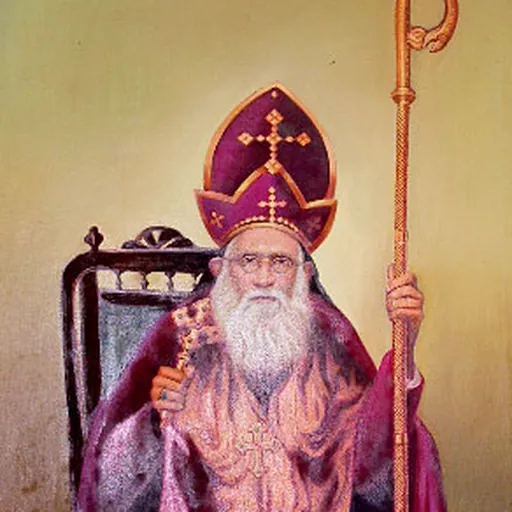
About Antonio Francisco Xavier Alvares
Lived 1836 – 1923 (aged 87). Antonio Francisco Xavier Alvares was a catholic priest, theologian, metropolitan and archbishop.
Antonio Francisco Xavier Alvares (Alvares Mar Julius) (29 April 1836 – 23 September 1923) was initially a priest in the Roman Catholic Church in Goa. He joined the Malankara Orthodox Syrian Church and was elevated to Metropolitan of Goa, Ceylon and Greater India in the Malankara Orthodox Syrian Church.
Early life Alvares was born to a Goan Catholic family in Verna, Goa, Portuguese India.
Priesthood Alvares was ordained a Roman Catholic priest in 1862 or 1864 by Bishop Walter Steins SJ, Vicar Apostolic in Bombay. Alvares began his ministry in the Archdiocese of Goa under the Archbishop of Goa. The Portuguese Crown claimed these territories by virtue of old privileges of Padroado (papal privilege of royal patronage granted by popes beginning in the 14th century). The more modern Popes and the Congregation for the Propagation of the Faith separated these areas and reorganised them as apostolic vicariates ruled by non-Portuguese bishops, since the English rulers wished to have non-Portuguese bishops.
Successive Portuguese governments fought against this, terming this as unjustified aggression by later Popes against the irrevocable grant of Royal Patronage to the Portuguese Crown, an agitation that spread to the Goan patriots, subjects of the Portuguese Crown.
When, under Pope Pius IX and Pope Leo XIII, the hierarchy in British India was formally reorganised independently of Portugal but with Portuguese consent, a group of pro-Padroado Goan Catholics in Bombay united under the leadership of Dr. Pedro Manoel Lisboa Pinto and Alvares as the Society for the Defense of the Royal Patronage and agitated against the Holy See, the British India government and the Portuguese government in opposition to these changes.
Uniting with Orthodox Church Their agitation failed to reverse the changes. Angry with the Portuguese government, the group broke away from the Catholic Church and joined the Malankara Orthodox Syrian Church.
Bishop Alvares was consecrated as Mar Julius I, on 29 July 1889, by the Orthodox Bishop of Kottayam, Paulose Mar Athanasios to be Archbishop of autocephalous Latin Rite of Ceylon, Goa, and India.
While he was a priest of the Catholic Church, he was in search of the true Biblically Christian One, Holy, Catholic, and Apostolic Church. He was against the false devotion and religious exhibitionism. He objected to the Concordat of the Pope and interference of the Government in the Church administration. He could not withstand the harassment meted out to him by the ecclesiastical and civil powers. He went to Western and Eastern Churches and finally joined the Malankara Orthodox Syrian Church. Credited with good faith and piety and true regard for others, he was consecrated as bishop by Joseph Mar Dionysius V, Geevarghese Mar Gregorios of Parumala, Mar Paulose Ivanios Murimattathilof Kandanadu and Mar Athanasios (Kadavil) in Kottayam Old Seminary on 29 July 1889. He was elevated to Metropolitan Archbishop of Goa-India-Ceylon(Presently Brahmavar) Diocese of the Malankara Church
When Joseph René Vilatte was soliciting for consecration by a bishop with orders recognised by the Catholic Church, he was guided to Alvares. Alvares, together with Mar Athanasios Paulose (d. 1907), Bishop of Kottayam, and Saint Geevarghese Mar Gregorios of Parumala (d. 1902), Bishop of Niranam (and later of Thumpamon), consecrated Vilatte in 1892 in Colombo, British Ceylon and named him "Mar Timotheos, Metropolitan of North America," most probably with the blessings of Patriarch of Antioch Ignatius Peter IV.
Alvares has a cathedral under the Syriac Orthodox Church in Colombo, British Ceylon. Alvares had lived in Colombo, Sri Lanka, for a significant time which is why he ended up having a Cathedral at this location. Alvares had also lived in the twin villages of Brahmavar and Kalianpur, Karnataka, which is now where The Evangelistic Association of the East has a number of churches and has been doing extensive mission work to support the descendants of Alvares converts from his initial missions in these areas and also to continue his missionary work. Alvares died of dysentery in Ribandar, Goa and was buried there. he was mostly based in Canara region of Karnataka with the main base at Brahmavar. Along with Roque Zephrin Noronha, he worked among the people along the west coast of India from Mangalore to Bombay. About 5000 families joined the Malankara Orthodox Syrian Church.
The Holy See sought to consolidate two co-existing jurisdictions, the Padroado jurisdiction and the Congregation for Propagation of the Faith jurisdiction. The Padroado was the privilege of patronage extended to Portugal which granted the right of designating candidates for episcopal and other offices and benefices in Africa and the East Indies; in addition, it was an exchange of a portion of ecclesiastical revenues for missionaries and endowments to religious establishments in those territories. In time it was seen by the Holy See as an obstacle to missions: the Portuguese government failed to observe the conditions of the agreement; disagreed about the extent of the patronage by claiming the agreement was restricted by Pope Alexander VI's Bulls of Donation and Treaty of Tordesillas while Rome maintained the agreement was restricted to conquered countries; and, contested papal appointments of missionary bishops or vicars apostolic made without its consent, in countries which were never subject to its dominion. As part of the transition, churches served by Goan Catholic priests remained under the jurisdiction of the Patriarch of the East Indies until 1843. Later, this transition was delayed and extended until 1883-12-31. In British Ceylon, it ended in 1887 with the appearance of a papal decree that placed all Catholics in the country under the exclusive jurisdiction of the bishops of the island. That measure met resistance. Alvares and Dr. Pedro Manoel Lisboa Pinto founded in Goa, Portuguese India, an association for the defence of the Padroado. Then, according to G. Bartas, in , they complained that the new diocese and vicariates were headed, almost exclusively, by European prelates and missionaries, and petitioned the Holy See for the creation of a purely native hierarchy. Bartas did not state if there was a response, but wrote that Alvares settled the difficulty by reinventing himself as the head of his schism, appearing in Ceylon, and settling into the main old Goan Portuguese churches in the village of Parapancandel. Alvares was a Roman Catholic Brahmin. Aiya wrote that Alvares, an educated man and the editor of a Catholic journal, was a priest in the Metropolitan Archdiocese of Goa. Failing to maintain amicable relations with the Patriarch of the East Indies, Alvares left the and joined Mar Dionysius the Metropolitan in Kottayam who consecrated Alvares as bishop. A strike at the largest publisher in Colombo, influenced by Pinto's propaganda, took place in September 1893. The next day, Pinto became president of the newly formed printers union. "The main grievances of the printers included low pay and bad working and living conditions." (See La Croix, Catholic Messenger of Ceylon reported that the Alvares schism ended in 1902.) Bartas did not recount the significance of Alvares' ideology, he only noted that the schism, around 1902, intended to convert corporately, to eastern orthodoxy. The cathedral in Colombo had one priest, Alvares, fairly advanced in age. He and his parishioners asked the Holy Synod of the Church of Greece, in Athens, to accept them under its jurisdiction and to send them an officiating priest preaching in Latin and English. Bartas wrote: A Greek Orthodox priest, delegated by the Holy Synod in Athens, to celebrate the Latin Mass and deliver the English sermons, in an independent Catholic Church of Ceylon in the cathedral of the priest who became Archbishop of Goa Indo-Ceylon by the grace of a Jacobite bishop of Malabar; that is the answer to a purely indigenous hierarchy, that ... Pinto and Alvarez demanded so loudly at the beginning of their schism!
Apostle of charity
In 1871, he started a charitable association in Panaji to render help to the poor, beginning with wandering beggars. After a few years he extended the association to other cities in Goa. During the last ten years of his life he concentrated his activities in Panaji. He worked with the poor and destitute as well as lepers and tuberculosis patients. He was persecuted by the Catholic Church and the Portuguese Government. Though he was advised by some of his old friends to reunite with the Catholic Church, especially when he was very sick, he refused and stuck to his Orthodox faith.
Death Alvares died of dysentery on 23 September 1923 in Ribandar hospital, a charitable institution.
Veneration
In 1927, his bones were collected by his friends and admirers, placed in a lead box and reburied, under a marble slab. The slab was inscribed with the inscription ", " (In memory of priest Antonio Francisco Xavier Alvares, who was very humanitarian missionary and a great patriot) and the largest cross in the cemetery. A small church was constructed in Ribandar and, in 1979, Alvares' remains were disinterred and placed in the church by Metropolitan Philipose Mar Theophilos of the Bombay diocese. St. Mary's Orthodox Syrian church, Ribandar. The location of Alvares' entombed remains When the St. Mary's church was reconstructed in the same place, Alvares' remains were moved to the present ossuary which was specially made on the side of the altar by Moran Mar Baselios Mar Thoma Mathews II, Catholicos of the East, on 6 October 2001.
Alvares' remains are entombed at St. Mary's Orthodox church in Ribandar. Although the congregation was small, the Brahmavar Orthodox Community has survived almost a century after Alvares' death. His dukrono (memorial feast) is celebrated at St. Mary's Orthodox Syrian church in Ribandar during the week of 23 September every year.
Works or publications
Alvares was also involved with several newspapers, including O Progresso de Goa, The Times of Goa, A Cruz, A Verdade and O Brado Indiano.
Notes and references
Don’t just read it —
keep it.
Full-length biographies made to live with: read them, listen on the way to work, watch them tonight.
- E-book
- Audio
- Video
Instant download · yours to keep · every purchase keeps this site free
Important facts
People in Antonio Francisco Xavier Alvares's life
Named in this biography and alive at the same time


Related people
Same field, nearest in time

Contemporaries
People whose lives overlapped Antonio Francisco Xavier Alvares's




Frequently asked questions
Who was Antonio Francisco Xavier Alvares?
priest (1836-1923)
When was Antonio Francisco Xavier Alvares born?
Antonio Francisco Xavier Alvares was born on 29 April 1836 in Verna.
When did Antonio Francisco Xavier Alvares die?
Antonio Francisco Xavier Alvares died on 23 September 1923 in Ribandar.
What was Antonio Francisco Xavier Alvares's occupation?
Antonio Francisco Xavier Alvares was a catholic priest, theologian, metropolitan and archbishop.
Sources & further reading
· Wikipedia: Antonio Francisco Xavier Alvares
· DBpedia: Antonio Francisco Xavier Alvares
Cite this page
APA: Biography.guide. (2026). Antonio Francisco Xavier Alvares. https://biography.guide/antonio-francisco-xavier-alvares/
MLA: "Antonio Francisco Xavier Alvares." Biography.guide, https://biography.guide/antonio-francisco-xavier-alvares/.
Chicago: "Antonio Francisco Xavier Alvares." Biography.guide. https://biography.guide/antonio-francisco-xavier-alvares/.
Data last updated: 2026-09-20 · Spot an error? Report a correction.
Portrait: Wikimedia Commons · author & licence
Page generated 2026-09-27 04:58 UTC