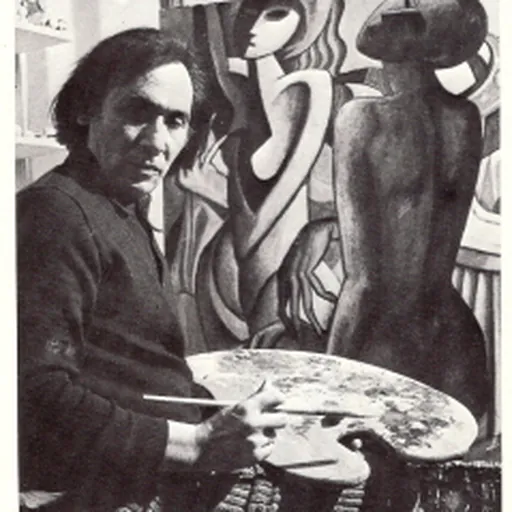
About Antonio Diego Voci
Lived 1920 – 1985 (aged 65). Antonio Diego Voci was an Italian painter and sculptor.
Antonio Diego Voci (10 August 1920 – 10 December 1985) was an Italian painter and sculptor. He was an internationally collected figurative artist with the largest group of owners of his works residing in Switzerland, England, Germany, Italy, Canada and the United States; as well as various works scattered the world over. Although constantly drawing or painting from childhood to the day he succumbed to lung cancer, Diego's most productive period was the last quarter century of his life which began when he met Helga Drössler in January 1960 in Paris. A significant turning point in Diego's career, Diego said, "My life took on new meaning. I became more." Helga who became Diego's wife, lover, best friend and confidant, published seven chapters of her life with Diego on Artifact Collectors.
1920–1938: early life Antonio Diego Voci (VOH-chee), the youngest of 3 brothers was born Antonio Innocenzo Voci on 10 August 1920 in the mountainous region near Catanzaro, Italy, in the small village of Gasperina, to Giuseppantonio Voci and Arcangela Messina Voci, a Catholic family of modest means. From childhood Diego felt compelled to draw as constantly and effortlessly as he drew a breath, endowed by nature to do both. Diego was called on in school for art, design and decoration projects. By age 12 he was awarded a year scholarship to a design school. Diego studied sculpture and painting for three years at Lycee d'Art, followed by studies of Greek and Latin, as well as tailoring.
Diego sold his first painting at age 18. Upon venturing out on his own Diego summoned his practical side to employ his art talent to works of art he knew the public would quickly buy, to raise money or trade for food, bed, paint and canvas, and to finance his study, to expand knowledge, experience and skill. Diego enjoyed those privileges until the end of the war. or the tortured life of Vincent van Gogh who died at age 37, with only one painting purchased in his lifetime. Diego greatly admired the exceptional work of both artists, but, unlike both artists who found few buyers for their work, in their lifetime, Diego did for his.
Diego's influences Professor Felice Carena (1879–1966), who was one of Italy's great religious artists displayed in Museum of Modern Religious Art in Rome, was a mentor for Diego. The following paragraph is excerpted from "HELGA and DIEGO" Chapter Two
Diego Voci and caricatures
Diego was popular in the World War II POW Camp doing caricatures and portraits Diego said he never copies. He creates from his vast library of mental images collected from international travels and mingling with everyday people.
February 1962, their next stop was Morocco and while there Diego received a commission in Marrakesh at the American Officer's Club. Schlossgalerie provided Diego a studio. He signed his works "A. Voci"
Helga Voci said, "The owner [R. Buri] sold quite many paintings." (later renamed 526th Tactical Fighter Sq.) and flown from Aviano Air Force Base to Wiesbaden. The President left Wiesbaden the next morning for Berlin for his famous "Ich bin ein Berliner"speech.
Return to Italy
Diego longed to leave Switzerland to return to the warmer southern country where he felt more at ease and more inspired to paint. this is the only evidence of the name Diego in a document signature from birth until 1976 when he registered in Taunusstein. In 1972, Schwetzingen, Germany became their home. There Diego and Helga had a daughter, Alessandra, cared for by a nanny from India who stayed with them until 1985.
The Voci's, who had no knowledge of credit cards, bought a used station-wagon with cash on the east coast to travel cross country. a writer for Stars & Stripes newspaper through Diego collector Coop Cooprider, a published article in AFN TV guide, Although Coop's volunteer working relationship ended in mid-1974, he and wife Patti continued to add to their Diego collection and kept in contact for several years later. 22 ½" x 18 ½", last work of art
That persistent urge to draw that possessed Diego from a young child carried into Diego's last hours.
The resting place for Diego Voci is in Neuhof, Germany. Puzzled, an owner of 5 Diego pieces, Mary Trimmins in 2008 posted a simple question on ArtifactCollectors.com, "Are there any Diego painting owners out there?"
Just as Diego travelled the world, so too did his art. "Horses Racing" went to auction in Paris where it was purchased by an antique dealer from Basel. It was then purchased by a Czech born grand-dame as a wedding gift to her new son-in-law, who came from a family of race horse breeders in India. When contacted about his Diego in London where he resides, the son-in-law declared, "You call it a Diego, I consider it a Voci". And it is signed "A. Voci". Schlossgalerie advertised the artist under the name "Antonio Voci" (No "Diego").
Also signed "A. Voci" is another significant Diego piece "Alt und Jung" pictured in the Schlossgalerie advertisement of the Neue Zürcher Zeitung 20 January 1965. This painting also travelled, purchased in Zurich and ending in US, 43 years later.
A colour image of Diego's "Alt und Jung" painting can also be seen in a 2008 rare internet recorded sale on LiveAuctioneers.com. Kodner Auctions mis-titled the painting "Horses Grazing". In the absence of information about the artist, the painting was sold for a fraction of its original selling price. Later, a Diego collector offered to triple the price (or more), but requests to Kodner to reveal the present whereabouts were rejected.
Innocenzo v. Diego "Diego" as he wanted the world to know him, rejected his birth middle name "Innocenzo". Being the youngest of three boys by fifteen years, that sweet little newborn was the picture of innocence (Italian: innocenza). Diego wanted to be seen as anything but innocent. The family pet childhood name "Toto" was enough to bear. "Diego told me he never liked his middle name," said Helga Drössler Voci, wife. "Innocenzo" is conspicuous by its official document absence in Diego's life. Innocenzo was discovered only on his birth certificate. After that it is "Antonio Voci" until 1976 when "Diego" is slipped into a government document.
Gallery Works
Faces
Surrealism
Cubism
Clowns, Harlequins, and Musicians
Landscapes
Horses/Boats
Signatures
Don’t just read it —
keep it.
Full-length biographies made to live with: read them, listen on the way to work, watch them tonight.
- E-book
- Audio
- Video
Instant download · yours to keep · every purchase keeps this site free
Important facts
People in Antonio Diego Voci's life
Named in this biography and alive at the same time
Related people
Same field, nearest in time


Contemporaries
People whose lives overlapped Antonio Diego Voci's





Frequently asked questions
Who was Antonio Diego Voci?
Italian painter and sculptor (1920-1985)
When was Antonio Diego Voci born?
Antonio Diego Voci was born on 10 August 1920 in Gasperina.
When did Antonio Diego Voci die?
Antonio Diego Voci died on 10 December 1985 in Taunusstein.
What was Antonio Diego Voci's occupation?
Antonio Diego Voci was a painter and sculptor.
What nationality was Antonio Diego Voci?
Antonio Diego Voci was Italian.
Sources & further reading
· Wikipedia: Antonio Diego Voci
Cite this page
APA: Biography.guide. (2026). Antonio Diego Voci. https://biography.guide/antonio-diego-voci/
MLA: "Antonio Diego Voci." Biography.guide, https://biography.guide/antonio-diego-voci/.
Chicago: "Antonio Diego Voci." Biography.guide. https://biography.guide/antonio-diego-voci/.
Data last updated: 2026-09-23 · Spot an error? Report a correction.
Portrait: Wikimedia Commons · author & licence
Page generated 2026-09-27 05:07 UTC