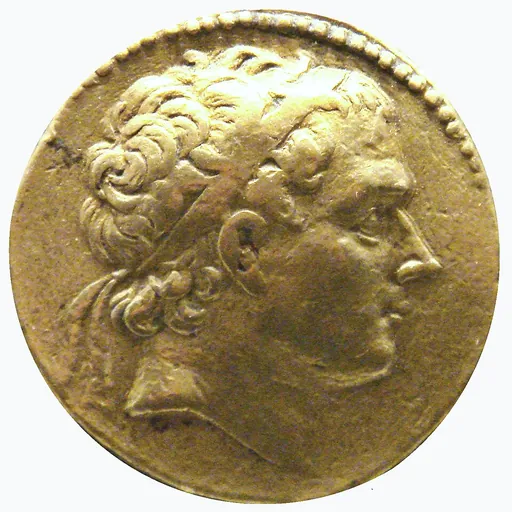
About Antiochus III the Great
Lived 242 BC – 187 BC (aged 54–55). Antiochus III the Great was a sovereign.
Antiochus III the Great (; , ; c. 241 BC – 3 July 187 BC) was the sixth ruler of the Seleucid Empire, reigning from 223 BC to 187 BC.
Ascending to the throne at the age of eighteen, Antiochus inherited an empire in turmoil after the death of his brother, Seleucus III Ceraunus. While his initial campaigns against Ptolemaic Egypt ended in failure, he spent the decade that followed successfully reasserting Seleucid authority over territory such as central Asia Minor, Parthia and Bactria. Pressing as far as the Kabul valley, he renewed a friendship with the Indian king Sophagasenus and earned himself the epithet "the Great" (Antiochos Megas). He also assumed the title Basileus Megas (Greek for 'Great King'), the traditional title of the Persian kings. Upon his return to the west, Antiochus launched another campaign against the Ptolemies and brought Coele-Syria, Phoenicia and Judea under Seleucid control.
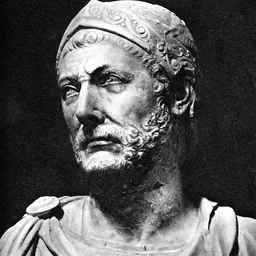
Antiochus's designs on the Greek city-states earned him the antagonism of the Roman Republic. Declaring himself the "champion of Greek freedom against Roman domination", he waged a four-year war against Rome beginning in mainland Greece in the autumn of 192 BC, advised by the exiled Carthaginian general Hannibal and supported by an alliance with the Aetolian League. He was resoundingly defeated at the battles of Thermopylae (191 BC) and Magnesia (190 BC), resulting in the loss of much of the Seleucid lands in Asia Minor to Rome's allies. Renewed rebellions ensued, and Antiochus died three years later on another expedition to the east.
Biography
Background and early reign Seleucid Kingdom at the time of Antiochus's accession to the throne. Antiochus III was a member of the Hellenistic Seleucid dynasty. He was the son of king Seleucus II Callinicus and Laodice II, aunt of Seleucus, and was born around 242 BC near Susa in Persia. He may have initially borne a non-dynastic name (starting with Ly-), according to a Babylonian chronicle. He succeeded, under the name Antiochus, his brother Seleucus III Ceraunus, upon the latter's murder in Anatolia; he was in Babylon at the time.
Antiochus III inherited a disorganized state. Not only had Asia Minor become detached, but the easternmost provinces had broken away, Bactria under the Seleucid Diodotus of Bactria, and Parthia under the rebel satrap Andragoras in 247–245 BC, who was himself later vanquished by the nomad chieftain Arsaces. In 222 BC, soon after Antiochus's accession, Media and Persis revolted under their governors, the brothers Molon and Alexander. The young king, under the influence of the minister Hermeias, headed an attack on Ptolemaic Syria instead of going in person to face the rebels. The attack against the Ptolemaic empire proved a fiasco, and the generals sent against Molon and Alexander met with disaster. Only in Asia Minor, where the king's cousin, Achaeus, represented the Seleucid cause, did its prestige recover, driving the Pergamene power back to its earlier limits.
In 221 BC Antiochus at last went far east, and the rebellion of Molon and Alexander collapsed which Polybius attributes in part to his following the advice of Zeuxis rather than Hermeias. The submission of Lesser Media, which had asserted its independence under Artabazanes, followed. Antiochus conspired with his physician and allies to have Hermeias assassinated, and then returned to Syria (220 BC). Meanwhile, Achaeus himself had revolted and assumed the title of king in Asia Minor. Though, due to the brewing mutiny of his troops arising from their dissatisfaction over his rebellion against their king, Achaeus desisted from his attempted coup and retreated. While sending additional threats to Achaeus, Antiochus left him for the time being and renewed his attempts on Ptolemaic Syria. Antiochus declined this counsel. He summoned Xerxes, waived the bulk of the tribute arrears his father, Arsames I, had accumulated, and accepted a reduced immediate settlement in silver, horses, and mules. He allowed Xerxes to continue ruling Sophene and gave him his sister Antiochis in marriage. In 209 BC Antiochus invaded Parthia, occupied the capital Hecatompylos and pushed forward into Hyrcania, winning the Battle of Mount Labus. The Parthian king Arsaces II apparently successfully sued for peace. Euthydemus was defeated by Antiochus at the Battle of the Arius, but after resisting the Seleucid king in the Siege of Bactra, he obtained an honourable peace by which Antiochus promised Euthydemus's son Demetrius the hand of Laodice, his daughter, and allowed Euthydemus himself to keep his royal title.
Antiochus next, following in the steps of Alexander, crossed into the Kabul valley, reaching the realm of Indian king Sophagasenus and returned west by way of Seistan and Kerman (206/5). In 205/204 BC the infant Ptolemy V Epiphanes succeeded to the Egyptian throne, and Antiochus is said (notably by Polybius) to have concluded a secret pact with Philip V of Macedon for the partition of the Ptolemaic possessions.
In 192 BC Antiochus invaded Greece with a 10,000-man army, and was elected the commander in chief of the Aetolian League. In 191 BC, however, the Romans under Manius Acilius Glabrio routed him at Thermopylae, forcing him to withdraw to Asia Minor. The Romans followed up their success by invading Anatolia, and the decisive victory of Scipio Asiaticus at Magnesia ad Sipylum (190 BC), following the defeat of Hannibal at sea off Side, delivered Asia Minor into their hands. Antiochus (221–193 BC), Antiochus III's first heir apparent and joint-king with his father from 210 to 193 BC Seleucus IV Philopator (c. 220175 BC), Antiochus III's successor Ardys Daughter (name unknown), betrothed in about 206 BC to Demetrius I of Bactria Laodice IV, married all three of her brothers in succession and became Queen of the Seleucid Empire through her second and third marriages Cleopatra I Syra (c. 204176 BC), married Ptolemy V Epiphanes of Egypt in 193 BC Antiochis, married King Ariarathes IV of Cappadocia in 194 BC Mithridates (215–164 BC), succeeded his brother Seleucus IV Philopator in 175 BC under the regnal name Antiochus IV Epiphanes
In 191 BC, Antiochus III married a girl from Chalcis, whom he named "Euboea". They had no children. Laodice III may have fallen in disgrace; however, she clearly survived Antiochus III, and appears in Susa in 183 BC.
Antiochus and the Jews Antiochus III resettled 2000 Jewish families from Babylonia into the Hellenistic Anatolian regions of Lydia and Phrygia. Josephus portrays him as friendly towards the Jews of Jerusalem and cognizant of their loyalty to him (see Antiquities of the Jews, Book XII, Chapter 3), in stark contrast to the attitude of his son. In fact, Antiochus III lowered taxes, granted subventions to the Temple, and let the Jews live, as Josephus puts it, "according to the law of their forefathers."
Books of Maccabees Antiochus III is mentioned in the deuterocanonical Books of the Maccabees. The subject of Maccabees is the Maccabean Revolt against Antiochus's son, Antiochus IV Epiphanes. Antiochus III is first mentioned in 1 Maccabees 1:10, when Antiochus IV is introduced as "son of King Antiochus [Antiochus III]". Antiochus III is mentioned later in 1 Maccabees 8, which describes Judas Maccabeus's knowledge of the deeds of the Roman Republic, including an allusion to the defeat of Antiochus III by the Romans. The NRSV says "They [the Romans] also had defeated Antiochus the Great, king of Asia, who went to fight against them with one hundred twenty elephants and with cavalry and chariots and a very large army. He was crushed by them; they took him alive and decreed that he and those who would reign after him should pay a heavy tribute and give hostages and surrender some of their best provinces, the countries of India, Media, and Lydia. These they took from him and gave to King Eumenes." (1 Maccabees 8:6–8)
Cultural portrayals During the Caroline era, the play Believe as You List was centred around Antiochus's resistance to the Romans after the Battle of Thermopylae. The play was originally about Sebastian of Portugal surviving the Battle of Alcazar, returning and trying to gather support to return to the throne. This first version was censored for being considered "subversive" because it portrayed Sebastian being deposed, it had comments in favour of an Anglo-Spanish alliance and it was possibly pro-Catholic. That led to the final version changing to the story of Antiochus, which led to historical inaccuracy in exaggerating his defeat at that phase in history to fit the earlier text and turning Spaniards into Romans and the Catholic eremite into a Stoic philosopher. Antiochus features towards the end of Norman Barrow's historical novel, The High Priest (Faber & Faber, 1947), after his forces have reacquired Jerusalem from the Ptolemaic occupation. The book was noted by John Betjeman in the Daily Herald as "interesting".
Don’t just read it —
keep it.
Full-length biographies made to live with: read them, listen on the way to work, watch them tonight.
- E-book
- Audio
- Video
Instant download · yours to keep · every purchase keeps this site free
Important facts
Family & relationships
People in Antiochus III the Great's life
Named in this biography and alive at the same time

Related people
Same field, nearest in time


Contemporaries
People whose lives overlapped Antiochus III the Great's


Frequently asked questions
Who was Antiochus III the Great?
sixth Seleucid emperor (223–187 BC)
When was Antiochus III the Great born?
Antiochus III the Great was born in 242 BC in Susa.
When did Antiochus III the Great die?
Antiochus III the Great died in 187 BC in Susa.
What was Antiochus III the Great's occupation?
Antiochus III the Great was a sovereign.
What nationality was Antiochus III the Great?
Antiochus III the Great's recorded nationality: Seleucid Empire.
Sources & further reading
· Wikipedia: Antiochus III the Great
· DBpedia: Antiochus III the Great
Cite this page
APA: Biography.guide. (2026). Antiochus III the Great. https://biography.guide/antiochus-iii-the-great/
MLA: "Antiochus III the Great." Biography.guide, https://biography.guide/antiochus-iii-the-great/.
Chicago: "Antiochus III the Great." Biography.guide. https://biography.guide/antiochus-iii-the-great/.
Data last updated: 2026-09-23 · Spot an error? Report a correction.
Portrait: Wikimedia Commons · author & licence
Page generated 2026-09-27 05:06 UTC