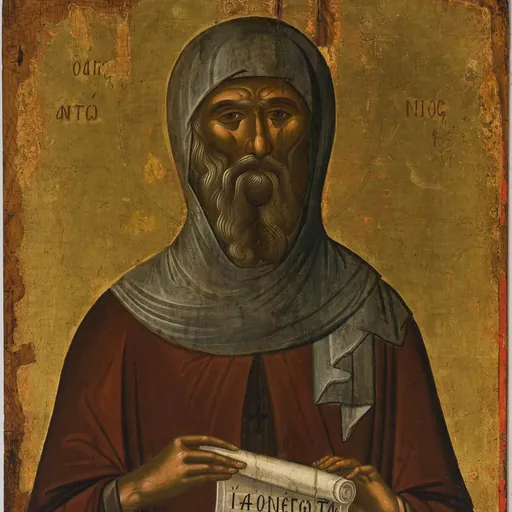
Anthony the Great
Egyptian Christian monk, hermit, and saint (died 356)
About Anthony the Great
Lived 251 – 357 (aged 105–106). Anthony the Great was a Roman christian monk, anchorite and writer.
Anthony the Great ( – 17 January 356) was a Christian monk from Egypt, revered since his death as a saint. He is distinguished from other saints named Anthony, such as , by various epithets: , , , , , and . For his importance among the Desert Fathers and to all later Christian monasticism, he is also known as the . His feast day is celebrated on 17 January among the Eastern Orthodox and Catholic churches and on Tobi 22 in the Coptic calendar.
The biography of Anthony's life by Athanasius of Alexandria helped to spread the concept of Christian monasticism, particularly in Western Europe via its Latin translations. He is often erroneously considered the first Christian monk, but as his biography and other sources make clear, there were many ascetics before him. Anthony was, however, among the first known to go into the wilderness (about AD 270), which seems to have contributed to his renown. Accounts of Anthony enduring supernatural temptation during his sojourn in the Eastern Desert of Egypt inspired the depiction of his temptations in visual art and literature.
Anthony is invoked against infectious diseases, particularly skin diseases. In the past, many such afflictions, including ergotism, erysipelas, and shingles, were referred to as Saint Anthony's fire.
Life of Anthony Most of what is known about Anthony comes from the Life of Anthony. Written in Greek by Athanasius of Alexandria, it depicts Anthony as an illiterate and holy man who, through his existence in a primordial landscape, has an absolute connection to the divine truth, which is always in harmony with that of Athanasius as the biographer. it became his most widely read work. Sometime before 374 it was translated into Latin by Evagrius of Antioch. The Latin translation helped the Life become one of the best-known works of literature in the Christian world, a status it would hold through the Middle Ages.
Translated into several languages, it became something of a "best seller" in its day and played an important role in the spreading of the ascetic ideal in Eastern and Western Christianity. It later served as an inspiration to Christian monastics in both the East and the West, and helped to spread the concept of Christian monasticism, particularly in Western Europe via its Latin translations.
Many stories are also told about Anthony in the Sayings of the Desert Fathers.
Anthony probably spoke only his native language, Coptic, but his sayings were spread in a Greek translation. He himself dictated letters in Coptic, seven of which are extant.
Hermit
For the next fifteen years, Anthony remained in the area, spending the first years as the disciple of another local hermit.
According to the Temptation of Saint Anthony (1878) by Félicien Rops:
Anthony is sometimes considered the first monk, and the first to initiate solitary desertification, but there were others before him. There were already ascetic hermits (the Therapeutae), and loosely organized cenobitic communities were described by the Jewish philosopher Philo of Alexandria in the 1st century AD as long established in the harsh environment of Lake Mareotis and in other less accessible regions. Philo opined that "this class of persons may be met with in many places, for both Greece and barbarian countries want to enjoy whatever is perfectly good." Christian ascetics such as Thecla had likewise retreated to isolated locations at the outskirts of cities. Anthony is notable for having decided to surpass this tradition and headed out into the desert proper. He left for the alkaline Nitrian Desert (later the location of the noted monasteries of Nitria, Kellia, and Scetis) on the edge of the Western Desert about west of Alexandria. He remained there for 13 years. He ate at most only once a day and sometimes fasted through two or four days.
According to Athanasius, the devil fought Anthony by afflicting him with boredom, laziness, and the phantoms of women, which he overcame by the power of prayer, providing a theme for Christian art. After that, he moved to one of the tombs near his native village. There it was that the Life records those strange conflicts with demons in the shape of wild beasts, who inflicted blows upon him, and sometimes left him nearly dead.
After fifteen years of this life, at the age of thirty-five, Anthony determined to withdraw from the habitations of men and retire in absolute solitude. He went into the desert to a mountain by the Nile called Pispir (now Der-el-Memun), opposite Arsinoë. There he lived strictly enclosed in an old abandoned Roman fort for some 20 years. as he organized his disciples into a community and later, following the spread of Athanasius's hagiography, was the inspiration for similar communities throughout Egypt and elsewhere. Macarius the Great was a disciple of Anthony. Visitors traveled great distances to see the celebrated holy man. Anthony is said to have spoken to those of a spiritual disposition, leaving the task of addressing the more worldly visitors to Macarius. Macarius later founded a monastic community in the Scetic desert.
The fame of Anthony spread and reached Emperor Constantine, who wrote to him requesting his prayers. The brethren were pleased with the Emperor's letter, but Anthony was not overawed and wrote back exhorting the Emperor and his sons not to esteem this world but remember the next.
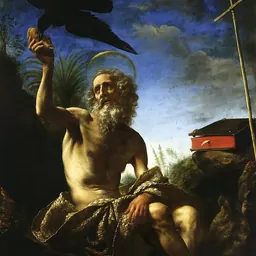
The stories of the meeting of Anthony and Paul of Thebes, the raven who brought them bread, Anthony being sent to fetch the cloak given him by "Athanasius the bishop" to bury Paul's body in, and Paul's death before he returned, are among the familiar legends of the Life. However, belief in the existence of Paul seems to have existed quite independently of the Life.
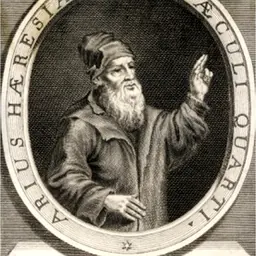
In 338, he left the desert temporarily to visit Alexandria to help refute the teachings of Arius. Anthony was interred, according to his instructions, in a grave next to his cell.
Anthony is said to have faced a series of preternatural temptations during his pilgrimage to the desert. The first to report on the temptation was his contemporary Athanasius of Alexandria. It is possible these events, like the paintings, are full of rich metaphor or in the case of the animals of the desert, perhaps a vision or dream. Emphasis on these stories, however, did not really begin until the Middle Ages when the psychology of the individual became of greater interest.
The satyr and the centaur
Anthony was on a journey in the desert to find Paul of Thebes, who according to his dream was a better hermit than he. Anthony had been under the impression that he was the first person to ever dwell in the desert; however, due to the dream, Anthony was called into the desert to find his "better", Paul. On his way there, he ran into two creatures in the forms of a centaur and a satyr. Although chroniclers sometimes postulated that they might have been living beings, Western theology considers them to have been demons.
Anthony found next the satyr, "a manikin with hooked snout, horned forehead, and extremities like goats' feet." This creature was peaceful and offered him fruits, and when Anthony asked who he was, the satyr replied, "I'm a mortal being and one of those inhabitants of the desert whom the Gentiles, deluded by various forms of error, worship under the names of Fauns, Satyrs, and Incubi. I am sent to represent my tribe. We pray you on our behalf to entreat the favor of your Lord, who, we have learnt, came once to save the world, and 'whose sound has gone forth into all the earth.'" Upon hearing this, Anthony was overjoyed and rejoiced over the glory of Christ. He condemned the city of Alexandria for worshipping monsters instead of God while beasts like the satyr spoke about Christ. Soon, after walking some more in that desert, he found a pile of gold coins that was also a temptation from the devil. Anthony cast the gold into a fire, and the gold coins immediately disappeared just like the silver ones.
After these two events, he had a vision where the whole world was covered with snares and traps. Anthony prayed saying, "Oh good Lord, who may escape from these snares?" He was responded to by a voice that said, "Humility shall escape them without more."
Demons in the cave Being an ascetic, Anthony went out to live in the tombs away from the village. There were so many demons in the cave though, that Anthony's servant had to carry him out because they had beaten him to death. When the hermits were gathered to Anthony's corpse to mourn his death, Anthony was revived. He demanded that his servants take him back to that cave where the demons had beaten him. When he got there he called out to the demons, and they came back as wild beasts to rip him to shreds. Suddenly a bright light flashed, and the demons ran away. Anthony knew that the light must have come from God, and he asked God where he was before when the demons attacked him. God replied, "I was here but I would see and abide to see thy battle, and because thou hast mainly fought and well maintained thy battle, I shall make thy name to be spread through all the world."
Veneration
Anthony had been secretly buried on the mountaintop where he had chosen to live. His remains were reportedly discovered in 361 and transferred to Alexandria. Some time later, they were taken from Alexandria to Constantinople, so that they might escape the destruction being perpetrated by invading Saracens. In the eleventh century, the Byzantine emperor gave them to the French Count Jocelin. Jocelin had them transferred to La-Motte-Saint-Didier, later renamed.
Veneration of Anthony in the East is more restrained. There are comparatively few icons and paintings of him. He is, however, regarded as the "first master of the desert and the pinnacle of holy monks", and there are monastic communities of the Maronite, Chaldean, and Orthodox churches which state that they follow his monastic rule.
Anthony is remembered in the Anglican Communion with a Lesser Festival on 17 January.
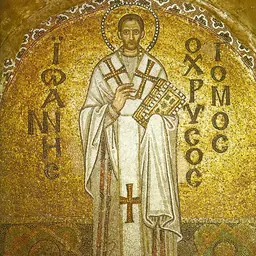
Though Anthony himself did not organize or create a monastery, a community grew around him based on his example of living an ascetic and isolated life. Athanasius' biography helped propagate Anthony's ideals. Athanasius writes, "For monks, the life of Anthony is a sufficient example of asceticism. and John Chrysostom.
The main centre of veneration of this saint in the Canary Islands (Spain) is located in the town of La Matanza de Acentejo, on the island of Tenerife. The sanctuary of San Antonio Abad is one of the oldest temples in the Canary Islands, founded shortly after the completion of the conquest of the archipelago.
Coptic literature
Examples of purely Coptic literature are the works of Anthony and Pachomius, who spoke only Coptic, and the sermons and preaching of Shenouda the Archmandrite, who chose to write only in Coptic. The earliest original writings in the Coptic language were the letters of Anthony. During the 3rd and 4th centuries, many ecclesiastics and monks wrote in Coptic.
Translations
Don’t just read it —
keep it.
Full-length biographies made to live with: read them, listen on the way to work, watch them tonight.
- E-book
- Audio
- Video
Instant download · yours to keep · every purchase keeps this site free
Important facts
more
Saint Anthony, St. Anthony of Egypt, Antonius Magnus, the Hermit, St. Anthony, St Anthony, Antony Abbot of Egypt, St. Antony, Saint Anthony the GreatPeople in Anthony the Great's life
Named in this biography and alive at the same time

Related people
Same field, nearest in time




Contemporaries
People whose lives overlapped Anthony the Great's


Frequently asked questions
Who was Anthony the Great?
Egyptian Christian monk, hermit, and saint (died 356)
When was Anthony the Great born?
Anthony the Great was born on 12 January 251 in Coma, Herakleopolis Magna.
When did Anthony the Great die?
Anthony the Great died in 357 in Thebes.
What was Anthony the Great's occupation?
Anthony the Great was a christian monk, anchorite and writer.
What nationality was Anthony the Great?
Anthony the Great was Roman.
Sources & further reading
· Wikipedia: Anthony the Great
Cite this page
APA: Biography.guide. (2026). Anthony the Great. https://biography.guide/anthony-the-great/
MLA: "Anthony the Great." Biography.guide, https://biography.guide/anthony-the-great/.
Chicago: "Anthony the Great." Biography.guide. https://biography.guide/anthony-the-great/.
Data last updated: 2026-09-22 · Spot an error? Report a correction.
Portrait: Wikimedia Commons · author & licence
Page generated 2026-09-27 05:03 UTC