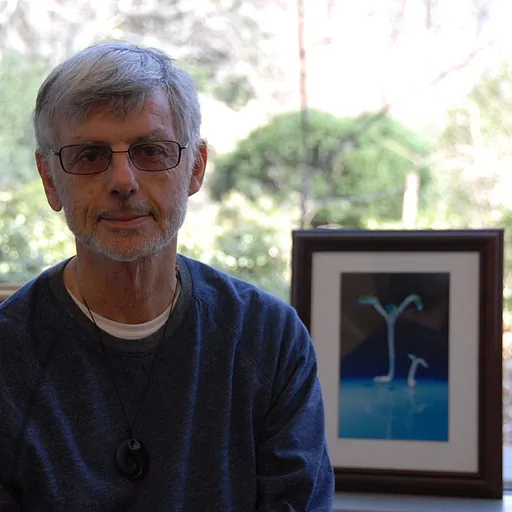
About Anthony Cashmore
Born 1941. Anthony Cashmore is a biologist and biochemist, known for Arabidopsis, Cryptochrome and Photoreceptor protein.
Nucleic acid chemistry Hydrazine degradation Working with George Petersen (a New Zealand biochemist) at New Zealand's Department of Scientific and Industrial Research (DSIR) (Palmerston North), Cashmore was introduced to the study of nucleic acids and how selective chemical reagents could be used to determine the nucleic acid sequence of DNA. Cashmore and Petersen examined the use of hydrazine as a tool to measure purine nucleotides in samples of DNA. Recognizing that hydrazine-treated DNA subsequently exposed to alkali conditions undergoes degradation, Cashmore defined a quantitative technique for measuring purine nucleotides in DNA samples.
tRNA Working with Dan Brown at Cambridge University, Cashmore demonstrated that the reagent methoxyamine reacted with a limited number of cytosine residues in tRNA. Later, Cashmore used the RNA sequencing procedure that had recently been developed by Fred Sanger to identify the reactive cytosine residues in a tyrosine suppressor tRNA of Escherichia coli. Studying a mutant of this tRNA, Cashmore identified a new reactive cytosine residue at the base of loop III. This finding suggested that base pairing of conserved residues occurred supporting one of the early models proposed for the three dimensional structure of transfer RNA.
Biosynthesis of RuBisCO Ribulose-1,5-bisphosphate carboxylase/oxygenase (RuBisCO), thought to be the world's most abundant protein, utilizes photosynthetic energy to fix carbon dioxide through the conversion of ribulose-1,5-bisphosphate to two molecules of 3-phosphoglycerate. It is an enzyme of interest in the field of climate change due to its role in fixing carbon dioxide. At New Zealand's DSIR Palmerston North, Cashmore studied the biosynthesis of RuBisCO, a multi-subunit (eight large and eight small subunits) protein located in plant chloroplasts. Using selective inhibitors of protein synthesis Cashmore showed that in contrast to the RuBisCO large subunit (which was known to be synthesized on chloroplast ribosomes), the small subunit of RuBisCO was produced as a soluble precursor protein on cytoplasmic ribosomes. The soluble precursor protein is subsequently processed and imported into chloroplasts.
Light-regulated enhancer sequences At Rockefeller University, Cashmore studied DNA sequences associated with light regulated expression of a pea nuclear RuBisCO small subunit gene. For these studies, Cashmore collaborated with scientists in the laboratory of Jeff Schell and Marc Van Montagu in Ghent (Belgium). Using transgenic plant cells, they demonstrated that in the pea plant, light-regulated expression was mediated by a 1 kilobase (kb) promoter fragment.
Cryptochrome In 1881, Francis Darwin and Charles Darwin demonstrated that plants exhibited a phototropic response to blue light. Elusive to discovery, scientists gave the name cryptochrome to the photoreceptor factor(s) responsible for this effect. Interested in adopting the "power of Arabidopsis genetics" for the study of light regulation, Cashmore's research group identified a second member of the cryptochrome family (CRY2) using cDNA library screening. and as the primary sensory molecule enabling light-dependent magnetic compass orientation in migratory birds. Today, light-based diagnostic and therapeutic wearable photonic healthcare devices, are based on the function of the cryptochrome photoreceptors.
Human behavior, free will and consciousness In recent years, Cashmore turned his attention to the topic of human behavior, studying the concepts of free will and consciousness. In a publication on this topic, Cashmore noted that in popular discussions regarding the relative importance of nature vs nurture, an element that is commonly missing is awareness that individuals are responsible for neither their genetic inheritance nor their environment. The article stimulated discussion and analysis by scientists in the fields of biology, behavioral sciences, and philosophy. Scientist and author Jerry Coyne stated that after reading this article on determinism and the criminal justice system, he was ‘instantly converted to determinism’.
Honors and awards Cashmore was a Professor of Biology at the University of Pennsylvania and Director of the Plant Science Institute there until his retirement in 2011. He was elected to the National Academy of Sciences in 2003.
Selected publications Journal articles Herrera-Estrella L, Van den Broeck G, Maenhaut R, Van Montagu M, Schell J, Timko M, and Cashmore A (1984). Light-inducible and chloroplast-associated expression of a chimaeric gene introduced into Nicotiana tabacum using a Ti plasmid vector. Nature 310, 115–120. Timko MP, Kaush AP, Castresana C, Fassler J, Herrera-Estrella L, Van den Broeck G, Van Montagu M, Schell J, and Cashmore AR (1985). Light regulation of plant gene expression by an upstream enhancer-like element. Nature 318, 579–582. Ahmad M and Cashmore AR (1993). HY4 gene of A. thaliana encodes a protein with characteristics of a blue-light photoreceptor. Nature 366, 162–166. Lin C, Robertson D, Ahmad M, Raibekas A, Jorns M, Dutton P, and Cashmore A. (1995). Association of flavin adenine dinucleotide with the Arabidopsis blue light receptor CRY1. Science 269, 968–970. Cashmore, A (2010). The Lucretian swerve: The biological basis of human behavior and the criminal justice system. PNAS 107 (10), 4499–4504.
Patents
Book chapters Jarillo J, Capel J, and Cashmore AR (2004). "Chapter 8: Physiological and molecular characteristics of plant circadian clocks", in Molecular Biology of Circadian Rhythms
Personal life Cashmore was born in Auckland (New Zealand), to parents Nancy and Norman Cashmore. He is married to American Neuroscientist and Geneticist Nancy Bonini.
Don’t just read it —
keep it.
Full-length biographies made to live with: read them, listen on the way to work, watch them tonight.
- E-book
- Audio
- Video
Instant download · yours to keep · every purchase keeps this site free
Important facts
Family & relationships
People in Anthony Cashmore's life
Named in this biography and alive at the same time




Related people
Same field, nearest in time

Contemporaries
People whose lives overlapped Anthony Cashmore's


Frequently asked questions
Who is Anthony Cashmore?
New Zealand molecular biologist
When was Anthony Cashmore born?
Anthony Cashmore was born in 1941.
What is Anthony Cashmore's occupation?
Anthony Cashmore is a biologist and biochemist.
What is Anthony Cashmore known for?
Anthony Cashmore is known for Arabidopsis, Cryptochrome and Photoreceptor protein.
Sources & further reading
Cite this page
APA: Biography.guide. (2026). Anthony Cashmore. https://biography.guide/anthony-cashmore/
MLA: "Anthony Cashmore." Biography.guide, https://biography.guide/anthony-cashmore/.
Chicago: "Anthony Cashmore." Biography.guide. https://biography.guide/anthony-cashmore/.
Data last updated: 2026-09-21 · Spot an error? Report a correction.
Portrait: Wikimedia Commons · author & licence
Page generated 2026-09-27 05:00 UTC