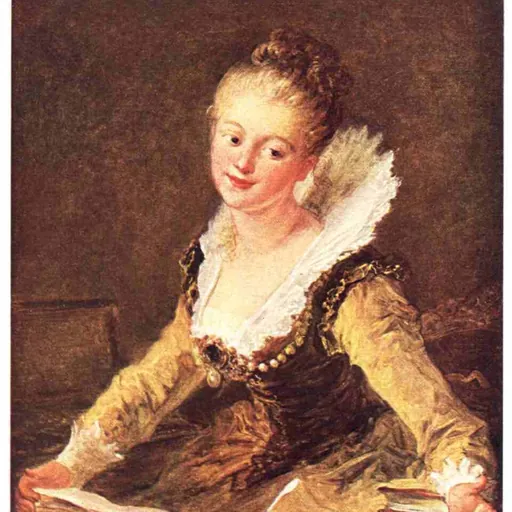
About Anne Louise Boyvin d'Hardancourt Brillon de Jouy
Lived 1744 – 1824 (aged 79). Anne Louise Boyvin d'Hardancourt Brillon de Jouy was a French pianist and composer.
Anne Louise Brillon de Jouy (née Boyvin d'Hardancourt; 13 December 1744 – 5 December 1824) was a French musician and composer. Born in Paris, she lived in Passy and played and composed for the harpsichord and the piano. She learned to play the harpsichord as a child.
Life Her parents were Marie-Élisabeth (; 1723-1785) and Louis-Claude Boyvin d'Hardancourt (1756), a royal tax clerk. In October 1763 Anne Louise married tax clerk Jacques Brillon de Jouy (1722–1787), 22 years her elder. They had two daughters, Cunégonde and Aldegonde. Cunégonde went on to marry the General Antoine Marie Paris d'Illins.
She died at Villers-sur-Mer, Calvados, aged 79.
Career Every Wednesday and Saturday Anne Louise held a salon at her house in the country in Passy, which became a permanent fixture. Foreign musicians passing through Paris performed with her. In doing so, she acquired an excellent reputation as a musician and composer, despite not performing publicly or having any of her compositions published. Several composers dedicated sonatas to her, including Johann Schobert, Luigi Boccherini, Charles Burney, Ernst Eichner, and Henri-Joseph Rigel.
Her compositions number almost 90. Most are instrumental chamber music, including solo and accompanied keyboard sonatas; sonatas for cello, violin or harp; trios for two harpsichords and piano; and vocal music. She wrote music to perform herself and with the two Brillon daughters, Cunégonde and Aldegonde. The piano music written for her own performance is virtuosic, incorporating new keyboard techniques and sonorities, along with a number of innovations usually associated with later pianist-composers such as Czerny and Liszt. Her manuscripts are in a private French collection and in the American Philosophical Society library in Philadelphia.
In 1767, Boccherini composed in Paris his Six Sonatas for Pianoforte and Violin op 5. The set was dedicated to Anne Louise Brillon: Madame, I have never before composed for the keyboard; I heard you play on that instrument, and then I wrote these sonatas; the homage that I offer you through them is, simultaneously, a fitting tribute, and one of reconnaissance; you have inspired them, and you embellish them. The piano was a relatively new instrument when Boccherini wrote his Six Sonatas op 5, but Anne Louise Brillon de Jouy inspired him to write the keyboard part specifically for the new instrument, including dynamic markings. When the sonatas were published in 1769, the reference to the pianoforte was replaced by "harpsichord" and many dynamic markings were removed because the harpsichord was still the dominant keyboard instrument, and the publisher had to adapt the sonatas for commercial reasons. Charles Burney wrote of her, She is one of the greatest lady-players on the harpsichord in Europe. This lady (...) plays the most difficult pieces with great precision, taste and feeling (...). She likewise composes, and she was so obliging as to play several of her own pieces both on the harpsichord and pianoforte accompanied with the violin by M. Pagin, who is reckoned in France the best scholar of Tartini ever made.
When Benjamin Franklin arrived in Paris in 1777 as ambassador from the American colonies, he lived near the Brillon residence and was a welcome guest at her distinguished salon, which he described as 'my Opera', where there are 'little Concerts' with music and singing. They became close friends and that same year, after she heard of the decisive American victory at Saratoga, she composed the Marche des insurgents (March of the Insurgents) to celebrate the colonies' victory in the American Revolutionary War, the first song written for the new American nation. She and Franklin maintained an active correspondence after his return to the United States in 1785.
Works 88 pieces have been listed to date.
1775-1783 Trio pour trois clavecins en ut-mineur (ou pour piano anglais, piano allemand et clavecin). (Trio for three harpsichords in C-minor, or for English piano, German piano, and harpsichord) Premier recueil d'œuvres pour clavecin ou pianoforte avec 15 sonates pour pianoforte et violon. (First collection of works for harpsichord or pianoforte, with 15 sonatas for pianoforte and violin) Sonate en la mineur pour pianoforte. (Sonata in A minor for pianoforte) Trio pour pianoforte, violon et violoncelle en sol mineur. (Trio for piano, violin, and cello in G minor) Quatuor pour clavecin, deux violons et contrebasse en mi mineur. (Quartet for harpsichord, two violins, and double bass in E minor)
1777 Marche des insurgents. ("March of the Insurgents", which was first published in an arrangement for brass quintet in 1992 by the Hildegard Publishing Company)
1779-1785 Duos pour clavecin et pianoforte. (Duets for harpsichord and pianoforte)
In popular culture Madame Brillon appears in the children's book Ben and Me (1939) by Robert Lawson, where she is the subject of an elaborate, humorous full-page illustration. She does not appear in the Disney Academy Award-nominated animated short film adaptation Ben and Me (1953).
Madame Brillon is played by the actress Ludivine Sagnier in the Apple TV+ original limited-run television series Franklin (2024).
Don’t just read it —
keep it.
Full-length biographies made to live with: read them, listen on the way to work, watch them tonight.
- E-book
- Audio
- Video
Instant download · yours to keep · every purchase keeps this site free
Important facts
People in Anne Louise Boyvin d'Hardancourt Brillon de Jouy's life
Named in this biography and alive at the same time


Related people
Same field, nearest in time
Contemporaries
People whose lives overlapped Anne Louise Boyvin d'Hardancourt Brillon de Jouy's




Frequently asked questions
Who was Anne Louise Boyvin d'Hardancourt Brillon de Jouy?
French musician (1744-1824)
When was Anne Louise Boyvin d'Hardancourt Brillon de Jouy born?
Anne Louise Boyvin d'Hardancourt Brillon de Jouy was born on 13 December 1744 in Paris.
When did Anne Louise Boyvin d'Hardancourt Brillon de Jouy die?
Anne Louise Boyvin d'Hardancourt Brillon de Jouy died on 5 December 1824 in Villers-sur-Mer.
What was Anne Louise Boyvin d'Hardancourt Brillon de Jouy's occupation?
Anne Louise Boyvin d'Hardancourt Brillon de Jouy was a pianist and composer.
What nationality was Anne Louise Boyvin d'Hardancourt Brillon de Jouy?
Anne Louise Boyvin d'Hardancourt Brillon de Jouy was French.
Sources & further reading
· Wikipedia: Anne Louise Boyvin d'Hardancourt Brillon de Jouy
· DBpedia: Anne Louise Brillon de Jouy
Cite this page
APA: Biography.guide. (2026). Anne Louise Boyvin d'Hardancourt Brillon de Jouy. https://biography.guide/anne-louise-boyvin-d-hardancourt-brillon-de-jouy/
MLA: "Anne Louise Boyvin d'Hardancourt Brillon de Jouy." Biography.guide, https://biography.guide/anne-louise-boyvin-d-hardancourt-brillon-de-jouy/.
Chicago: "Anne Louise Boyvin d'Hardancourt Brillon de Jouy." Biography.guide. https://biography.guide/anne-louise-boyvin-d-hardancourt-brillon-de-jouy/.
Data last updated: 2026-10-01 · Spot an error? Report a correction.
Portrait: Wikimedia Commons · author & licence
Page generated 2026-10-04 14:44 UTC